More light, frothy content
Cross-posted at The Kitchen Drawer.
Over at Althouse they’re discussing Thursday’s Presidential visit to the University of Wisconsin’s Madison campus. They’re shutting down the campus for at least part of the day so the President can have a nice photo-op post-debate. The Thursday timing is brilliant. Most students will have classes on Friday so they’ll stick around. If the event were on a Friday many students (and probably some professors and staff) would just take off after class on Thursday and make a nice, unexpected three day weekend of it.
They’re discussing many aspects of this visit, including whether or not the students should be upset by this intrusion. After all, this is a denial of one day’s paid education. Personally I think they should be upset, but who are we kidding – most of them won’t be because they won’t be thinking of the payments they’re making (or will make) for their education.
One commenter speculated that the lost tuition was worth it for the chance to see the President in person on one’s own campus. Maybe, but I’ll hold to the idea (expressed by others) that we shouldn’t worship our pols.
Nevertheless, this led me to reminisce about the times I’ve been in the presence of a sitting US President.
I’ve seen three Presidents in person. I saw Ronald Reagan at EPCOT for his 1984 Inaugural Parade. (The one in DC was cancelled due to weather, so a few months later they did it down here in Florida.) I got to see him from less than 30 feet away as he drove by in a Presidential limo.
I saw George H. W. Bush twice. Once in the White House from about 10 feet away (pure luck, the family was taking a tour and he unexpectedly showed up with some ambassador from some African nation) and once at Daytona International Speedway during the race in July. I may have even been within 1000 feet at that time!
(Funny/strange story from that one. Our tickets were for the stands right behind the pit road in the infield. Awesome seats! So as we approached the tunnel for the infield in a Ford Explorer we were questioned by the Secret Service. “Do you have any firearms in your vehicle?” “No, sir.” “No bazookas or anything like that?” “No, sir!” “Carry on.” That was it! Like we would have answered “Yes” if we were bringing in a bazooka! And who the Hell was talking about bazookas in 1992?! Very strange incident, but I guess the guy sized us up with a 14 and 10 year-old in the car as well as people up in their 60s and assessed us as “NOT terrorists”.)
And I once saw George W. Bush at a campaign rally. I still can’t believe I went to one of those things.
All in all it was kind of neat, but not awe inspiring. They are, after all, just men.
Now my sister, when she was little, once got to sit in JFK’s chair behind his desk in the Oval Office. That happened through a series of happy accidents, and if anything like that were to happen today it would be a major security breech complete with drone strikes on the houses of everyone in the family.
Mom and Dad lived in DC back in the early 1950s. Dad was out taking a morning walk one morning and bumped into someone on the street. Dad said something along the lines of “Hey, watch it buddy!”, took a few steps and stopped. He turned around and there stood President Truman (who was found of walks), hands on hips, just glaring at Dad! Dad muttered apologies and scrammed!
I’ve also wondered about the time Nixon wandered out of the White House one night to visit some protesters over at the Lincoln Memorial. How strange that must have been for the protesters!
With friends like these ….
Naked man kidnapped, robbed by friends, deputies say
Six Osceola County residents are behind bars after deputies say they kidnapped and robbed a friend then left him naked in Kissimmee early Saturday morning.
Osceola County Sheriff’s deputies say the victim agreed to give friends, 18-year-old Lindsey Saucedo and 33-year-old Rosa DeJesus and their two friends 20-year-old Stephen Batista and 24-year-old Frederick Rodriguez, a ride around 2:45 a.m. Saturday.
Deputies did not say where they five were headed, but along the way, investigators say Batista and Rodriguez pulled out weapons and demanded the driver give them money.
Shortly after the demands, the victim ran out of gas, and the five abandoned the car and walked to meet up with two others — 35-year-old Crystal Gonzalez and 18-year-old Abraham Buil.
After all seven met, they drove to two local banks and forced the victim to withdraw money, deputies said. They also took his personal items, including his clothing.
They ditched the naked victim on McLaren Circle in Kissimmee, where he walked to a Wawa store on Orange Blossom Trail to report the crime.
Deputies caught up to the six suspects.
All six were booked into Osceola County Jail and face charges of armed robbery, conspiracy and kidnapping charges.
You can get a look at the perps here.
On the Sentinel website larryboy77 comments: “you can plan and plan and plan the perfect crime and something can still go wrong”
NOTE: I do have a couple of better posts I’m working on, but the last three days have not been conducive to writing. Nothing like not having a properly functioning toilet in the house to induce writer’s block!
Wax off….
I take my daughter to parks frequently. In my part of town a long-ish bike trail, the West Orange Trail, runs by most of the parks. It is part of the local Rails-to-Trails project, in which old unused rail-beds get converted to bike trails. So I see lots and lots of cycling enthusiasts. Not just people out cycling with the family, or enjoying the Great Outdoors, but hard-core cyclists, complete with the funny shoes and all the spandex.
What I don’t get are the guys that ride bikes and wax off their body hair and wear all spandex. Now I get why professional racers do that, to cut down drag. But they’re actual, you know, racers, doing it not just for fun but for profit, and eliminating every last bit of drag is a professional necessity.
But if you’re just some guy doing it to stay in shape (and not all of these waxed be-spandexed folks have achieved that goal), why cut down drag? Wouldn’t more drag help you get into shape faster? And it isn’t like these guys go whizzing by much faster than the Moms and Dads out cycling with their five year-olds that just took off the training wheels last week, either. A little faster, yes, but Lance Armstrong they ain’t.
WTF, Cycling Guys, WT-f’ing-F?
Falling in Love All Over Again . . .
. . . with Noo Yawk City.
After having a very pleasant exchange with our mail carrier on the phone early this morning, I took the subway down to Canal Street around 10 a.m. to pick up my mail, in which there were, sure enough, several checks.
It is such a beautiful fallward day—cool, sunny, cloudless—in fact, it’s a “September 11 day,” but while we will always note that, we are now well able to note it and then move on and enjoy the day. I decided to walk home. I also had a rebate in the form of a prepaid credit card in the mail, so I used that to buy and compare TWO lattes, sipping as I strolled.
I stopped to admire this painting (click to enlarge and see words for and about “butterfly” in many languages), which the 50something artist, John van Orsouw, was selling, among others, on the sidewalk out of his truck. (I knew he was Dutch, from his accent, before I saw his name.) He has had gallery shows of his paintings and sculptures but sets up shop on the street to supplement his income. If I’d happened to have a spare $950 lying around I’d have walked right off with “Burst Out.” Instead, I wound up getting into a 15-minute conversation with the artist, about the art biz, the weather, and not wanting to commemorate/relive 9/11. After being cooped up in my apartment doing little but working, then plunging into an equally hurried, preoccupied crowd to run errands, it was amazing to find a stranger so open and ready to engage even with a non-customer. But he was just the first.
Next, I stopped by a bookstall selling old natural-history prints and bookplates, which made me feel as if I was in Paris. When I mentioned this to the proprietress, also within arm’s length of my age, she shrugged and said with an unmistakably native New York inflection, “Why not?” Her name is Phyllis Newman, and she is on West Broadway every Saturday weather permits and at the Greenflea Market on Columbus and 76th on Sundays. We talked, too: about last Saturday’s tornado, rising sea levels inundating Breezy Point, weathering Hurricane Irene under a skylight (“It sounds wonderful. I envy you!” she said), and how all our digital wonders have nothing on those delicately meticulous 19th-century depicters of nature, quite a few of whom we’ve covered in Natural History. As an appreciation for the publisher, who has struggled so hard to keep the 110-year-old magazine alive (almost certainly a losing battle), I bought, at a generous markdown, a 200-year-old bookplate, a hand-colored engraving of a clamshell, which occasioned the following exchange:
May I give you a check?
Sure. I’ve never had a bad check.
Well, actually, right now this is a bad check. But as soon as I get to the bank it won’t be.
Phyllis looked at my name on the check, sized me up and said, “Happy New Year.”
I made a left turn on Houston Street and, between LaGuardia and Thompson, was stopped by a downstairs storefront newly painted to look like it was on a waterfront, with a large sign saying that it was soon to open as a membership café, offering “Access to community and a HOME AWAY FROM HOME.” For $25 a month you could come in every day and drink good coffee, espresso, and tea for free (quite a saving if you think about a Starbucks a day), read the paper, and just hang out. They would also have member events “like design previews, tastings, classes,” and discounts on merchandise. The young man, probably south of 30, sitting by the open door waiting for the tile floor man and the city inspector introduced himself as Anthony Mazzei and also struck up a conversation with me. He and his now wife, Aurora Stokowski (Leopold’s granddaughter), avatars of warmhearted hip, had created this encompassing concept blending an “aesthetic club” (on the analogy of an athletic club) with “dim sum retail” and moved it from Manhattan to NOLA and back again:
Started in an old ballroom in Manhattan, this hyper-curated art-design-fashion-culture concept expanded to New Orleans a year ago. In New Orleans, Fair Folks and a Goat occupies an old, bright-yellow Creole shotgun cottage with green clapboard shutters in Marigny. In the front room, there’s a boutique filled with furniture, clothing and art, followed by a design studio, a cafe called Fair Folks and a Roast (which serves the best iced coffee I have ever tasted), art gallery, design parlor, and a one-room b&B with rotating, in-room installations by local artists and designers.
“It’s thought-out. Everything you touch and see–we pull our hair out trying to decide what to buy and where it should go and how it should be incorporated into the space,” says New Orleans cofounder Anthony Mazzei, who runs FF&G with his New York counterpart Aurora Stokowski. “We wanted to do a magazine and thought, ‘What would a magazine look like if you walked through it?’”
We talked about how remarkably difficult it is to find a place just to hang out in NYC—the options are a) your place or mine, b) a restaurant or bar table with the meter running and the babble too loud to hear each other think, c) a public park where no matter how you try to mind your own bidness you get hit on, shit on (by pigeons, at least), and hit up. I told him about my own attempts at a solution when I was their age: open-house Sunday brunch and (later, with J) the funky little health club where non-9-to-5ers hooked up for lifelong friendship and creative collaborations in the Jacuzzi in the middle of the day. I had no idea just how hip these two were till I came home and looked up their website (the Times is writing them up later this week), but let me stress the warmhearted part.
* * * *
Well, what with having this adventure, writing it up, and (inadvertently) sleeping it off, like an overstimulated child with a full tummy (read: bank account), there goes most of the day.
Ranting, elsewhere.
I don’t really want to post about politics here. But that’s okay because I have other places I can rant. Faced with the day’s absurdities I have written a post over there. If you’re looking to see what’s got me steamed you can look at it there.
The verdict: very good!
So, I finally got around to making the steak sauce I mentioned a bit ago….and forgot to take pictures!
But it is a very good sauce! Darker in color than the picture I had posted, it is also a bit sweet, but with a lot of flavor. I’ve been using it on burgers and even fries, but not a steak yet!
Yes, I did like it better than a commercially made sauce, so I recommend making it. It’s a lot of ingredients, but it’s pretty easy to make, and I love roasting a pepper right on the burner of the stove to get the blackened effect on it.
Update: Ah! In the comments, Amba requests the link and recipe.
The recipe (from SmittenKitchen, scroll down a bit…)
Update II:
We strive to be a full service blog, so I made some more sauce!
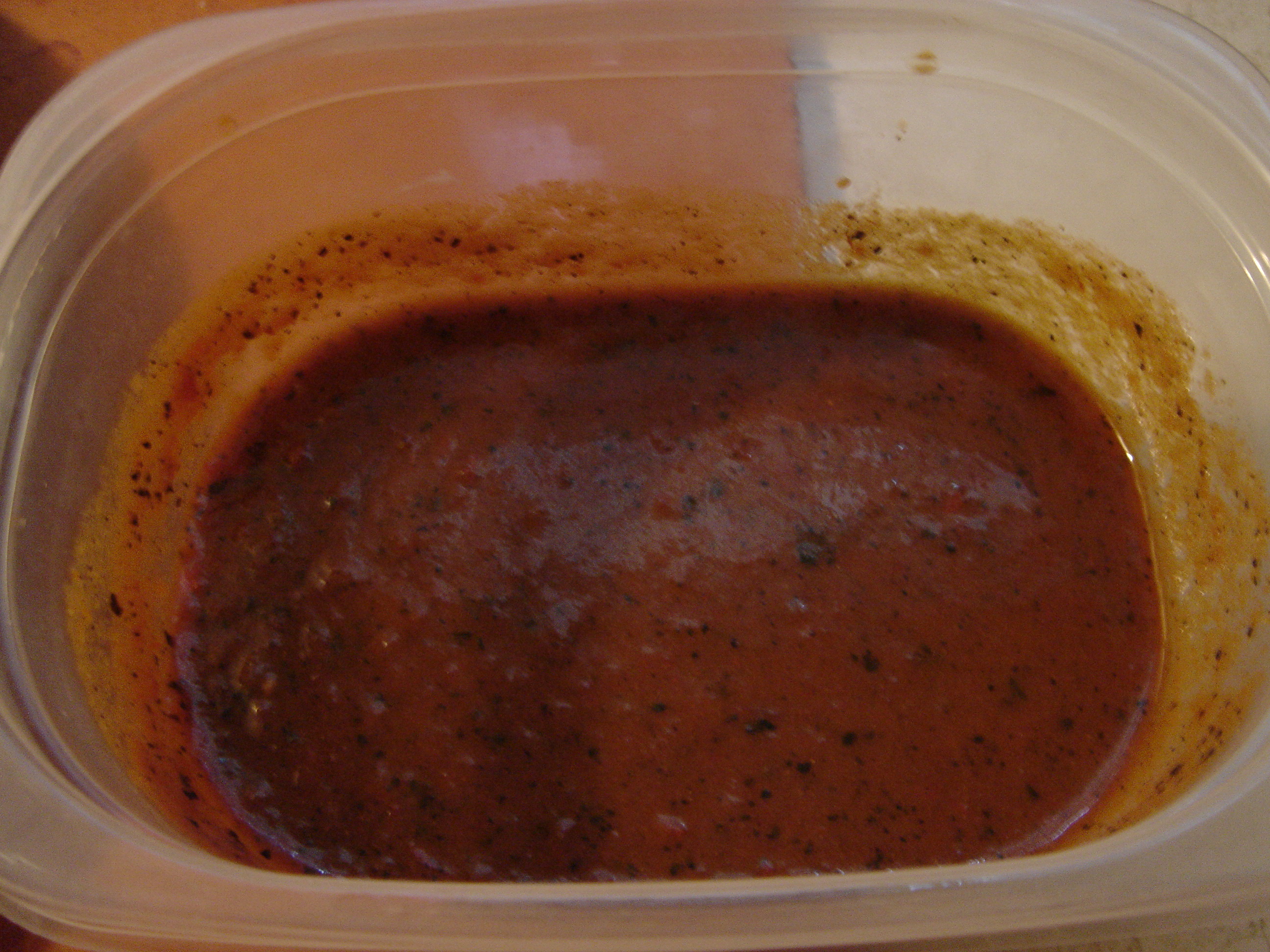
Notice it looks a bit darker than the earlier pictures
and put it on some burgers, made with sauteed spinach and mushroom with sauce on top.

these are for me…
Two Experiences with Science, A Week Apart
A week ago I visited friends at the beach. She is my best friend from high school, her husband is a mathematician and photographer. She sat on the beach and read while he and I bounced in the waves and, back on terra firma, discussed a number of things. Somehow—ah, I remember, it was in regard to the Flynn Effect, the slow but sure worldwide rise in IQ scores—I happened to bring up the limitations of current scientific theory and the soon-to-appear major book by the derided heretical scientist Rupert Sheldrake, who posits mind-like “morphogenetic fields” that are repositories of collective experience, governing form and behavior in nature. Sheldrake is vehemently ridiculed and virtually excommunicated because he suspects that something nonmaterial may be operating in nature. The current dogma—not too strong a word, given the emotional response to even tentative speculations otherwise—is that every phenomenon in biology, at least, can be explained by matter bumping into matter, chemicals locking onto receptors; thus, for example, the development of an embryo is directed by gradients of signaling molecules expressed by a timed sequence of genetic programs. No esoteric “fields” need be invoked to account for the differentiation and choreographed migration of cells into their destined somatic roles and places.
I didn’t get nearly that far into explaining who Sheldrake was or how he applied his theory to fields ranging from crystal formation in mineralogy to simultaneous discovery in science. I had barely begun when some cue, some keyword, alerted my friend’s sniffer to the sulfurous stench of heresy, and he began rather aggressively herding me back towards consensus. It reminded me of the compulsion of a border collie to herd guests into one corner of the living room, or the way an alarmed adult will too firmly grip a child’s arm to steer it away from the curb of a busy street. I couldn’t escape the impression that I was being policed, for my own good and the common good; that every spark of dangerous nonsense must be pounced on and extinguished before it gets out of control and starts a forest fire. Smokey the Science Bear. It was very strange.
After I got home, my friend followed up with an e-mail offering, to my mind a bit patronizingly, to send me a book called The Demon-Haunted World, by Carl Sagan. I thanked him and said that I knew that book, and I was doing OK without it.
* * *
Tonight I am copyediting an article by an authority on molecular epigenetics, the fairly new, now exploding science of extragenomic modifications to DNA and its associated proteins that can modulate or silence gene expression in response to environmental stressors in lifelong, even heritable (and yet perhaps reversible), ways. The article contains an astonishing statement that, a decade or less ago, would have been regarded as beyond the pale.
Until recently, it was believed that epigenetics stayed out of the genome—that it modified the expression of genes, but not the genetic code itself. But now it turns out that methylation of DNA, one of the main epigenetic mechanisms, predisposes a cytosine base (C) to be deaminated and turn into thymine (T). Yep, a change in the actual genetic code. That can happen spontaneously—it would be one cause of what’s called a random point mutation, resulting in a single-nucleotide polymorphism—but it seems to happen at twice the usual rate in methylated regions. Not quite so random.
The author of the article is investigating the notion that “long noncoding RNAs” somehow play a guiding role in directing methyl groups to particular places on the genome in response to environmental factors. And where do lncRNAs come from? From the long stretches of what has, till now, sweetly been called “junk DNA”—”junk” because we don’t know what it’s doing. (Now they’re dubbing it “dark matter,” by analogy to the invisible majority-mass of galaxies, and finding that it seems to be a mass of switches that regulate the expression of the coding genes.)
What we have here, the author says, is “a mechanism by which epigenetic changes, guided by lncRNAs, could make permanent and heritable changes to the genome. . . . epigenetics, rather than random genetic point mutations, could provide the missing link between environmental pressure and resulting genetic variability.”
That’s the astonishing statement. It’s rocked me because the one piece of neo-Darwinan dogma I’ve never been able to get my head around is that the mutations from which natural selection selects are entirely random. I raised that question at the bottom of this AmbivaBlog post and in this one (where there is also an amusing warning for me) back in 2005, right around when the groundwork for the epigenetic revolution was being laid. It was, on my part, a naïve, intuitive, boneheaded incomprehension that adaptation could be so unresponsive at root, could be shaped out of such dumb and blind materials. What if genes could “perceive” the environment in some way, if the genetic changes that took place were somehow biased towards usefulness? Wouldn’t it better account for the exquisite specificity of adaptation? Scientists at the time patiently and patronizingly explained to me that the truths of science are often counterintuitive; the fact that they are so unbelievable to us is one of the ways we know they are true.
Meanwhile, the epigeneticists in their labs were working away.
P.S. I am not trying to prove the existence of God. My contention is, just give it time, and science itself is going to blow what we’ve known as “science” out of the water—and religion, too.
Gaps in time
The other night my wife noted something remarkable. “Do you realize that men walking on the Moon is more distant in time to Cat [our daughter] than WWII is to me?”
She’s right. WWII ended in 1945, she was born in 1971. Men last walked on the Moon in 1972, Cat was born in 2010. Incredible!
(I was born in 1968, BTW.)
 Ambiance
