Hot Town, Summer in the City
. . . back o’ my neck gettin’ dirty and gritty . . .
grab the scissors and chop without pity!

(Couldn’t find a pitchfork, Ron.)
What I Learned from The Learning Channel
At least, that was what it was originally called. Now it’s just TLC, leaving you to wonder what that stands for: Tender Loving Care? Or Transgressive Looking Club? Quoth Wikipedia:
In 1998 the channel officially began to distance itself from its original name “The Learning Channel”, and instead began to advertise itself only as “TLC”. It is possible the new audience may have held the common misconception that TLC stood for “Tender Loving Care”, a common initialism.[dubious – discuss] The marketing maneuver to use only “TLC” may have been intended to encourage this misconception, as the station moved more towards reality-based personal-story programming that would engage a wider, more mainstream audience.[dubious – discuss]
(So learning isn’t “mainstream”!) All that is quite euphemistic, as the “reality-based personal-story programming,” at least in the evenings when we notice it, is almost entirely devoted to the “half-ton mom,” the “man with half a body,” the “baby with 8 limbs,” the world’s tallest woman and man, the mother with 19 children and counting, the “little people” (midgets and dwarves), and so on and on. It’s the video equivalent of that farthest-out supermarket tabloid, the Weekly World News. Superficially, at least, it ought to be called the Freakshow Channel. This seems to have been a winning play for TLC: people with genuinely kinky tastes may be a small niche market, but who doesn’t have morbid curiosity?
Jacques, no sylph himself, is jaw-droppingly fascinated by the phenomenon of American obesity as manifest in shopping malls, swimming pools, and other public places; we joke that the tagline for his movie could be, “I . . . see . . . fat people!” So when he wasn’t sleepy yet after The Tailor of Panama last night and in all the 600-whatever channels I couldn’t find another movie to his taste, in desperation I asked him if he wanted to watch the story of “The World’s Fattest Man,” a Brit who was considering gastric-bypass surgery to save his life.
It was mesmerizing! The body of 800-pound Paul Mason was fully on display (only genitalia blurred out, if one could even find them), and it was indeed . . . what? far beyond mere obesity, a swollen starfish of blobby petals, prodigiously grotesque . . . but that was actually the least of it. At one point I said to an absorbed J, “Look at that . . . monster,” and J said seriously, “He’s not a monster. He’s Paul!” and damned if he hadn’t hit the nail on the head. Paul was actually quite a charming, intelligent, well-spoken fellow, his nice-looking, witty head emerging from the boulder-puddles of fat like that of a man trapped in quicksand. He talked about how he’d become addicted to food during a stressful period in his life; showed pictures of himself as a normal, lively little boy; allowed the camera to expose the sacramental act of his addiction, shoving buttered toast nonstop into his mouth; wept with self-pity and self-loathing at what he’d done to himself and to his late mum, whom he’d literally eaten out of house and home (spending mortgage money on food to the point of foreclosure); acknowledged to his doctor that he understood he might not survive surgery; and took total verbal responsibility for his condition while at the same time stating that he could not control the addiction, and while depending to an infantile degree on the British Health Service, which unquestioningly provided two caregivers to wash him four times a day and tend to all his needs. You could only imagine what the care of this government ward was costing — even before his surgery and prolonged hospital stay. In politically mixed company, the show would have been sure to provoke spirited philosophical debates on personal responsibility, socialized medicine, the nanny state, the question of free will, the victim mentality, etc. etc. etc.
The uncanny effect of the show, however, was to make Paul seem normal in his abnormality. To be sure, the quandary he’d gotten himself into was unusually extreme, but you could relate. The traps you’d gotten yourself into at one time or another might not have gone as far or been as visible, that’s all. There but for the grace of God. Worst of all, at the end of the hour Paul had only just had his surgery (also shown in unflinching full color). He’d survived, but would he lose weight? Would he relearn how to walk? That’s not decided even now, because his surgery was just last December! We’re very nearly seeing this in real time! To my horror, I found that I needed to know. I had gotten to know Paul, and I cared what happened to him.
When the next show came on, we kept watching.
This one was “The Man with Half a Body.” Kenny Easterday, 35, was born with a rare developmental failure called “sacral agenesis,” which means that for all practical purposes his body stopped at the waist. (He looks as if he has less than half a body — a thorax, but no abdomen. It is hard to figure out where he keeps his guts. But both he and his fiancée state on the show that his male organs are in good working order.) His vestigial legs were amputated in infancy, so that the bones could be used to reinforce his spine, and his doctor gave him 21 years max to live. But his father had taught him to walk on his hands — which he does with oddly graceful motions, like a heron or a big cat — and he had had a remarkably normal, active childhood. Kenny has actually had more than his 15 minutes of fame: he starred in a TV movie about himself when he was 10, and appeared many times on the Jerry Springer show as “the Messenger.” But now, osteoporosis is eating away his cobbled-together spine, and repeated urinary-tract infections (he has to catheterize himself to pee) are compromising his kidney function; his days seem numbered, and he wants more than anything to be a biological father, not just a stepfather figure to his fiancée’s two kids, the younger of whom, the girl, might be his.
There were two stunning emotional impacts in this show. One was the immensely touching devotion of Kenny’s father. His mother admits that when he was first born she was afraid to touch him; his father picked him up and held him, and never quit. The show is actually worth seeing just for the humble wonder of that father’s love.
The second was that you expect a happy ending — that Kenny will find out from a DNA test that the little girl is his — but you don’t get it. There is “zero chance” of that, the report says. Right in front of the camera, Kenny’s fiancée tries to comfort him, and he slashes out at her and shoves her away. “Leave me alone,” he says, and hops down from the bed and stalks out of the room. Next scene, Kenny is saying that he’ll still always consider that little girl his little girl. And then the show ends and you learn that he and his fiancée have split up. It is shocking and even angering; of course you can’t know the whole story of the relationship, but having been let so deep into their business, you feel it’s your business. How can Kenny abandon those two kids who have become so attached to him they already called him Dad? How can a man who’s been so loved by his own father be so cruelly selfish in his disappointment (his fiancée was unable to have another child)? It seems a lot to ask of someone who’s been through so much, and yet ask it of him you do — or I did — precisely because he’s so triumphantly claimed the status of a whole man who just happens to have half a body.
Once again, you are drawn in by uneasy curiosity about the physical difference and leave an hour later merely gripped by the same-old, ever-new human drama. So does it deserve to be called The Learning Channel after all?
Hero of the World?
This is really funny — and scary — but there seems to be no way to embed it. Once you’ve watched, make one for your favorite megalomaniac or self-effacing shy person.
Is Conservatism More Advanced than Progressivism?
Somewhere, someone must have looked at it precisely this way. But I haven’t seen it. If you have, please let me know where.
The tendency towards ever bigger government organizing everything, planning and controlling more and more of social and economic life, is being portrayed — isn’t it? — as a necessity and an inevitability, given the size and complexity of modern societies and their growing global entanglement. Conservatism’s preference for smaller government, most of it local, is portrayed as nostalgia for bygone times when everything was smaller-scale, and societies were more homogeneous and organically tradition-driven. It’s regarded as “progressive” — and compassionate — to plan and organize and energetically tackle the big systemic problems, because if you leave problems alone, trusting or forcing them to solve themselves, they may just fester, or more likely, may solve themselves at enormous cost in human suffering and waste of lives.
Yes, they may. But assuming they will shows a lack of faith and trust, not in God, necessarily, but just in the extraordinary (yet quite ordinary) self-organizing and innovating capacity of complex systems. A society, or a world, is not a dinosaur that has such a tiny brain in its head that it needs another one in its ass (the latter perhaps being a good working definition of government). Even a single organism is not a Command Central run by a unified conscious brain, but a collection of semi-autonomous centers managing their own affairs quite nicely in balance with one another. But a society is even more like an ecosystem than an organism, with a remarkable capacity to maintain homeostasis, to right itself when thrown off balance by change, and to innovate towards a new balance when change tips it beyond righting. Central control cannot possibly match the complex inherent intelligence of these processes.
This is not to say that human ingenuity has no place in these processes. It is a part and a manifestation of these processes! It’s simply that no single large entity, like a central government, can possibly see and wisely regulate every part of a large, complex system. It works only when semiautonomous parts are free to regulate themselves and work things out with each other.
What am I saying? That the conservative view may actually be more advanced than the progressive view. It may not be consciously more advanced. Conservatives may speak the traditional language of religious faith rather than that of cybernetics, systems theory, or chaos theory. But the effect can be much the same: a trust in people’s innate creative capacity to cope, to innovate, and to work things out for themselves, from the bottom up. There is certainly a need to protect vulnerable people from the harshest consequences of change, and a place for government as well as religion to do so. But there is not a need to convince people (as both government and religion have at times tried to do) that they are more vulnerable and helpless than they really are, and that they should cede their share of life’s creative force to some distant entity that knows better. If God helps those who help themselves, government should not hinder those who govern themselves.

2nd and 3rd-Generation Friends
It’s so cool when that happens.
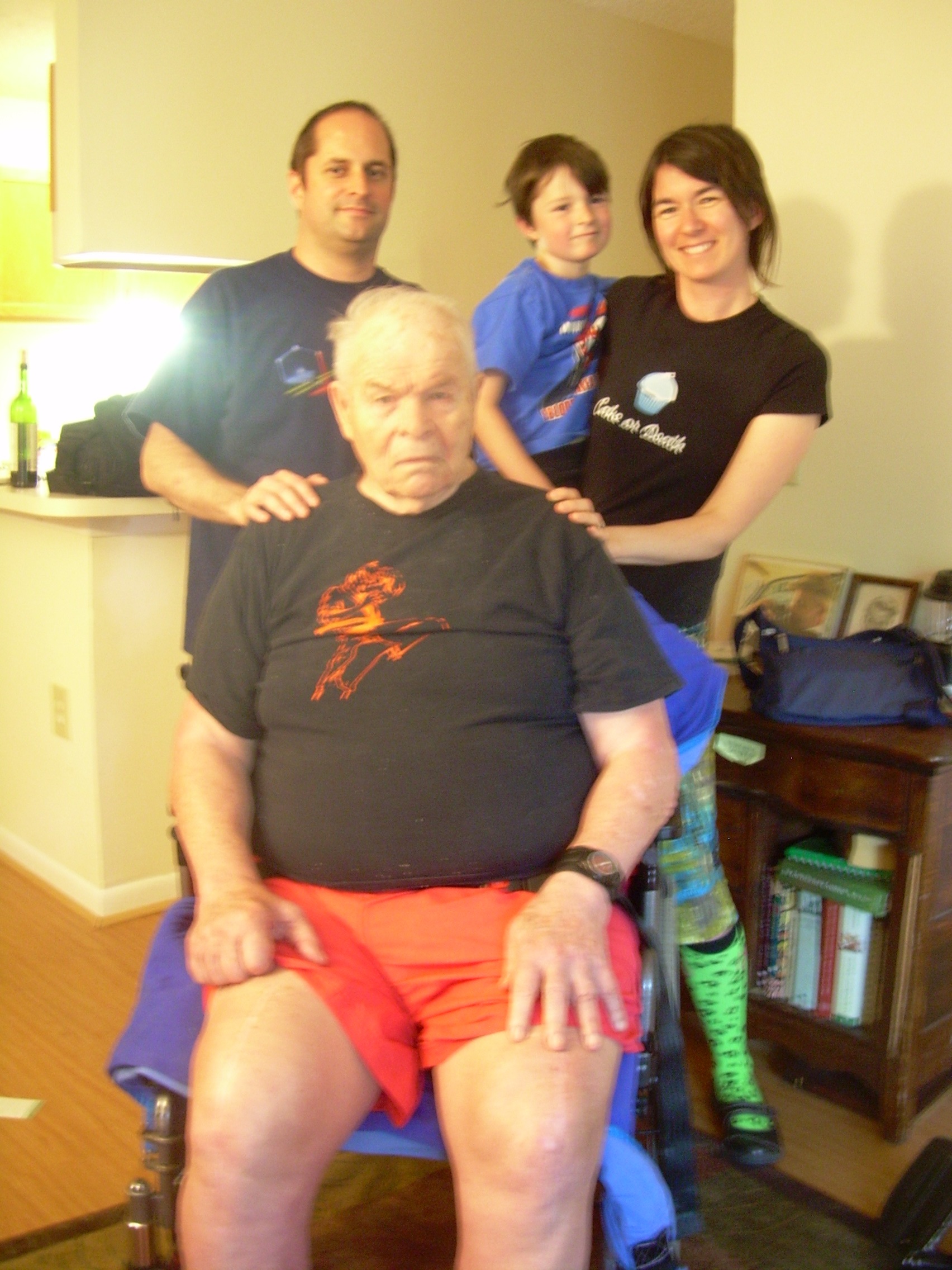
Ralph’s father Warren operated on Jacques in 1975, and we became fast friends with the family. Ralph was Ben’s age then.
Robyn built and Ralph hosts Jacques’ website, donbas.com.
Robyn is Vampandora on Twitter. Ralph works for a company that tries not to be evil. They are serious foodies (don’t just make their own beer but grow their own hops) and have a website called foodporn.com that is to drool for.
We were at their wedding on a cliff overlooking the Pacific in 1999. Jacques doesn’t like heights, and was wobbly from his second knee replacement and probably the beginnings of his present troubles, but by God he got out there.
Ralph’s mother Margie visited us here 3 years ago, and when I get to Chicago in the summer I always visit them. But the last time we saw Ralph and Robyn was in New York in late 2003. Ben became a twinkle in someone’s eye about a month later. We met him today for the first time: our 3rd-generation friend.
How Valuable is Intelligence?
Ann Althouse (on a roll this morning) quotes P.J. O’Rourke in a (highly intelligent, ironically) expansion on William F. Buckley’s remark that
I’d rather entrust the government of the United States to the first 400 people listed in the Boston telephone directory than to the faculty of Harvard University.
I’m sure up at Harvard, over at the New York Times, and inside the White House they think we just envy their smarts. Maybe we are resentful clods gawking with bitter incomprehension at the intellectual magnificence of our betters. If so, why are our betters spending so much time nervously insisting that they’re smarter than Sarah Palin and the Tea Party movement?…
The C student starts a restaurant. The A student writes restaurant reviews. The input-worshipping universe of the New York Times is like New York itself—thousands of restaurant reviews and no place we can afford to eat.
Let us allow that some intelligence is involved in screwing up Wall Street, Washington, and the world. A students and Type-A politicians do discover an occasional new element—Obscurantium—or pass an occasional piece of landmark legislation (of which the health care reform bill is not one). Smart people have their uses, but our country doesn’t belong to them. As the not-too-smart Woody Guthrie said, “This land was made for you and me.” The smart set stayed in fashionable Europe, where everything was nice and neat and people were clever about looking after their own interests and didn’t need to come to America. The Mayflower was full of C students. Their idea was that, given freedom, responsibility, rule of law and some elbow room, the average, the middling, and the mediocre could create the richest, most powerful country ever.
That’s wonderfully said, but it is, of course, not a condemnation of intelligence but an argument for multiple intelligences. O’Rourke is talking about a particular, narrow kind of neck-up intellect, based on a very top-heavy books-to-real-life-experiences ratio. Brains in jars, disconnected from hands and guts. Would you even call that “intelligence”?
Poverty is Like Gravity.
After the CNAs (certified nurse assistants) from hospice bathe and dress J and get him up, I like to hang out with them and have coffee before they go on to the next patient or (since we’re often their last stop) to their family caregiving duties at home. Most of them are black (in all the multifarious shades of golden, freckled, ruddy and brown that word so flatly fails to suggest), and single motherhood is the norm in their community; the men have long since left or been kicked out, and those who’ve stayed are often described as not much help or not worth the trouble. (By contrast, the South American woman who stays with J when I go away is married, and her husband helps with their three boys — all of whom were born with congenital vision problems and/or cleft palate, possibly because of occupational chemical exposure of one or both parents. To paint these trends as monolithic would be stereotypical, but to say they are representative is, sadly, just statistical.) On the plus side, mothers/grandmothers are always there to be relied on and to take care of babies and little children while daughter-mothers go to work and to school, struggling doggedly for education and certification and advancement. In return, they take care of their aging mothers who struggle with arthritis, diabetes, heart failure. It’s a hard life and takes a heavy toll on health.
Talk about the working class, these women work harder than anyone I’ve ever seen in the most palpable sense of “work.” They are extremely conscientious. They need physical strength and endurance, bottomless patience, basic medical knowledge, a strong stomach, a sense of humor, and a kind heart to do what they do. And they get paid, and sometimes treated, very poorly. Home health agencies charge the client $20 an hour and pay the woman or man who does all the work $9. Hospice, I hope, pays more than that, but probably not a lot more. Hospice patients, they say, are mostly grateful and respectful, but home health patients — those just out of the hospital convalescing from something acute and temporary — often treat them high-handedly like servants, expecting them, for instance, to clean house.
As I was thinking about what they’ve achieved against the odds and what it takes out of them, it struck me that poverty is like gravity. The lower in economic altitude you start, the stronger a force you must overcome to rise. Against that down-dragging force, to get an education, to have a career, to raise children and get them into college, you must ignite a solid rocket booster of will and determination over and over again.
It always takes effort and perseverance to achieve anything. Inertia and dissipation are universal drags on our dreams. But those of us who were launched into orbit by the circumstances of our birth — that is, by the struggles of our ancestors — will never know what it takes, and takes out of you, just to get off the ground.
 Ambiance