I Read a Book!
That’s news. I can’t tell you what was the last one I read, or when. The last one I vividly remember reading was this one — a strangely gripping and grieving tale of species extinction (discussed in the second half of this column). (Icepick, you’d love/hate this book — it’s by a Florida native and is about the destruction of Florida, summed up in the extinction of one bird.) That was in . . . omigod. November 2008. I’ve read a book since then. Haven’t I? [silence]
Anyway, I’ve been feeling the need to dive into a lake of words, if not the ocean, after splashing in Twitter’s backyard inflatable pool too long. Also, unpacking my books, and seeing all the ones I’ve never read but want to, has reawakened book-greed.
The book I read was Acedia & Me, by Kathleen Norris. (Thumbnail review: it’s disorganized and has a few dry, preachy stretches, but there are many startling insights in it.) It was a book I needed to read just now because acedia (a combination of sloth, indifference, and cynicism once regarded as the deadliest of sins) was a self-inflicted malady I was succumbing to. Maybe that’s the secret to reading a whole book: you have to need it.
But I think I also just needed to read a book. Maybe a lot more than just one. Maybe my attention was caught by this statement in Roger Ebert’s blog post about Twitter:
I’ve made a change recently. After writing my blog, “The quest for frisson” and reading two recent articles about internet addiction, I have looked hard at my own behavior. For some days now I have physically left the room with the computer in it, and settled down somewhere to read. All the old joy came back, and I realized the internet was stealing the reading of books away from me. Reading is calming, absorbing, and refreshing for the mind after hectic surfing. […] I like the internet, but I don’t want to become its love slave.
The Internet was coming to feel like a shallow puddle in which I was fretfully seeking what can only be found in the depths. Next I’m going to dive into two books I had meant to read and discuss with @chickelit months ago: memoirs of the German resistance to Hitler by Helmuth von Moltke and his wife Freya.
Of course, an added factor besides frenzied Internet fragmentation — frequent interruption by the requirements of caregiving — makes it difficult for me to read a book (and easy to hop in and out of the tweetstream or blogiverse). Since childhood I have been notorious for getting lost in a book to the neglect and active exclusion of everything else. I’d bring my book to the dinner table and would have to be physically pried apart from it. The absorption a good book invites can be a torment when you keep getting torn away. But even the tenacity of longing for and preoccupation with a book may help to “knit up the ravell’d sleave” of a mind shredded by distractions.
The Most Brilliant Thing I’ve Read All Year.
A must, must, must read: Shelby Steele on why “world opinion” is smugly scapegoating Israel while Obama’s America largely stands by:
This is something new in the world, this almost complete segregation of Israel in the community of nations. And if Helen Thomas’s remarks were pathetic and ugly, didn’t they also point to the end game of this isolation effort: the nullification of Israel’s legitimacy as a nation? […]
“World opinion” labors mightily to make Israel look like South Africa looked in its apartheid era—a nation beyond the moral pale. And it projects onto Israel the same sin that made apartheid South Africa so untouchable: white supremacy. Somehow “world opinion” has moved away from the old 20th century view of the Israeli-Palestinian conflict as a complicated territorial dispute between two long-suffering peoples. Today the world puts its thumb on the scale for the Palestinians by demonizing the stronger and whiter Israel as essentially a colonial power committed to the “occupation” of a beleaguered Third World people. […]
This […] has become propriety itself, a form of good manners, a political correctness. […]
One reason for this is that the entire Western world has suffered from a deficit of moral authority for decades now. Today we in the West are reluctant to use our full military might in war lest we seem imperialistic; we hesitate to enforce our borders lest we seem racist; we are reluctant to ask for assimilation from new immigrants lest we seem xenophobic; and we are pained to give Western Civilization primacy in our educational curricula lest we seem supremacist. Today the West lives on the defensive, the very legitimacy of our modern societies requiring constant dissociation from the sins of the Western past—racism, economic exploitation, imperialism and so on.
And on what really drives hatred of the West in the Muslim world:
[T]he Palestinians—and for that matter much of the Middle East—are driven to militancy and war not by legitimate complaints against Israel or the West but by an internalized sense of inferiority. […] For better or for worse, modernity is now the measure of man.
And the quickest cover for inferiority is hatred. The problem is not me; it is them. And in my victimization I enjoy a moral and human grandiosity—no matter how smart and modern my enemy is, I have the innocence that defines victims. I may be poor but my hands are clean. Even my backwardness and poverty only reflect a moral superiority, while my enemy’s wealth proves his inhumanity.
In other words, my hatred is my self-esteem. This must have much to do with why Yasser Arafat rejected Ehud Barak’s famous Camp David offer of 2000 in which Israel offered more than 90% of what the Palestinians had demanded. To have accepted that offer would have been to forgo hatred as consolation and meaning. […]
[T]his attraction to the consolations of hatred, is one of the world’s great problems today […] The fervor for hatred as deliverance may not define the Muslim world, but it has become a drug that consoles elements of that world in the larger competition with the West.
Go read it, quick. Stop me before I quote more.
ADDED: I’ve observed before that people who can claim suffering, directly or by association, often love to have that absolve them of moral complexity: the wronged can do no wrong (we know this is wrong: look at the generational handing-down of child sexual abuse, for just one example). (No, I’m not immune to this temptation either — at least in its insidious, venial “gateway drug” form: the tendency to seize on excuses for being less than responsible.) And many who do not claim suffering themselves love to take up the cause of “the victimized innocents” — be it fetuses, animals, or oppressed peoples — at least in part because it justifies their expression of moral superiority and rage. I consider this opportunistic sanctification of victimhood one of the nastiest psychological dodges of this, or any, time.

Curly, Moe, & Larry
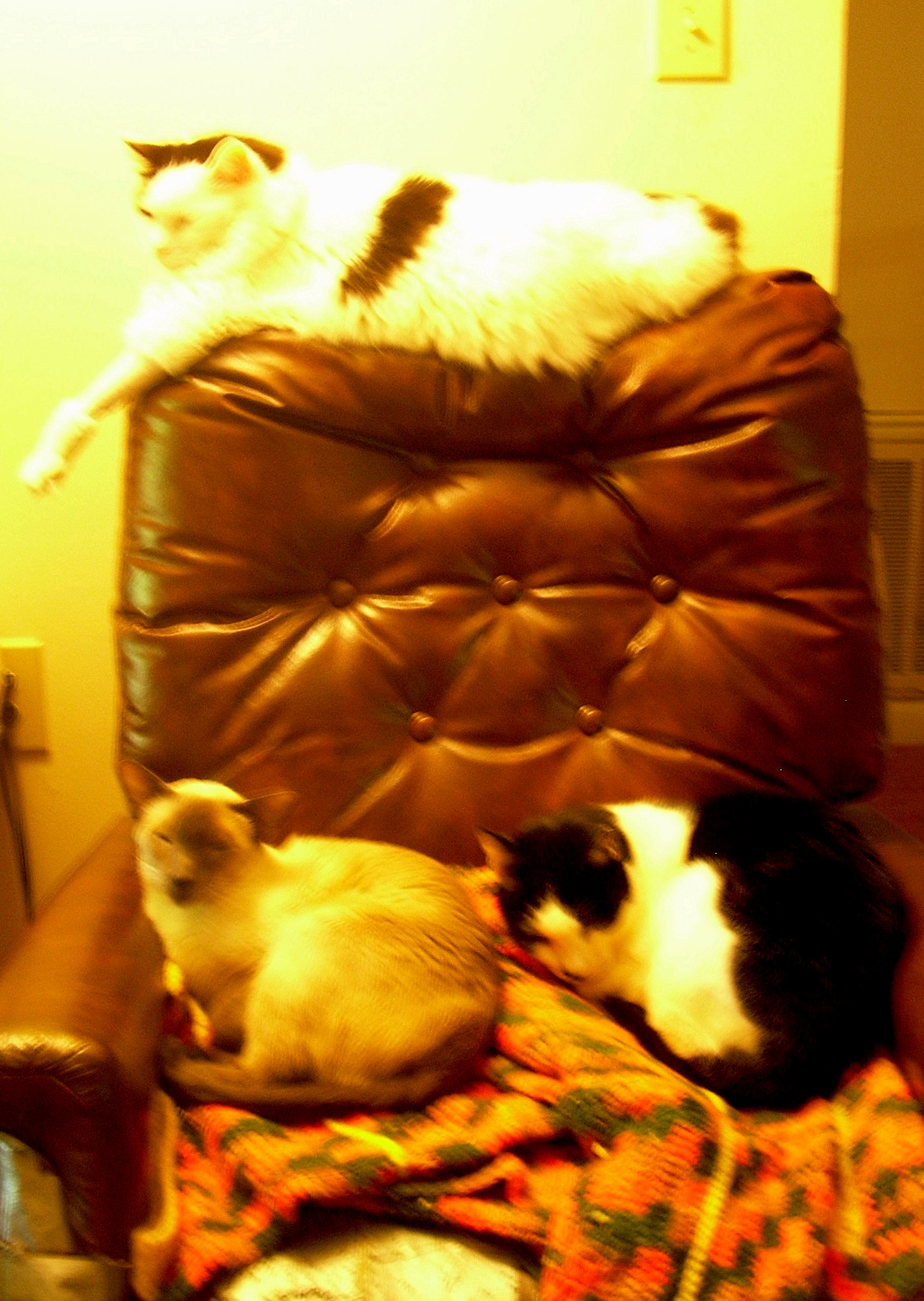
It’s a lousy picture, but you get the picture. It’s rare to get all three agreeing to share one sleeping place, and one photo frame.
Buzzy, completely recovered, is king of the hill, still growing out his IV poodle cut that makes him look like Puss in Boots.
Elegy for the Gulf

This is where the mysteries of Nature unlocked for me. Even later — in the Adirondacks, in the Cascades, on the Pacific — I never felt Nature to speak more plainly. Different rhythms — diurnal, tidal, seasonal — were interwoven. You could sense, even as a kid, how delicate the whole balance was.
Now, it’s also where the limits of our care and the boundlessness of our appetites are most plainly apparent. For me, the spreading plume of oil is, to this decade, what the smouldering and collapsing towers were to the last decade: the next installment, the graven image, of our penchant for destruction of entire human and natural systems.
~ David Gottlieb

F*ck God.
It’s okay for me to say that because I’m Jewish. We’re His chosen people and that means we have a privileged, intimate, familiarity-breeds-contempt relationship with the big guy. We’re always giving Him a hard time. And boy is it ever mutual.
What a load of crap. The very C-4 plastique crap that’s getting ready to blow up the world. The Abrahamic religions with their tripartite tribal god, the three-headed spawn of schism, brought at least as much insanity and evil as good onto this planet. We can’t see how insane it is because we’re inside it. It is some crazy, destructive holy shit.
Really, the crap going down in the Middle East, the inexplicable insanity that never ever stops swirling around the Jews, makes me feel uncharacteristically like a Sam Harris, Christopher Hitchens religion-hater. If the real God is this God, invoked by the brawling Abrahamic triplets, then He evidently intends to destroy the world and has created, with His Revelation, the perfect nuclear time bomb. But the Biblical, Koranic God is a human projection, or misconception, if you ask me. (I know. You didn’t.) The apocalyptic mindset is a raging mental illness. At bottom it is a human tantrum over death, nothing more. It’s all about how we can’t accept that we die. Paradoxically, we’re likely to destroy this beautiful world simply because the price of entering it is having to leave it. Dog in the manger. If I can’t have her forever, nobody can have her ever. So there.
I want to invite you to seriously consider the following conception of God, written by someone who I think was, is — he’s still alive — a real prophet. (Jewish? How’d you guess?) Without honor, of course: his “eccentric” vision was almost unnoticed and almost instantly forgotten. A longer excerpt at the link, which I strongly commend to you; better yet, get a copy of the book for as little as 99 cents. But here. God, who has taken the form of a black man (for reasons explained in the longer excerpt), and Seth, the only white man (a Jew) working in a Southern Illinois coal mine, are talking in a chamber deep in the mine. They discuss the recent death of a man in the community stabbed by the husband of his lover.
“It was terrible about Sam, wasn’t it?”
“Quite so.”
“Lord, did he have to die like that?”
“No, awful waste,” replies God.
“But Lord, why didn’t you do something about it?”
“To breed, Seth, is not the simplicity that humankind believes it to be. Men and women had to be rewarded with storms of delight if they are to create destiny. I must have sand hurricanes of men to fulfill my universe . . . Seth, let’s play a hand, cut the cards.”
“I don’t play pinochle.”
“But you play gin rummy.”
“Sure. Grandpa and I did all the time . . .”
[after the game]
“I miss grandpa, is he happy in heaven?”
“There is no heaven, Seth.”
The engineer stills in his chair, the deck of unshuffled cards inert in his hands. He ventures a numb reply, “But Lord, if you are real there has to be a heaven, doesn’t there?””
“No logic to that, Seth. No heaven, no hell, no purgatory, just Earth for men until they learn to sail off into the vacuum seas of my stars. Fellow like your grandpa dies and he sweetens the earth with his decay. Those were contented grubs that ingested grandpa’s flesh.”
Seth weeps, “Please, Lord, don’t.”
“The sensibiities of humankind,” muses God. “They kill one another without remorse yet deny the gift of the corpses to redeem new life as do my mute worms beneath the leaf mold. If you slay your brother should you not eat him? The cannibals understood.”
“Lord, the grubs, the worms, they don’t love one another. People love people,” the man states.
“That’s right, Seth, how silly of me to forget.”
“You forget nothing, Father.”
A God with a sly sense of humor, who wants us to accept death, stop killing one another, and sail out into the stars?
This Jew won’t settle for less.
Stuffit. [UPDATED]
New bookcases were built and painted out on the porch, much sooner than I thought. I could not have afforded them, but our friend Nathan, the karate teacher, paid for most of it in partial trade for my editing of his memoir.
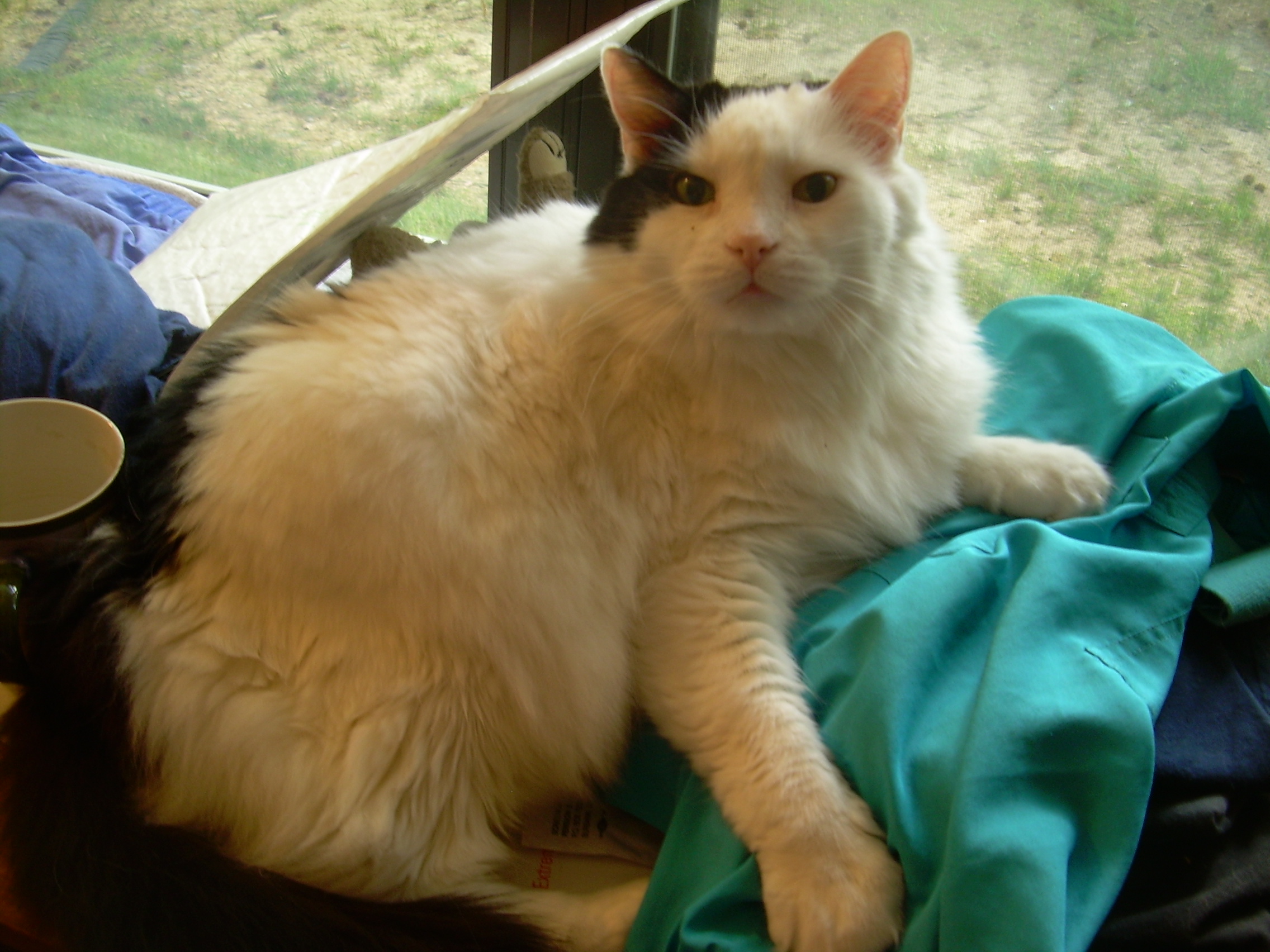
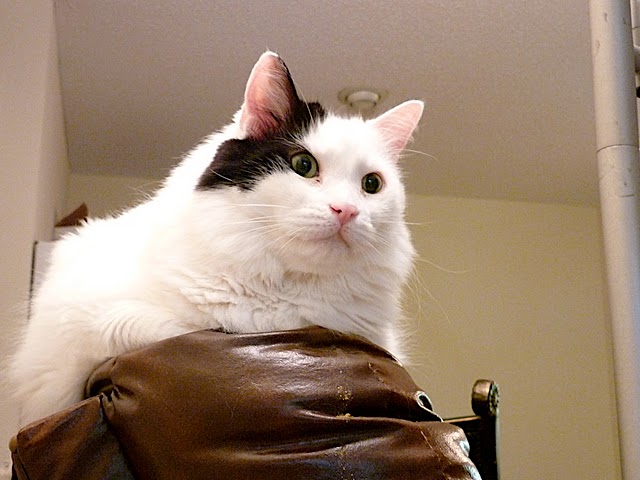
Yesterday the bookcases were installed, and the unpacking of boxes commenced. (Let me hasten to add for the cat fans that a cat tree awaits assembly to replace Box Mountain: the cats have become addicted to napping near the ceiling.) My reaction is surprising, or maybe not: I recoiled from how much stuff we have — although I am helpless to effect a sweeping purge — and recoiled, especially, from the commitment implied by planting it all here. I’d been feeling like “OK, this is home, for now,” and now I’m all “Hey, not so fast!” (Fast? The boxes have been piled against the dining-alcove wall for six months.) The simple inertia of all that stuff makes moving again overwhelmingly aversive and unlikely. Not that it was any likelier before yesterday — but the asceticism of having our stuff packed up and out of sight must have created a pleasant illusion of spareness and transiency. Of being able to travel light, if one could travel.
And worse than the material inertia of it all is the weight of the past. I made the mistake of opening a box I hadn’t opened before, one of the ones my parents sent me when they dismantled their Chicago apartment and gave me first pick of their library, including first editions and Paris-published banned books collected by my father’s bold bookseller mother. That’s all wonderful, but the box I opened was warningly labeled “Non-Books.” It was memorabilia that had moldered in my parents’ storage locker for decades: waterskiing badges from summer camp, a spelling-bee plaque, Communist propaganda pamphlets in English picked up with horrified fascination in East Berlin in 1962, bluebooks from Harvard science exams (interesting only that it’s the science ones I saved), clippings of articles I’d forgotten writing . . . stuff of no conceivable interest to anyone but me, and of only tenuous interest to me. I have no children to mock and cherish this archive of their own backstory. If I don’t throw this stuff out, it will just have to be shoveled out of my digs by strangers after I die.
My past is unusually dead to me. I feel almost no connection to the 30- and 31-year-old who wrote the neurotic and pretentious journals that were also in the box: an Anaïs Ninny who wasted vast stretches of healthy youth in anguished introspection. Maybe 5 percent of it is either observant or funny. An astringent sense of humor begins to surface here and there, cutting the gunk like dispersant. For the sake of one good joke would you save the city?
Moral: don’t look back. Your life may not add up.
Meanwhile, as the books come out of storage, I go in. Every one I place in the shelf is another nail in my crate. I feel like a Strasbourg goose having my feet nailed to the plank.
UPDATE: Now I’ve flipped and the books are making me feel rich.
Also, found these quotes in the old notebook/commonplace books.
And this mysterious body, this body whose transience we try to vainly to feel as a fact, is loved with a special reverence for continuing, miraculously, to live, and hated with a special loathing for promising, incredibly, to die.
* * *
The sinking sense of falling — loss of maternal support — is the permanent archetype of catastrophe.
Both are from The Mermaid and the Minotaur by Dorothy Dinnerstein, which relates to the Jimmy Buffett lyric, “Some people claim/ that there’s a woman to blame . . .” From Amazon reviews:
I read this book twenty years ago when I was in college. I found (and still find) Dinnerstein’s feminist argument for shared parenting to be one of those books that has the potential to change lives. . . . The kernel of her argument is that so long as we all are raised (exclusively or predominantly) by our mothers or by female caregivers, children will grow up with a deep-seated resentment of the feminine (since no parent can perfectly anticipate a child’s needs, and all children, in growing up, will be conditioned by our infantile rage at our parent’s imperfections). . . . At the age of twenty, I was persuaded by Dinnerstein to be (when I did have kids) an active and equal participant in the raising of my children, from changing diapers to feeding and everything else. I was so convinced of the importance of her analysis, and of its potential to change lives, that I have, in the past few decades, bought and given away as gifts eighty-eight copies to male and female friends. (I figured that if I just told people what a great book it was, few would follow up, but that if I actually bought it and thrust it into their hands, they might be moved to actually read it.) I’m not sure how many of these were actually read by the recipients. But I can report that out of 88 copies given away, eight people came to me afterward and said something to the effect of, “This book changed my life.”
* * *
Dinnerstein also relates the fear of death to how women rule the infant’s world and men the adult’s world. Seem unrelated? Phrase “womb to tomb” captures it best perhaps.* * *
it is not “just another” “feminist ” title. Indeed quite a few feminists have objected mightily to it over the years. The big problem, though, it that it has been roundly ignored over the years!
I agree. The book made enormous sense to me, especially in explaining the cruel control of women in so many traditional cultures. Its influence still lingers. (Matter of fact, I’ll cross-post this last part at Cloven Not Crested.)

