Credit Card Communism . . .
. . . is when we go out and spend money we don’t have because, hey . . . “to each according to his need!”
Having done this myself tonight, I’m feeling a little bit friendly, or at least lenient, toward that disgraced principle.
Yes, of course we should all be responsible and productive, live within our means, and strive to make, do, give, achieve, and succeed so that our abilities surpass or at least suffice for our needs.
But isn’t one of the very definitions of a human being that creature whose needs are always threatening to overwhelm its abilities? “To get ahead” doesn’t mean to get ahead of the Joneses, it means to gain some distance on the ravening wolf that is our own body and soul.
Just look at our caloric requirements, for starters, and the great difficulty most humans have always had securing or producing enough calories to keep themselves and their growing families going. The activity required to get calories burns more calories, so it’s a kind of vicious cycle. (Of course, that vicious cycle is called “life,” for all living things. We are all on a treadmill outracing entropy.) And as many calories as hard physical labor consumes, the brain, especially the growing brain, is the biggest glucose glutton of all.
The brain is also the only body part that can lift us above a hand-to-mouth existence, given wit, perseverance, luck, drive, and sometimes ruthlessness. Its needs are proportionate to its potential abilities. But what a struggle! Especially if we don’t have anyone to stand by with water bottles and energy bars along the marathon route. And we don’t only need food and water, we need rest and pleasure.
So now and then we break down and tell ourselves that we’ll run the race better if we can have just some of the rewards in advance of crossing the finish line. It’s a tough call where the line is between needs and wants (not to mention addictions), and the line tends to move. It’s also a tough call how many of us, given access to the rewards, will slack off on the efforts. There is a belief out there that humans need a mortal threat to be properly motivated. (Note the approving use of the word “hungry.”) But there’s another fine line — in different places for different people — between what spurs and what paralyzes.
This is part of what credit card debt was all about.
But on the other side of the argument, it is cruel — in a social-Darwinian way — to make survival itself contingent on success. Success is something different from the willingness to work hard; it’s an amalgam of many ingredients, fused by an ineffable alchemy. If you’re lazy you’ll most likely miss the gold ring, but missing the gold ring doesn’t mean you’re lazy. Even if everyone tried their best to be a successful entrepreneur or inventor, entertainment star, or bestselling author, relatively few would succeed. Yet we are moving toward this sort of jackpot economy where not even years of education or experience — only some kind of freak fame or empire-building — can lift us above a hand-to-mouth existence. For a while, in the industrial era, there was this thing called a “job” that was a pretty decent fit for a man’s needs, whether or not it fully tapped his abilities (gendered language intended). Now, we’re left with our orphaned abilities flapping uselessly in the breeze as we struggle desperately to stay ahead of our needs.
So, credit-card communism — our unsafe plastic safety net, stretched across the gap between abilities and needs.
If George Carlin Were God . . .
. . . things would make much more sense.
Life is tough . . . What do you get at the end of it? A death. What’s that, a bonus? I think the life cycle is all backward. You should die first, get it out of the way. Then you live in an old-age home. You get kicked out when you’re too young, you get a gold watch, you go to work. You work forty years until you’re young enough to enjoy your retirement. You do drugs, alcohol, you party, you get ready for high school. You go to grade school, you become a kid, you play, you have no responsibilities, you become a little baby, you go back into the womb, you spend your last nine months floating — and you finish off as an orgasm.
An Economic Ice Age
Very exhausted, so this won’t make much sense . . .
The other day I “tweeted” approximately “America is in decadence; we’ve had it too easy for too long; can a nation get out of decadence? how?” Jason the Commenter tweeted back, “Let individuals face the consequences of their choices.”
I keep thinking of that as I watch the steel jaws of this recession relentlessly closing on so many of my friends (flash of Poe’s “The Pit and the Pendulum”), and I observe that we are now to be relentlessly punished for every wrong choice we’ve ever made: every opportunity we ever let go by, every reckless investment we got seduced into, every job or home value or interest rate or state of health we ever took for granted, the happy heedlessness bred of affluence and security that felt like it would go on forever. Everyone who was the grasshopper instead of the ant, everyone who was vaguely rather than ruthlessly “creative,” everyone who was stupid enough to be unlucky or wounded enough to be unsure — all who hesitated and all who impulsively leaped off the beat — will be lost.
(Well, no. Many will adapt, strip down, toughen up, and survive. But so much of what we thought was rightful entitlement — to do what we pleased, say what we thought, fulfill and amuse ourselves, deposit a paycheck — turns out to have been luxury.)
Elegantly Fisking Materialism.
David B. Hart, reviewing Marilynne Robinson’s Absence of Mind:
Again and again, Robinson emphasizes the degree to which the mind’s experience of itself continues to elude the reach of the monist materialisms that want to subdue it.
And yet the reductionist project apparently understands itself, and certainly presents itself, as a kind of scientific project. Thus it generates the literature of what Robinson aptly calls “parascience”: a form of discourse whose rather grand, frequently incoherent, and usually irreducibly metaphysical assertions about the nature of the universe, the self, the genealogy of morality, and so on, masquerade as purely scientific claims. This is a literature that systematically blurs the distinction between fact and theory, and between legitimate theory and ideological invention; but it is marketed to readers who for the most part lack the special training needed to recognize when they are being misled, and so enjoys — as Robinson says of the works of Dawkins and Dennett — “the effective authority that comes from successful popularization.”
A great deal of the pleasure that Absence of Mind affords the reader comes from Robinson’s patient deflation of parascientific pretensions. She does not counter the reductionist case with vague appeals to hopeful sentiment, but instead quite effectively demonstrates how much of that case consists in baseless assumptions, ungoverned metaphors, and sheer assertion.
I love it!! This is on the Templeton Foundation-sponsored website Big Questions Online, which looks like the kind of sandbox I love to play in. You see, while Hart doesn’t suffer fools gladly, neither does skeptic.com‘s Michael Shermer, who in another piece on BQO eviscerates Deepak Chopra’s “quantum flapdoodle.” (Shermer may be a parascientist, but that doesn’t make Chopra’s equation of subatomic and mental nonlocality anything but fanciful.) You end up not knowing which is worse, the so-proud-to-be-boneheaded parascience or the mooshy new “spiritual” pseudoscience, but in any case being glad that there is a place that is ready to scrutinize all varieties of bad thinking with an endangered intellectual rigor.
The Survivors Club
Jacques and Charlie Miller have been through more between the two of them than all the rest of us put together. Charlie was fascinated by Jacques and gave him the first smile of the visit.
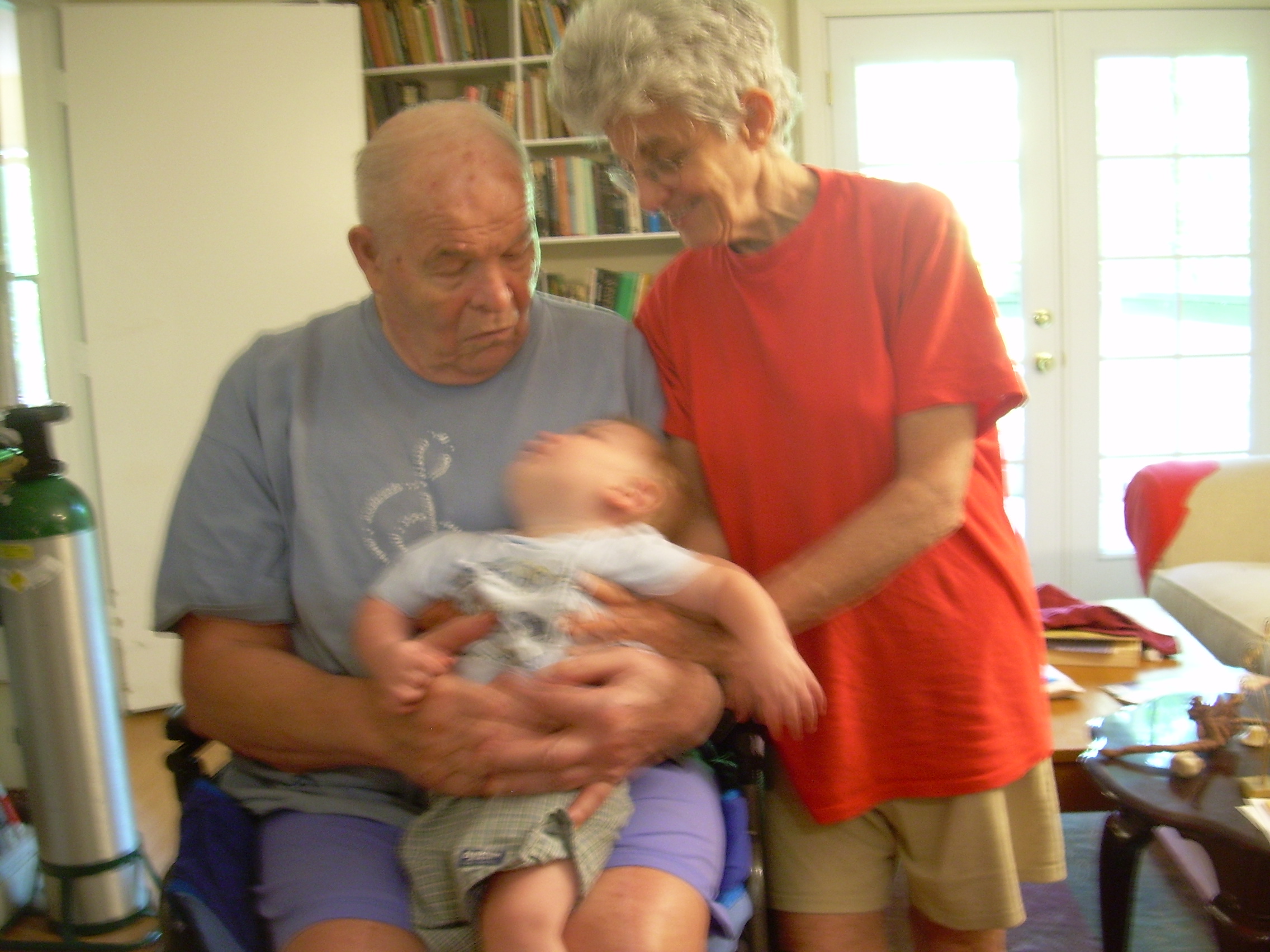
For a better view of Charlie:

They’re both miracles — Jacques who survived gangrene and boxed and did road work on his scarred legs; Charlie who came through brain bleeds and intestinal resection and just being born one and a quarter pounds, and claps his hands, stands on his feet with a little help from his friend above, laughs and says “Da-da” and “Ca” — cat — not known before today to be in his vocabulary.
For more and better pictures, watch Danny’s blog in the days to come. Danny and Kendall went out of their way from Chicago to see old friends in Durham, and Danny and Charlie came out of their way from Durham to see us.
Oh, I feel blessed.
“We Are the Freaks of Freedom.”
Michael Reynolds restates American exceptionalism for our time.
What I’ve Been Trying, and Failing, to Tweet . . .
. . . about Imam Rauf, splendidly said by Rick Moran at Right Wing Nut House:
[T]he more I read about this fellow Rauf makes me ask my liberal friends if they know who they are getting in bed with when they so viciously attack those who are opposed to building the mosque. I don’t trust people who say one thing in one language, and another thing in another language as Imam Rauf has done repeatedly. He has also been silent in the face of extraordinary statements by his colleagues in Malaysia about suicide bombings, Hamas, and hatred of the US. He has blamed the US for 9/11, defended Palestinian terrorism, refused to disavow Hamas’s goal of eliminating the state of Israel, and attended at least one conference with known terrorist sympathizers.
This guy is about as moderate a Muslim as Rush Limbaugh is a moderate conservative.
Despite this, to summarize my take on the “mosque” controversy (otherwise strung out on Twitter), the actual building and its location do not merit the rabble-rousing verbal description of a triumphal structure “towering over Ground Zero.” It is neither towering nor over Ground Zero. It doesn’t live up to its blazing marquee billing as a symbol either of Muslim triumphalism and dhimmitude, or of tolerant pluralism. It’s just another building in a busy neighborhood. The overwrought Right has made it much more important than it really is, thus elevating Imam Rauf to celebrity (rather than subjecting him to outside-the-limelight investigation) and causing the idiot Left to rush to the “mosque’s” defense. Maybe that was the plan. Maybe it was just a political trap that the Democrats obligingly fell into in plenty of time to lose them more votes in November. If so, does the end justify the means? Or does cranking the volume of our political “discourse” up to 11 over this poor choice of symbol merely deafen everyone further, locking the left into their defense of yet another dubious ally and the right into an ever-hardening opposition to all of Islam? The Left is too uncritically eager to designate and embrace Muslim allies, but the Right has now created a litmus test in which the only possible good Muslim is one who opposes the Ground Zero Mosque.
By the way, I bolded the line in the quote above because the encounter of my brother, an education journalist, with the Fethullah Gülen movement (depending on your point of view, a modern, tolerant, world-peace-promoting strain of Sufi Islam or a stealth Islamist attempt to theocratize Turkey and resurrect the Ottoman Caliphate), which actually runs (without admitting it) over a hundred charter schools in the U.S., got me thinking about taqqiya, the Muslim precept of deception in the service of the faith. (Here, about a third of the way down, is Gülen allegedly, and eloquently, advocating taqqiya to followers back in the 1990s. If authentic, this speech should probably not be understood as plotting for world domination; it’s all about Turkey and, perhaps, Turkic Central Asia.)
It struck me that one of the best ideals of the West (even though richly honored in the breach), and at the same time one that can render us vulnerable, is the assumption that people mean what they say, that we can take them at their word, that candor, forthrightness, transparency are aspects of honor, values we can trust we share with most of those we have dealings with. Given this noble yet naïve orientation, perhaps unique to a young and fortunate civilization, we are particularly ill-equipped to cope with the unnerving concept of taqqiya. We are bound to meet it with either excessive trust or excessive paranoia.
If . . .
Hitchens has a deathbed conversion after all, and swears that the him who told us that wouldn’t be the real him wasn’t the real him, which one do we believe?
(My answer in the comments.)
Goodbye, Cousin.
This picture was taken yesterday in the van at the airport, just before Christian went to catch his plane to Philadelphia and from there to Frankfurt.

Jacques was a little out of it and didn’t quite seem to get what was happening. Or didn’t want to.
Christian stayed with us for almost two weeks, during which he cheerfully came and went, exploring the town, going salsa dancing, renting a bike and a car, driving all the way to Cape Hatteras on the Outer Banks and back, reporting on his adventures. I cooked, he bought pizza and lasagna, and, as the visit wore on and his early resolve to lose weight gave way to some kind of emotional fatigue and comfort need, he brought home Coke and potato chips and chocolate and Danish. Which I found endearing.
Notice I said “home.” This is the longest continuous visit or proximity we’ve had with anyone in years, certainly in the four years we’ve been in Chapel Hill. (He had one of those lavish European vacations.) Most of our two handfuls of treasured visits have been for a night or two. Probably because Christian is family and we’ve known him since he was a kid, and because he’s a cheerful, energetic, affectionate person as well as (now) a keen and worldly grown man, it seemed completely natural and comfortable — and comforting — to have him here. I woke up this morning assuming that warm wall of presence, shouldering out the infinite, still closed off the far end of the apartment and my consciousness. It felt strange to realize it was gone.
For the most part I don’t get avidly attached, don’t latch on to people. I have too bone-deep a familiarity with the futility of it. (Maybe that’s what aborting your only child can do to you.) It was so unusual to experience something so usual — simply having another person living with us. He didn’t try to be super-helpful with J, though he was in small ways, nor did I ask him to be. That I would not have wanted to get used to. (I have dared to become dependent on the hospice ladies’ three-times-a-week physical help, because it seems like it isn’t going away, though it could.) It was the casual, steady company that was such an unaccustomed luxury.
Only this afternoon, as I was in the kitchen rinsing dishes, did it occur to me that he must be long since safely home. (Air travel is so remarkably safe that on the very rare occasions when anything goes wrong, the whole world hears about it.) I wondered how the trip had been and whether I’d soon get an e-mail from him. Within three minutes of that thought, he called.

