How often is it that you have anything good to say about your experience with an airline’s customer service?
I have flown to Chicago on American enough times to have enough miles for half my trip to Miami and back for the jazz cruise to be award travel. But the AA website’s page for booking award travel was hopelessly byzantine. It looked as if I could only use award travel for roundtrip, and in that case, either fuhgeddaboudit or “buy miles,” which has always seemed to me to cancel out the whole point. Why would you do that?
With a sinking heart I called the 800 number, expecting to speak to someone reading from a script in a call center half a world away. Now, I’m glad for that person that they have a job. It’s their turn to be the middle class. I can see without too much rancor that someone benefits from almost any situation someone else objects to. (For example, if Trump does win the election—which I don’t think is a done deal by any means—I’ll at least have the consolation of knowing that a few friends of mine, like Mike Castellaneta, are happy. And then I’ll have the consolation of Schadenfreude when things go deep south. 😜) When I’ve had time and patience, I’ve had conversations that were little windows opening on Manila or Bangalore. But when it comes to making a domestic U.S. plane reservation, it’s hard to imagine that that person can begin to imagine what goes on here. Any question that’s not on the script, and you have to ask for a supervisor. I often start out asking for one.
But, no. It was a smooth and gracious-voiced all-American, who spoke like an idealized 1950s air hostess. She sounded blonde. We chatted; turned out she had grown up in New York City and is now in Raleigh. She was extraordinarily efficient, friendly, and helpful. She said that under today’s circumstances she was grateful to have her job, and loves it—loves solving people’s travel problems. She was certainly good at it. With her help I could indeed book half my trip as award travel and pay for the other half. The outcome was that it’s costing me $150 roundtrip to fly to Miami.
I could hardly believe it. What a smart corporation, I thought, focusing on human, homegrown, interactive customer service. What a pleasure. They’ll beat the pants off their competitors with this approach.
Gradually it dawned on me that she was on the elite award travel desk. She must have dealt all day long with Platinum Club members. I was just getting crumbs from the rich people’s table.
That said, American is pretty good. They don’t punish you for flying “Basic Economy” the way United does. You get a free carry-on AND a personal item.
I’ve been focusing on its insidious and evil aspects, which are real, to get myself off it. Now that that’s settled (with the proviso you’ll find at the end of this post), I’m strolling around there feeling nostalgic, getting a good look at what I’ll be missing. Anticipated distance has already given me perspective.
In an age when we are so scattered physically, it’s how we have community. It might be disembodied community, but it isn’t illusory, the word I was first going to use. Unlike the one-to-one, spoke-and-hub communications by which we otherwise maintain our long-distance connections, FB is a collective virtual space where we can have a shadow of that comfy tribal feeling we evolved with, the solidarity of many bodies nearby, sitting around the fire.
And—this may be crucial—we can have it without the inconvenience and conflict that unavoidably comes with the presence of actual people, in their bodies, with their moods, needs, neuroses . . . we can have it stripped of most of that, even stripped of a lot of its “otherness” and turned into our own mental content. (The immune system comes to mind, with its snuggling up to everything “self” and suspicious bristling at “other.”) As incorrigible humans, we still manage to get into hurts and fights on FB, we still need to work at maintaining and repairing the relationships we care about, but it’s all carried so much more lightly, those “surly bonds” are more easily slipped. We can withdraw, unfriend, or just tune out. We can “turn on” presence like a TV show when we’rein the mood for it and not have to deal with it when we’re not. It’s less substantial, but more controllable.
This is the part that’s scary to me. Some commentators have worried that our animal instincts for relating directly to others will atrophy and our cultural skills for doing so will be lost. I’m not very experienced or good at relating to people on a day-to-day basis (I started out shy and unconfident and then, for almost 40 years, for all practical purposes, related to only one), and so it’s too easy to retreat into a solitary real life populated with a virtual community where I can vamp in my avatar of words, definitely my best foot forward. Yet the things I want and need most to do (if I’m not to die feeling I haven’t lived) are the things I’m not good at and am awkward and afraid of: real writing, Feldenkrais, intimacy. If I’m getting enough pseudo-hits on FB I may never get around to risking them. (I’ve got another post in the works on “the comfort zone,” how it is a needed nest to rest in but can become a comfortable coffin to dream in.)
But this was supposed to be a post on what’s GOOD about Facebook. It’s a hive mind, where we all fetch and cross-share bits of information and wit with a rapidity and richness that is impossible alone or one-to-one. This may be the wave of the future. Participating in such a hive mind, with such good other minds as you guys, is a privilege, a chance to make a small, often unsigned contribution to creating the world and the future. To retreat into 19th-century “Individuality” and try to create alone, with a byline, feels regressive and vain. It may call on my capacities more deeply, which will be privately satisfying, like a good workout, but the results are also likely to lie uselessly off to the side of the real conversation.
All that considered, I’ve decided to deactivate my FB account—for a contractual year—before I decide whether to delete it. Maybe after a year in solitary I’ll be fit for a better balance. I love you guys. Hope to see some of you in “the real world.”
This article by Douglas Rushkoff is one of the best things I’ve read about the virtual unreality we’ve been lured into. Rushkoff more than anyone puts his finger on what’s driving me off Facebook.
I feel myself being experimented on, my mood and behavior manipulated, and not even by a sadistic sentient being. It’s AI with an electrode in my brain—a monstrous feedback loop between my own nervous system and an automated commercial imperative. If I click more when I’m sad (or mad), the algorithm will fiddle with my feed to fine-tune a mix that makes me sadder (or madder). It’s not even the sacrifice of privacy that bothers me (my “secrets” are boring!) so much as the theft of neurological autonomy.
√√√
Rushkoff:
“What happened to us in the 2010s wasn’t just that we were being surveilled, but that all that data was being used to customize everything we saw and did online. We were being shaped into who the data said we were. The net you see and the one I see are different. Your Google search results are different than mine, your news feeds are different and your picture of the world is different.”
√√√
“{We are] living in a new sort of environment. It’s an environment that remembers and records everything we have done online, every data point we leave in our wake, in order to adapt itself to our individual predilections – all in order to generate whatever responses or behaviors the platforms want from us. The digital media environment uses what it knows about each of our pasts to direct each one of our futures.”
√√√
“We can no longer come to agreement on what we’re seeing, because we’re looking at different pictures of the world. It’s not just that we have different perspectives on the same events and stories; we’re being shown fundamentally different realities, by algorithms looking to trigger our engagement by any means necessary.”
√√√
“We’ve spent the last 10 years as participants in a feedback loop between surveillance technology, predictive algorithms, behavioral manipulation and human activity. And it has spun out of anyone’s control.”
√√√
“We may be benefiting from the internet’s ability to help us find others with whom we share rare diseases, hobbies, or beliefs, but this sorting and grouping is abstract and over great distances. We are not connecting with people in the real world, but gathered by our eyeballs in disembodied virtual spaces, without the benefit of any of our painstakingly evolved social mechanisms for moderation, rapport, or empathy.
“The digital media environment is a space that is configuring itself in real time based on how the algorithms think we will react. They are sorting us into caricatured, machine-language oversimplifications of ourselves. This is why we saw so much extremism emerge over the past decade. We are increasingly encouraged to identify ourselves by our algorithmically determined ideological profiles alone, and to accept a platform’s arbitrary, profit-driven segmentation as a reflection of our deepest, tribal affiliations.”
I have low expectations that anyone will show up, and no idea, at this point, how enticing I’ll make it.
But, less often and with a higher bar than on Facebook—because more effort is involved than just hitting “share”—I’ll still post links and photos, write thoughts and commentary, share music and other videos, anything that clears that higher bar. I may find stuff you in turn would like to share further. And if you send me something irresistible (most of you know how to reach me), I may post or link to it. It’s “slo-mo, remote Facebook.” It’s how we lived before there was Facebook.
(Just in case anyone shows up, I’ll try to shape up and write as clearly as I sometimes managed to do on Facebook. I don’t always bother when I’m just talking to myself.)
I have several neglected blogs—Purr View, for cat stuff; Cloven Not Crested, about women; A Cold Eye, a dark-themed scienceblog; The Compulsive Copyeditor for word nerds—but YOU DON’T NEED TO KNOW THIS. This main blog, Ambiance, will be the bulletin board (as well as the place for anything personal, political, musical, or hysterical), and I’ll post notifications and links on this blog if and when I post on any of the others.
I’m told there is a “Follow” box to check in the lower right corner of this blog’s homepage, and by checking that you can receive an email when I post something. (I think the email actually contains the whole post, so you won’t even have to navigate.) I’ll also see if I can put an obvious “Follow” widget in the sidebar for proper internet redundancy.
If you “follow” the blog you will also be able to comment. (If you ever wanted to write your own post[s], or just copy a FB post you like over here, that too could be arranged. Ambiance started out as a group blog.)
Or, you can just come over here now and then and see what’s new.
All this is whistling in the dark, but it will be my place to vent and to share any irresistible links, images, ideas, or laughs I come across. That was the good part of Facebook . . . that and “seeing” you guys.
BONUS: Whether you come here or not, go to Time Goes By and look at posts called “Interesting Stuff.” Ronni Bennett finds better links than most Facebookers. I’ll be sharing her finds and so can you. Here are two:
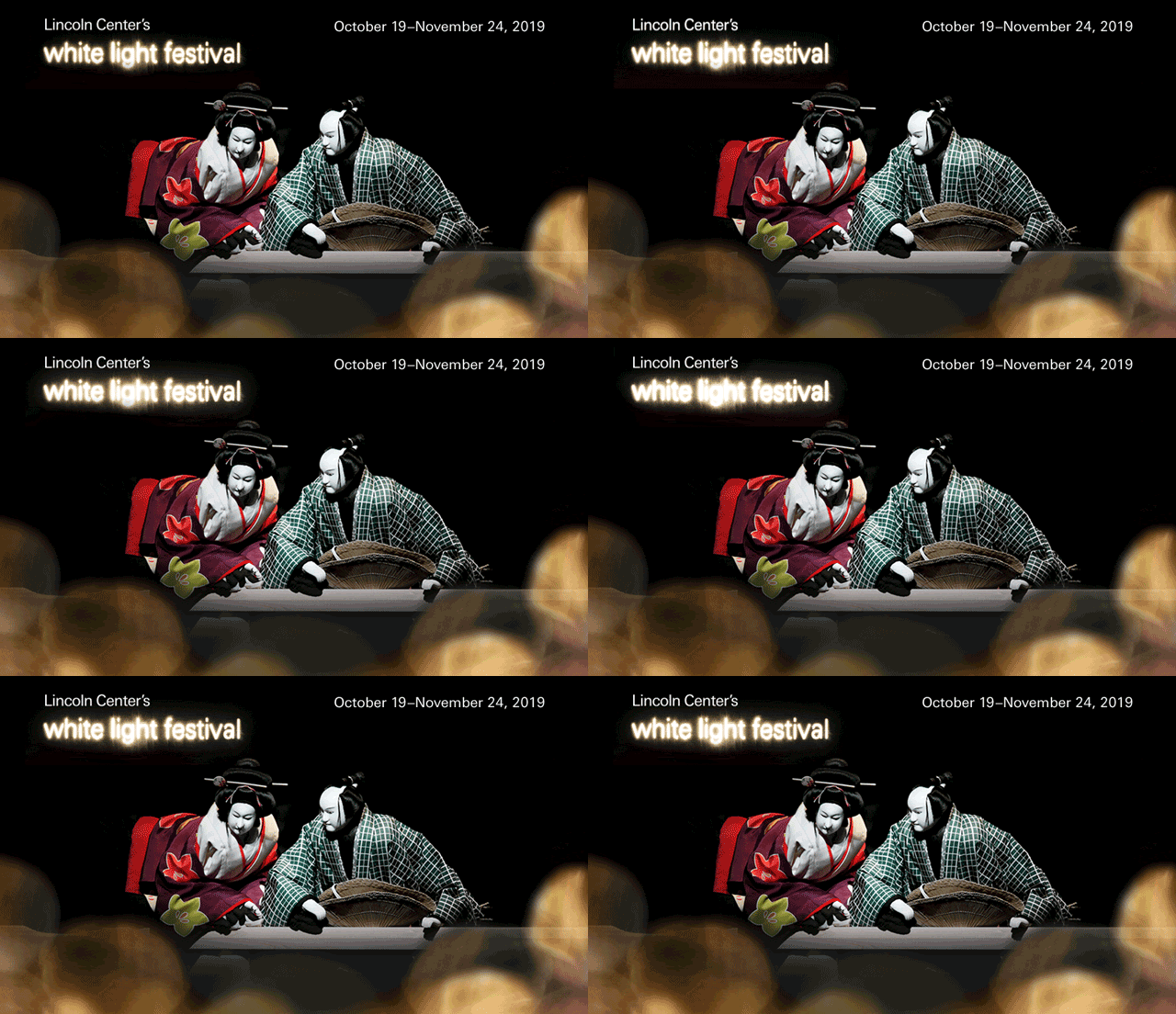
I wrote briefly to a friend that I had seen this performance, and he responded:
I had heard or read the word bunraku before but didn’t know what it was. I searched You Tube and was delighted with what I found. The marionettes are quite magical but the sound is beyond magic. Listening to classical Japanese music is like walking among the redwoods in the early evening mist. There is room in the air for everything that might come along. In a way, the music is not created sound. It’s more like the result of applying a filter to the sound of nature so that certain frequencies, among the sounds that comprise the world, have been selected out at that moment. I’m not aware of any other musical tradition that evokes so convincingly the natural world without sounding forced or merely imitative.
That prompted me to write more about it:
What a marvelous description of Japanese music. That is certainly true of Zen music, shakuhachi and the very spare string accompaniment (shamisen?). But the music that went with this melodrama, which was really a kind of opera (“the sung narrative particular to bunraku,” says the program)—the text was part sung and part recited, really acted—was in large part more social and courtly (in the sense of an aristocratic court) than natural. It doesn’t say when it was written, but the Tokugawa shogunate apparently BANNED it in 1721 because it was provoking copycat love suicides (like Goethe’s The Sorrows of Young Werther) and wasn’t performed again for more than 200 years! A very ritualized, courtly kind of Buddhism, with pilgrimages and prayers and chants of “Namu Amida butsu,” in search of liberation, plays a part in the story. It’s about a prostitute (age 19) and her client (24) who really love each other and face insurmountable practical and social obstacles that drive them to despair.
Despite my long acquaintance with Japanese culture, the surface of the music was very alien, agitated and atonal (Webern’s got nothing on these guys). So it took me a while to penetrate the surface and begin to comprehend that this was a human comedy as well as a tragedy. A lot of the falsetto and hysteria in the (all-male) voices was probably as satirical as it sounded: behold the pathetic obsessions of these touchingly frail humans. (The helpless passions enacted by the colorful puppets contrast starkly with the enigmatic dispassion of their black-swathed manipulators.) Subtitles were projected above the stage, and quite a lot of the goings-on were about business and money. The author, Chikamatsu Monzaemon, is called the Japanese Shakespeare, and this story was quite a lot like Romeo and Juliet, another tale about very young people, which is foolish, flowery, and even funny for much of its length, until the tragic ending. In this tale, right up to the last minute the young people are coming up with all sorts of natural reasons (e.g. breaking their families’ hearts) for not going through with it. But then they do, in a gruesome, graphic, determined way. And in a forest, away from all the noise of society—and at that point the music becomes exactly as you describe it.
Caitlin Johnstone ends an essay of exquisitely layered, aged-spirits-soaked mille-feuille political paranoia (she’s been at this a long time, and her paranoias are positively fractal) with this disclaimer, which I salute as the last word.
It’s so weird how we move through life like it’s no big deal, like “Yeah, just a toothy, fingery ape monster who consumes the life force of other organisms and excretes them out its anus walking around and looking at stuff in a universe that nobody understands, whatever.” I mean, we get THIS. This strange, shimmering, mysterious world full of flying feather beasts and air we breathe parts of into our bloodstreams and electromagnetic radiation which we process with our ocular organs, and people are still waiting around for a miracle. The miracle already happened. The miracle is here. What’s already happening currently dwarfs any miracle anyone is currently praying for by infinity orders of magnitude. And we only get a few years here. So like, I dunno, maybe let’s worry less about wrong people on the internet. By all means push for changes in this world. But never lose sight of the fact that the Really Big Deal in any given moment is not whatever change you’re trying to make, but the fact that this world is here at all, and that you get to stand up and look around in it for a while.
Whatever else happens, humanity, do pause to pull your head out of your a** and poke it out into the miracle as often as you remember.
Our brains are made to reward us with pleasure when we accomplish something. The purpose of this mechanism (the dopamine system) evidently is to motivate us to anticipate the reward and so to repeat the survival-promoting effort, such as hunting. (We have a predator’s version of this instinct; we stalk an insight as intently as a cat fixates on a spider, and make a “killing” on the stock market much as Paleolithic tribesman drove mammoths off a cliff.)
***
In an unanticipated kink of evolution, though, our brains are also clever enough to figure out how to take a shortcut to the pleasure reward and bypass the effort.
***
This arguably backfires in the long term—the pleasure loses potency when it’s pursued as an end in itself, leaving us trapped in addiction or stranded in meaninglessness. But in the short term it works very well, and there is loads of evidence that our natural focus, very hard to overcome, is on the short term.
***
There are a million illustrations of this, but the one I was thinking about this morning was status.
***
There are people who merit admiration by being masters of what they do, and there are people who go after admiration as an end in itself. You could actually call the first kind of reward “stature” and the second “status.”
***
The first group of people may enjoy admiration, but they wouldn’t enjoy it without earning it, and it makes them uneasy because they often wonder if they have really done enough to deserve it, and if they will be able to do it again. Such people are intently focused on what they do, and the reward of status, if it comes, is a byproduct—it may even be perceived as a dangerous distraction, a temptation to rest on one’s laurels and lose one’s mojo.
***
The first group of people are often not very good self-promoters, because self-promotion doesn’t really interest them. It would be a waste of their time. An example is the great artist who isn’t “discovered” and whose genius isn’t recognized until dead. (Not to get too Romantic about it, there have been exceptions—great artists who are also great self-promoters. They must be people with a double or triple helping of energy, because for most of us either art or self-promotion would be a full-time job.)
***
The second group of people are interested in a shortcut to status, and their art becomes a means to that end. They are assiduous self-promoters, often gifted at taking the public’s pulse and riding, or even creating, market trends for the kind of thing they do.
***
The catch is that people in general have a tendency to be dazzled by status and to overlook or underrate stature, which is loath to blow its own horn. The audience can’t always tell the difference, and their senses are attracted to what makes more noise and draws a crowd.
Historian Claire Berlinski jokes that she’s “the Dear Abby of liberal democracy,” but she’s more like the Joan of Arc of liberal democracy, beating the bushes to raise an army. (Of course “liberal” has become a dirty word on both right and left, but it used to stand for an ideal claimed by both, the optimistic faith that freedom of thought and enterprise would bring out the best in people—with some healthy arguing over the details.) In Berlinski’s view, it’s giving way to “illiberal democracy” —”democracy without freedom.” She writes about the wave of “authoritarian populism” sweeping the world and of the “New Caesars” who (shades of the Roach Motel), once voted in, may make it impossible to vote them out.
This is worth reading. You can skip the hissy fit for unsubscribers at the beginning, and start with “The Dear Abby of Liberal Democracy,” and further down, “Newspeak: How Did We Get Here?” A couple of appetizers:
[to a reader in the Czech Republic] The first task: No despair. You may feel utterly overwhelmed by the weight of the illiberal forces lined up against you. … You will not be alone in feeling this way. But don’t succumb to this sentiment. This is a path to ruin. None of us can retreat, in the coming years—as we will surely be tempted—to the politics of internal exile. … We must learn from each others’ experiences … It’s especially important for ordinary American citizens to be in personal contact with citizens of what I call the laboratory countries, countries like yours—the countries where the New Caesars are experimenting with and perfecting their techniques.
* * *
[After quoting Orwell on “Newspeak”] The shrinking of our vocabularies … has not been imposed upon us. We’ve freely and willingly contracted our own verbal skills, our own reading skills, our own sense of nuance in our language … People who care about speaking and writing precisely—people who use the full range of the English language’s rich vocabulary, people who understand language as a subtle and nuanced tool—have become despised by both the right and the left as elitists.
This is perhaps an outgrowth of our commitment to egalitarianism, in that we are hostile to aristocracy in any form. Our educated elites were once a form of aristocracy. Perhaps they suffered so intensely from the shame of being aristocrats in an egalitarian country that they adopted not only the concerns of the popular classes, but their manner of speech. …
Whatever the causes of the diminution of the American vocabulary, it has had political effects. The effects are those Newspeak was designed to have. We lack the words we need to speak precisely and accurately about our own system of governance.
For more of this historically literate point of view, which may help to clarify your view of what’s going on in front of your eyes:
In The Law, human beings attempted to create an authority that would transcend their own best efforts to besmirch, evade, manipulate, and abuse it. A North Star of dispassionate justice that would shine far above the nonstop mud wrestling of human affairs.
In practice, of course, the law, a human product, has often been used as the protector of privilege or the refuge of scoundrels. But it is a work in progress, and over time it’s been hewn and refined and fought over toward something that begins to vaguely resemble the ideal of objectivity—to extend its protection to the powerless and its demand for accountability to the powerful, “without fear or favor.”
Those words, as you’ll see if you follow the link, arose in the context of journalism, which has now largely made a travesty of them. Only The Law is left.
(Digression: it’s interesting that the English, who tore through this globe creating, exploiting, and destroying with their mind-boggling drive to industrialize, capitalize, and colonize—a truth brought home to me by copyediting this forthcoming book—also created much of what we now know as The Law, and slowly, from Magna Carta to the reformers of the 19th century, broadened its protection, imperfectly, from the rights of property to the rights of the naked person.)
Here, you hear the authority and dignity of The Law awakening, shaking its wings, clearing its throat—not a moment too soon. Things have finally gone too far, rousing it from its “stony sleep,” like the more-than-equal and opposite monster to Yeats’s in “The Second Coming“:
somewhere in sands of the desert
A shape with lion body and the head of a man,
A gaze blank and pitiless as the sun,
Is moving its slow thighs, while all about it
Reel shadows of the indignant desert birds.
In The Law, we finally have a Godzilla to fight the Megalon of chaos.
Or, in a more mundane image, the parents burst through the door just as the kids who’ve been gleefully trashing the house are about to burn it down.
But The Law is no human parent. It’s our own imagining of a power authoritative and impartial enough to stop us from destroying each other and ourselves.
 Ambiance