State of Emergency
That’s what the State of North Carolina calls this:

Well, OK, I’m exaggerating. But not by much.
Meet “my” new tree, the OctoBaum:

facTotem lives!
The science blog I had the great fun of writing for a while on my employer Natural History magazine’s website is all archived here, thanks to my collaborator, the magazine’s longtime webmaster, Jim van Abbema. He’s now moved on and the magazine, along with so many print media, is trying to keep its head above water, but in the meantime, Jim has kept the archive of our work together alive by hosting it on one of the domains he manages.
It was the magazine’s publisher, Charles Harris, who had the bright idea of giving me a place to stash the cool links and stories I was stumbling on in the process of fact checking (and overstuffing the footnotes with; they had to go somewhere!). Since we didn’t yet have blogging software on the website that I could use to post directly, I “had to” work through the webmaster: I’d supply text, hunt down images, and he would compose and post them. This apparent inconvenience turned out to be a godsend, as Jim had creative visual ideas (this is probably my favorite) and nifty scripts (click on the images here and see what happens) that I could never remotely have approached. The arrangement evolved into a true collaboration, of which this extravaganza on the Hubble Space Telescope was undoubtedly the pièce de résistance.
I’ve put a permanent link to the archive into the blogroll here in case you want to poke around in it.
John Avlon: The Scott Brown of the Center Left?
It’s obviously time for centrists to make their carefully crafted moves. These moments have to be seized; they don’t necessarily last. Political moods are fickle as March winds. Fed-up independents may be ready for some stirring rhetoric of their own — common sense need not be bland and wishy-washy — and just as Scott Brown played it perfectly (he almost had me!) and got himself elected to the Senate, John Avlon, author of Independent Nation, is coming out with his well-timed new book, Wingnuts: How the Lunatic Fringe is Hijacking America.
Right out of the gate I question the title, because Avlon must know that “wingnuts” is generally used to traduce the fringe on the right; he means his brush to tar both “wings” equally, but it won’t be taken that way. That makes me think it’s a center-left book. If it just plays into liberals gleefully bashing “birthers” and the like, that’s nothing new. I hope the book overcomes that impression and at least gives the center left a strong, sane voice, as Brown has the center right. I’ve met Avlon once, he’s a smart guy, and I’m happy to see him making his well-timed bid for influence.
I’m going to post his press release and go back to work. That way, while we’re waiting for the book, we can review the press release. :)
Friends:
My new book, Wingnuts: How the Lunatic Fringe is Hijacking America, is now available from Amazon.com and Barnes and Noble. It is also available in e-book and audio-book format. It will be available in book stores next week.
What’s a Wingnut? It’s someone on the far-right wing or far-left wing of the political spectrum – the professional partisans and the unhinged activists, the hardcore haters and the paranoid conspiracy theorists. They’re the people who always try to divide us instead of unite us.
The book looks at the outbreak of extremism in the opening of the Obama administration — from the unprecedented government spending that spurred the Tea-Party protests to the onset of Obama Derangement Syndrome. The book explains how hate-fueled rumors take hold (one section is called “How Obama Became Hitler, a Communist and the Antichrist”), examines the “hunt for heretics” that is taking place inside both parties, looks at the growth of the “Hatriot” movement and details the rise of increasingly hyper-partisan media. It compares current merchants of political paranoia with past
fear-mongers and finds that we’ve heard much of this hate-filled snake oil before. But the increased polarization of the two parties and the echo-chamber of the internet are helping the fringe blur with the base, making the Wingnuts more powerful than ever before. Not to fear, though — more Americans are declaring their Independence from extremes on both sides, and the book ends with “How to Take America Back from the Lunatic Fringe.”Buy a copy and please pass this email on to friends who would enjoy the book — we need to show that there is an untapped market for books [that] take on extremes from both sides. It’s also the debut book from BeastBooks. Below are the links to Amazon and Barnes & Noble as well as Audible.com — and feel
free to write a review if you feel so inspired.Amazon:
Barnes & Noble:
http://search.barnesandnoble.com/Wingnuts/John-Avlon/e/9780984295111/?itm=1&USRI=wingnuts
Audible.com:
Sometimes Nothing Says It Like 140 Characters.
Nobody knows anymore what an unimproved 60+-year-old looks like. “Everybody” dyes their hair, does a little Botox, a snip–and no wonder!
Given a choice, who w/a smidgen of vanity would stay the course? Last week I got mistaken for my 86-yr-old mom’s sister & 53-yr-old bro’s ma
You can look salt&pepa distinguished in 50s, in 60s you just look old–if yr Caucasian & fried the bejesus out of yrself in the sun as a kid
It could be worse–it’s only genetic luck that nobody in my family’s dead of melanoma. In the 1950s & ’60s we fried ourselves yearly in FL
Remember Sea&Ski? Little coconut-oil droplets acted as lenses actually magnifying UV rays. My nose peeled so much I shouldn’t have a nose.
We were such savages–we fried ourselves ritually in the sun. & we killed anything that moved. Buckets of live shells, fat stringers of fish
There were like 1/3 as many people in the world. Nature still had the upper hand & nature seemed inexhaustible. If you shelled & fished (c)
(c) like that today, you’d be in jail. *sigh* It’s worth being old to have memories of those days.






Valentine’s Day Proposition. [UPDATED]
(No, no, not that kind of proposition.)
Consider this:
The world is roughly divided into lovers and beloveds. Those who send valentines, metaphorically and literally, and those who receive them.
Which are you?
Why is this?
UPDATE: Full disclosure: I wrote this post after seeing my parents. My mother is so clearly one of the beloved — love just rolls downhill towards her. She’s irresistibly adorable. Also temperamental, mercurial, and when she was young, narcissistic. (She’s actually outgrown it. Some never do.) My father once said to me (I was seventeen), “There’s only room for one like that in a family.” That turned out not to be true: at least two of my sisters are “beloveds” in the same vein, although perhaps they could not unfold their wings till they got out of her house and into their own families. I turned out a lover like my father.
Another way to think of it is in terms of gifts. The ratio of the number of times I have thought of the exact right gift for someone to the number of times anyone has done this for me is, I don’t know, maybe 30 to 1. This does not make me virtuous. It makes me pathetic. (See the comments.)
Witness
That title’s rather memorably taken, but it’s one of the ones I wish I could use for the book I imagine someday writing about J. Others: Titanic, Lesser Lives (namely mine), and, obviously, The Book of J.
It’s my contention that one of the purposes of marriage, maybe the main purpose, is to be an intimate witness to another person’s existence; to see one other human being, as far as is humanly possible, as God does. (You know I am an agnoptimist and use the word “God” in a manner of speaking, for a surmised supremity of being that keeps us reaching, regardless of whether we postulate it or it postulated us.)
Of course, J has written his own book, of another order entirely, “I-witness news” that renders any book “about” him superfluous or worse. I often say to myself, “Leave well enough alone. It’s done.” Anything I wrote could only detract from the inspiring starkness of his testimony — if it touched it at all. My 38 years of living with him have often seemed like a very long, very pale shadow of his two-year imprisonment — like being imprisoned within a shadow, so forceless yet spellbinding that you could walk right out of it, but you don’t. Surviving is simple, living is complicated. The survivor must forever after feel both envy and contempt for us heedless drama queens who have the luxury of just living. One of his flagship quotes was from Céline: “Experience is a muffled lantern that sheds light only upon the bearer.”
So what would he need with a witness who can’t see into the heart of his experience? The answer that comes (just now) is surprising: he’s more than just a survivor. While nobody but he (and the others who were there, almost of all of whom he’s outlived) could witness what happened to him, nobody but I could witness so close up, like a little tiny corner of God, the piece of work he became through that and so much else. That takes a long time, it takes not only earning trust but also getting over your own issues, to the very limited extent that that’s even possible — rubbing a clear spot in a dirty window — but (as anyone long married and paying attention could tell you) it’s quite a privilege to have a ringside seat on another soul. Much less such a capacious and contradictory one. Anything you make a lifelong study of and record as best you can, even in your own heart, is a little bit of the Creation that did not pass unwitnessed. Every long-married person has a witness, and is one.
Of course, marriage isn’t the only place this happens. A close friend is a witness, too. And these thoughts were originally provoked by a beautiful piece of journalism as witnessing. A one-time, short-work opponent of Muhammad Ali named Sweet Jimmy Robinson had fallen off the human map. When you finish this long and riveting piece by ESPN’s Wright Thompson, you realize he has been put back on it.
My Favorite Feminist Tract. [UPDATED]
UPDATE: Delighted to have this piece published on Boston arts forum Big RED & Shiny!
Surprised that I even have a favorite feminist tract? Read on.
Back in the heady early days of the second wave, feminist theorists poured forth torrents of words about the male monopoly on public power — economic, political, religious, cultural. If you had grown up in a world where the politicians, doctors, lawyers, novelists, scientists, artists, ministers, bankers, and entrepreneurs were overwhelmingly male, and where such aspirations on the part of a girl were not only against all odds but officially (by the reigning Freudians) ruled unnatural — hard to imagine now, half a century later — these scalding exposés and analyses couldn’t help but strike a chord, especially at first. They gave a word, a name — Patriarchy, rule of the fathers — to the wall of maleness that loomed all around you in the public world and the near-exclusive femininity it walled into the soft home-heart of that world. Before that, you wouldn’t have been able to find words for it. It was just the way things were.
Soon, though, as the wall was breached and women began to pour into the public world, feminist tracts became, to many of us, increasingly strident, doctrinaire, and tiresome. There was still resistance, there were still barriers, inequities, prejudices, condescension — but the focus shifted to proving ourselves, which we were now free to do, with an optimistic sense that merit and resolve would prevail. And they have — with remarkable rapidity, considering the weight of millennia on the other side of the scale. Some areas of the culture still remain tougher than others for a woman to break into and excel in. I’ve heard the art world is one of them.
Jo Ann Rothschild is an ambitious abstract artist who often paints on a large scale.
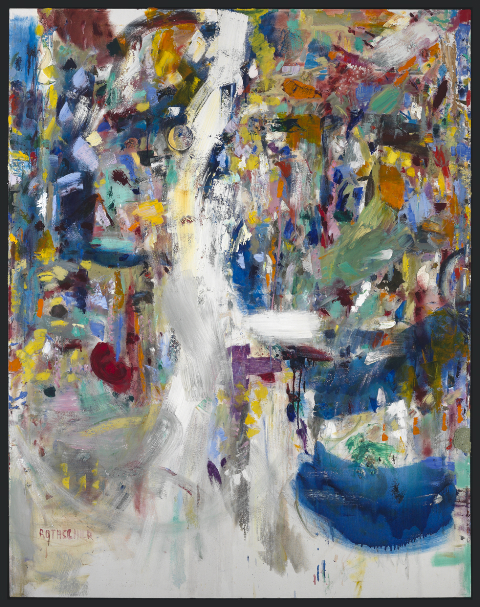 AFTER CHICAGO 2009 oil on canvas 96″x66″
Jo Ann is also my oldest continuous friend. I moved to her street when we were about four, and I still remember her throwing a hammer at the back fender of my bike as part of my initiation into the neighborhood. She was tough. I toughened up.
If I was a tomboy — climbing trees and catching spiders — what to call Jo Ann? When we played Roy Rogers and Dale Evans (*blush*), she was always Roy. When the boys played football, she was always devastated not to be allowed to play. She hated being dressed up in frilly girl clothes (although she later came to appreciate little black dresses) and saddled with the nickname “Missy,” bestowed to highlight the contrast with her older brother. Following stereotype you might deduce that she grew up to be a lesbian; you’d be wrong. She is the only female in her immediate family (husband, son), including the dog. She just thought the things the boys were doing, back then, were the really interesting things.
Like, art.
[At the Boston Museum School in the late 1970s] (Jo Ann writes), [a]n overwhelmingly male faculty taught an overwhelmingly female student body. The chief Boston art critic Ken Baker wrote almost exclusively about male artists. When he wrote about women artists his tone seemed snide. As a trial lawyer’s daughter I began to document, in a statistical way, the gender bias of the Boston art scene. In 1982 Art New England published my findings. They had to be edited because I was so shocked and angry. This created a little space for me. Not the publishing of the stats but my discovery that this is the world I live in, work in. This is what I’m dealing with.
I remember Baker’s calling one of my MFA classmates, Ralph Helmick, a “genius.” I had a show at Helen Shlein’s gallery around the same time and couldn’t even get a negative review. The ICA had an exhibition of Boston Artists that had only men.
Jo Ann could’ve remained “shocked and angry;” allowed bitterness to wither her work, or turn it polemical; blamed The Patriarchy for all her career disappointments (being an abstract painter in the ’80s wasn’t trendy, either). However, unlike some of the theorists I’ve cited above, she had . . . a sense of humor.
Sometime after [the all-male ICA show], I had the thought that the penis, this is the difference. . .
I thought about that until it seemed funny.
And so Jo Ann began to pen my favorite feminist tract:

I have loved this little book from the moment I saw it and have held onto a battered Xerox copy for many years, but now at last it’s in print, thanks to micropublisher Pressed Wafer and Small Press Distribution (SPD). Why do I love it? Because it’s funny. Because it says everything that needs saying about the other P-word in almost no words at all. Because the vulnerable hand-drawn line and iconic shape almost make the satirical edge caressing instead of cutting. Because it is so absurd (an all but one-gendered public world was absurd!) that it finally becomes endearing.
I am sure some of my readers will be offended by this little book, and by my love for it. How would you feel, they’ll say, if the types and roles of women were caricatured by cartoons of your genitalia? (I think it actually has been done, but with less class.) How is this a constructive contribution to relations between the sexes? Aren’t the religion parts downright blasphemous? Isn’t this trying to rekindle a war that’s over?
To them I can only say: please, try not to be as touchy and humorless as some feminists can be. (Note also that the book’s publisher, and the eminent museum curator who calls it a “little masterpiece” in his afterword, are male.) Indeed, this is a salvo in a battle that’s won in principle, if not yet over (and that could still be lost in many parts of the world, like Afghanistan). Indeed, Rothschild’s drawing of a phallic “Saturday Night Special” is aimed at a target that for us is largely in the past: at the likes of Norman Mailer, who, in Ancient Evenings (via a reviewer — I’d rather quote The Prisoner of Sex directly but can’t access it), asserted that “the Egyptian word medu . . . means both word and stick (or penis)” and equated “speech and storytelling . . . with male ejaculation.” Mailer was certainly one of those who qualified, by his own hand, for my old friend’s most piquant distinction:

The Mother’s Milk of Politics
The Las Vegas Review Journal reported today that Harry Reid raised $15M in political contributions for his campaign in 2009. It amounts to $7.50 for every man, woman, and child in Nevada and probably about $30 per voter, which seems to me an astounding sum when you consider that Harry wasn’t on a ballot in 2009. He spent $2M campaigning in the last three months of a year when he wasn’t running. All of this occurred in the middle of a deep recession before the Supreme Court struck down caps on corporate contributions. By the next election day, Harry might end up spending $45M running for office. If he gets 50% of the vote, he will end up spending an amazing $180 for every voter who actually presses the button for him.
Admittedly, the Nevada Senate raise is going to draw more attention and money than usual this year, but I believe these numbers are indicative of how much of our money is getting devoted to the political process.
At first blush, you might think this would lead me to favor imposing campaign spending limits. I might do so if I thought they had any chance of working. Instead, they invite massive evasion. I suppose disclosing how much Exxon or Bank of America gives to a candidate might help keep the public informed about who owes what to whom, but there are very few public servants who will not listen to the donor of $100,000.
Tiptoe Through the Tulips . . . [UPDATED]
. . . antagonize through the amaryllis.

My best friend from high school sent the basket with the bulbs for Christmas. All I had to do was add water, and KA-POW!!
J is looking unhappy only because I’m shooing Buzzy away. It’s for his own good. Buzzy wants to eat an amaryllis and I’m afraid it may be toxic. The amaryllis have the guest room all to themselves.
UPDATE: Nance, in the comments, makes the excellent suggestion to invite captions. So???
 Ambiance