Ash Cloud, My Ash??
The UK’s Mail reports something AbFlab (no! not flabby abs — absolutely flabbergasting):
Britain’s airspace was closed under false pretences, with satellite images revealing there was no doomsday volcanic ash cloud over the entire country. […]
[N]ew evidence shows there was no all-encompassing cloud and, where dust was present, it was often so thin that it posed no risk.The satellite images demonstrate that the skies were largely clear, which will not surprise the millions who enjoyed the fine, hot weather during the flight ban.Jim McKenna, the Civil Aviation Authority’s head of airworthiness, strategy and policy, admitted: ‘It’s obvious that at the start of this crisis there was a lack of definitive data.
‘It’s also true that for some of the time, the density of ash above the UK was close to undetectable.’
The satellite images will be used by airlines in their battle to win tens of millions of pounds in compensation from governments for their losses.
If you’re thinking this is Climate Change Redux, I’m seeing it a bit differently. The key passage for me is the one that comes next:
The National Air Traffic Control Service decision to ban flights was based on Met Office computer models [emphasis added] which painted a picture of a cloud of ash being blown south from the Eyjafjallajokull volcano.
These models should have been tested by the Met Office’s main research plane, a BAE 146 jet, but it was in a hangar to be repainted and could not be sent up until last Tuesday – the last day of the ban.
Evidence has emerged that the maximum density of the ash was only about one 20th of the limit that scientists, the Government, and aircraft and engine manufacturers have now decided is safe.
Based on computer models. Huh!
Have you ever noticed how the very same trends play themselves out in miniature in our personal lives and writ large on a national and even global scale?
Debt, for instance: household debt and national debt mushroomed in tandem, manifesting the exact same Scarlett O’Hara, “I’ll think about it tomorrow” mindset individually and collectively.
When I think of a whole country’s airline system shut down on the basis of computer models, what I see is all of us hunched over, faces pallidly lit, scrying our computer screens instead of looking out the window . . . or walking out the door.
(Thanks to reader_iam for the tip.)
Facebook is Square.
They wouldn’t upload this:
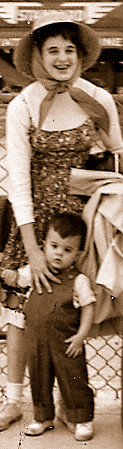
— which I clipped from a larger family picture as proof that me and my bro True Ancestor go back a long way. “Too tall or too skinny,” Facebook said. (The picture. Not its subjects.)
Squares.
[The date is March 1961, and yes, that’s a mouthful of braces.]
Cats and/or Furniture?
I maintain you can’t have both — magnificent, intact feline predators and magnificent, intact furniture. A declawed cat is not a cat, and a clawed Chippendale is . . . well, you get the picture.
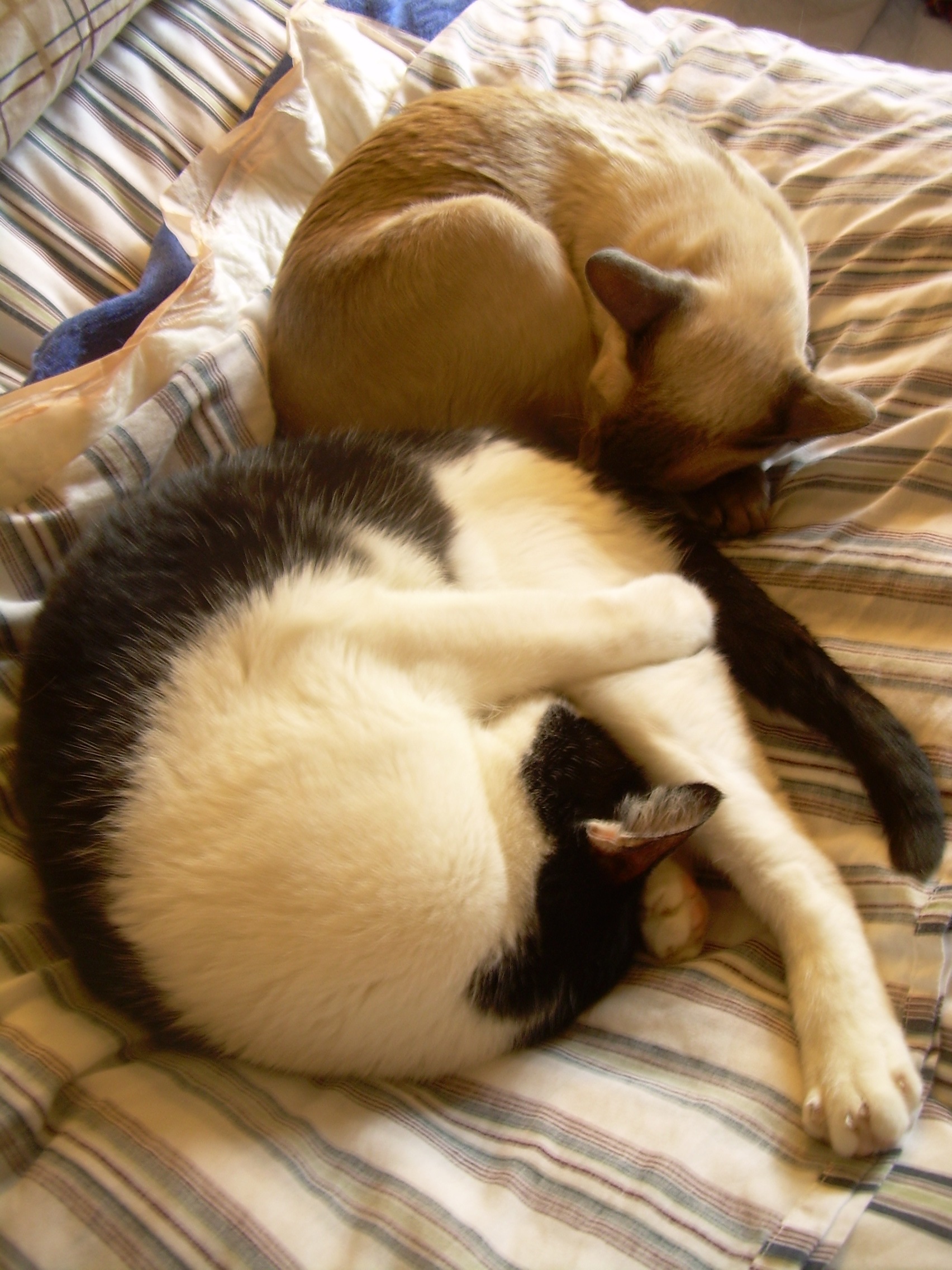
Today, though, Dito (short for Bandito), seen here sleeping off his accomplishment [b&w], gave the lie to that assertion.
We had a table that was really very inappropriate for a house with cats (and would have been an extreme hazard in a house with children). It was a heavy disk of glass, 3.5 or 4 feet in diameter, resting unsecured except by its own weight on top of a sturdy openwork base. Nathan, our karate teacher friend, had bought it and four really beautiful matching bentwood safari chairs at a flea market. He and his former wife weren’t using them, and gave them to us when we first moved here.
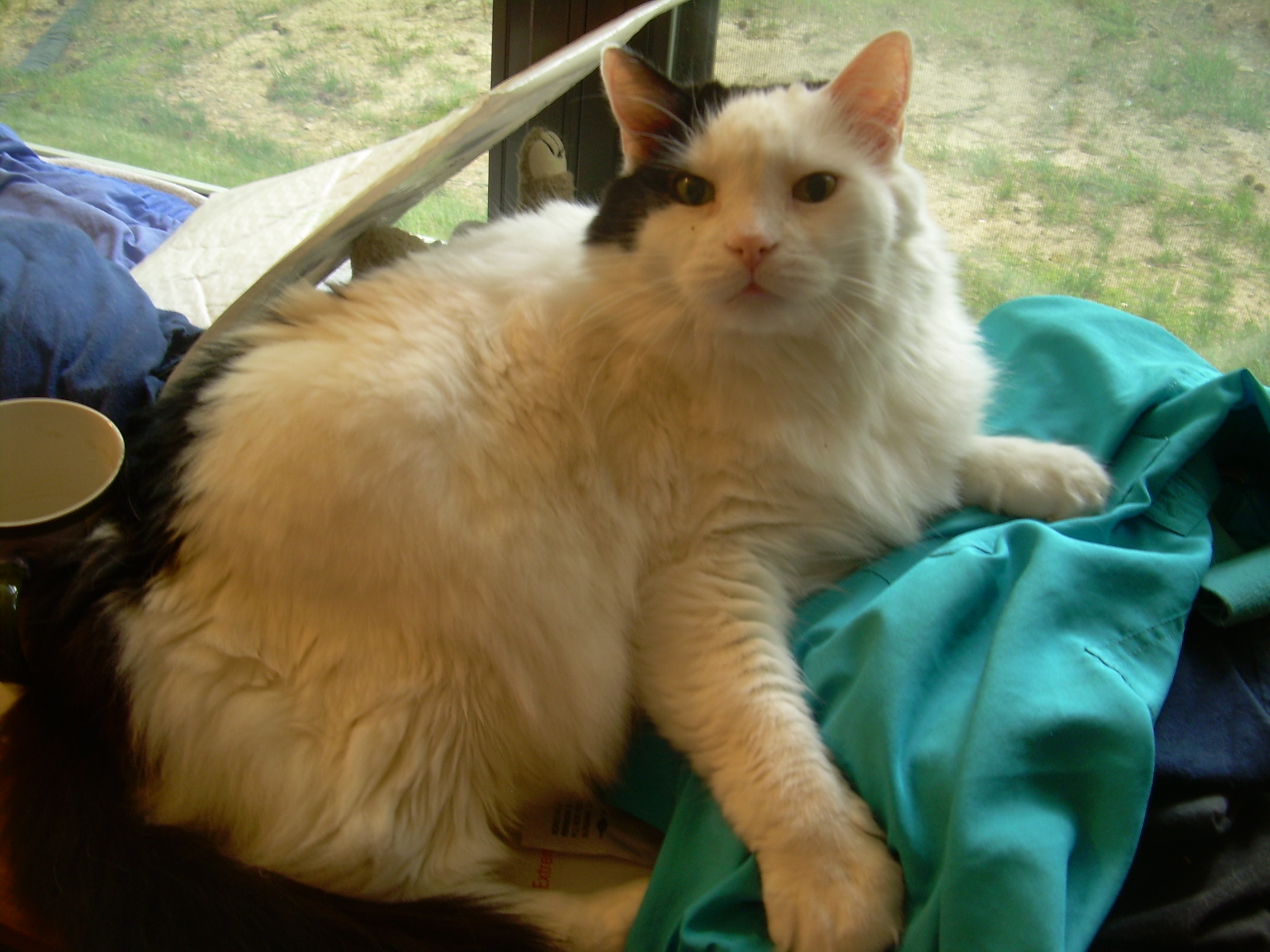
It’s amazing it lasted this long, what with the disk tending to edge unnoticed off-center under the tablecloth, and cats jumping on and off it. (Table-trained, these guys? To stay off it, I mean? Are you kidding?) There have been a few close calls, including one in which Buzzy landed on the near edge and flipped the disk into my arms. Pause for a visual of Buzzy:
But the mountain of book boxes that’s still piled against the dining-alcove wall six months after the fire was the last straw. I made the mistake of calling Dito down from the mountain in a let’s-play voice, and he dived melodramatically off the boxes onto the rear arc of the glass top. It flipped backwards, crashed to the floor, and shattered into a million pieces, ranging in size from guillotine blade to razor blade to sliver to dust. Cats, of course, are long gone before whatever it is hits the floor.
I called Dito every name in the book (even though it was not his fault, it was my fault for trying to have both cats and temperamental furniture) as I plucked and swept glass into cardboard boxes that I will probably have to drive to the town dump, and then vacuumed, vacuumed, vacuumed. Nathan and his girlfriend were coming to dinner, and Nathan had e-mailed me to ask what they could bring. I said, “A table.”
I was kidding, of course. What I really meant was, “Don’t come to dinner, I am in no mood to cook.” But Nathan anticipating being fed is an unstoppable force, so he said, “Okay!” And within a couple of hours showed up with this.

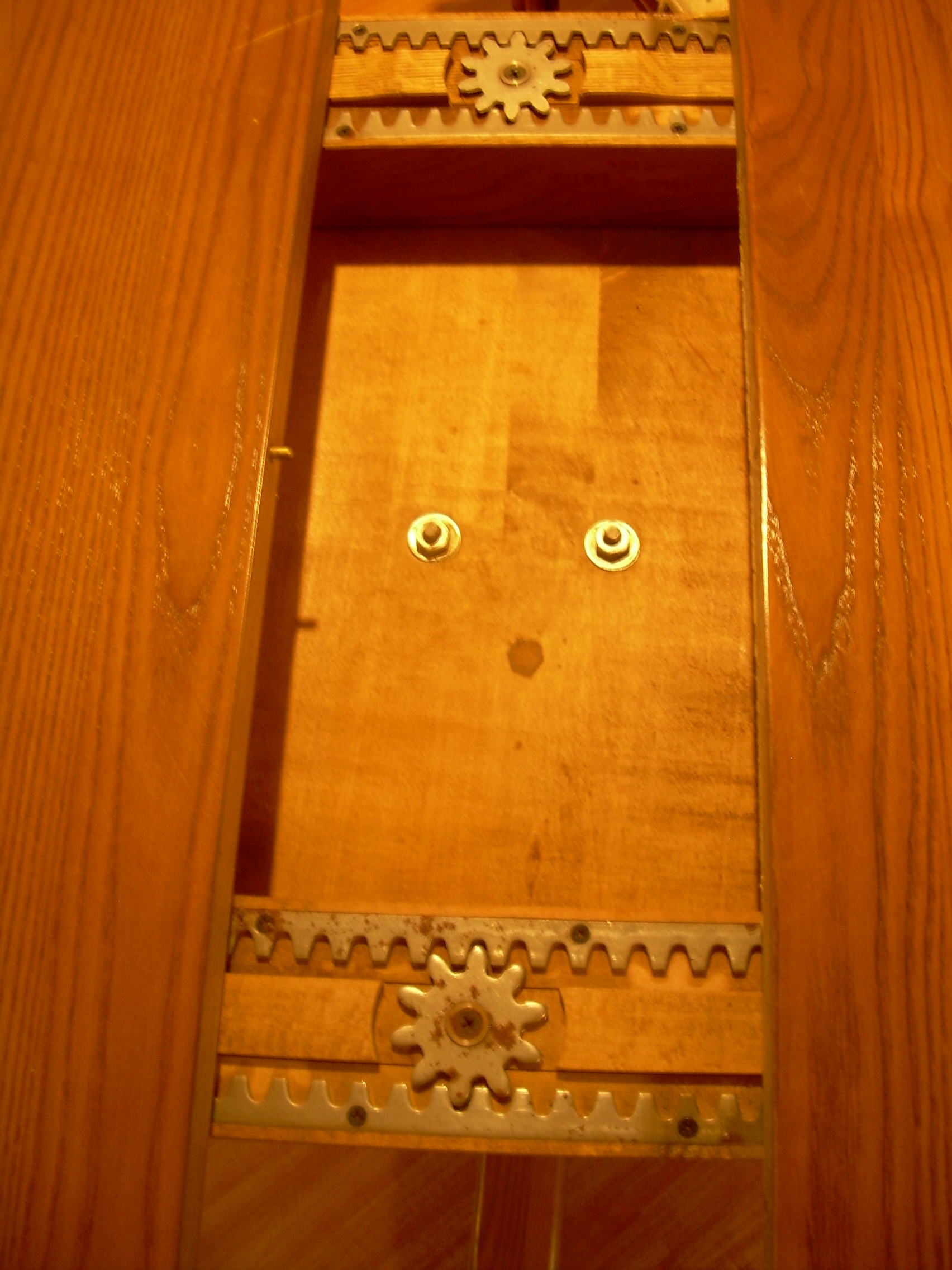
(That would be an Althousian photo, with the laptop and all, if it weren’t blurry.) This very solid pedestal table, with only minor dings (which for all I know we put on it getting it through the front door), has a leaf and is expandable. The mechanism for opening it up to insert the leaf is a thing of beauty, with little flat gears that turn as you slide the halves apart:
The table is the same size as the old one — J’s knees and feet even fit under it — but much more solid and cat-friendly. Nathan got it at the Habitat for Humanity store for $75. It has all the earmarks of a conspiracy; he and Dito have been in cahoots for a long time.
See, you can have both cats and furniture — as long as you let the cats pick the furniture.
Dito got a kiss and an apology. Nathan’s getting dinner.
Hungary Post-Elections: Our Fun-House Mirror?
Hungary could not be more different from the United States, yet the push and pull among corrupt Socialists, populists, and the Right feels eerily familiar.
What the Socialists did was catastrophic. For eight years they governed they steered the country on a zigzag course. All their attempts at reform failed, the budget in Hungary was so poorly managed that Hungary was hit extremely hard by the global economic downturn. But you could not really call them a socialist party. They no longer uphold socialist values. Behind the mask of socialist slogans lies an authoritarian pattern. This is the legacy of the Kadar regime: a caring state which tolerates no opposition. And again, it was riddled with corruption which inculpates the socialists in power.
* * *
The party political struggle became nothing but a front for the battle for cash.
* * *
[Y]ou shouldn’t be surprised at [far-right populist party] Jobbik’s popularity when desperate family men are constantly being laid off only to be rehired under worse conditions. The Europeans should not just look for the easy way out now by simply distancing themselves from these genuinely abhorrent neo-fascists. These people were not born that way.
* * *
The country is heavily in debt and in need of radical reform – in education, health, pensions. The bureaucracy is absurdly inflated. A third of the population lives off the state.
Hmmm. My friend Casselman the Prairie Editor sees omens and lessons for America in the upcoming British elections. Yesterday on NPR while driving the van I heard Bolivian president Evo Morales kick off the alternative climate summit at Cochabamba by saying, “Capitalism dies or Mother Earth dies. Capitalism lives or Mother Earth lives.” These shifting winds are blowing around the globe.
A Walk in the Park
Like a root cracking cement, Chapel Hill is starting to get through to me. It’s taken three years, but I’m beginning to feel as if I live someplace besides just Planet Jacques. My fractured mental map of this place, isolated snapshots from frazzled forays out to fetch this or that and rush back home again, is beginning to fuse into some kind of whole.
With me it’s not the culture (though I’m starting to be interested in that, too), it’s the nature. I grew up in a city, Chicago, that at the time had a lot of big old trees and weedy wilderness left in its back alleys, back yards, and empty lots. This is like that, only the town is much smaller and the green is bigger. Whether by accident or design, or a combination of the two, there’s a lot of greenery streaked through the town — parks, leftover woods, greenways for biking and jogging built under the streets where, except for the distant swish and growl of cars, you can feel as if you’re deep in the country. It’s reawakening the nature nut I was as a child.
Pushing Jacques along the Bolin Creek Trail greenway this afternoon, I kept stopping to examine things, locking J’s brakes so I could stray off the path, peering up into trees to try to locate and identify singing birds. I made the unoriginal discovery, new to me, that birds of the same species make the same call very differently — they have individual voices. Why don’t I know any of these trees’ names? It seems as rude and alienating as not speaking a word of the language of the country you’re living in. I found myself wanting to find the binoculars I won on Wheel of Fortune, wanting to get bird and tree field guides, or maybe to find a local botany course to take. Natural History, baby! Got the name, might as well have the game!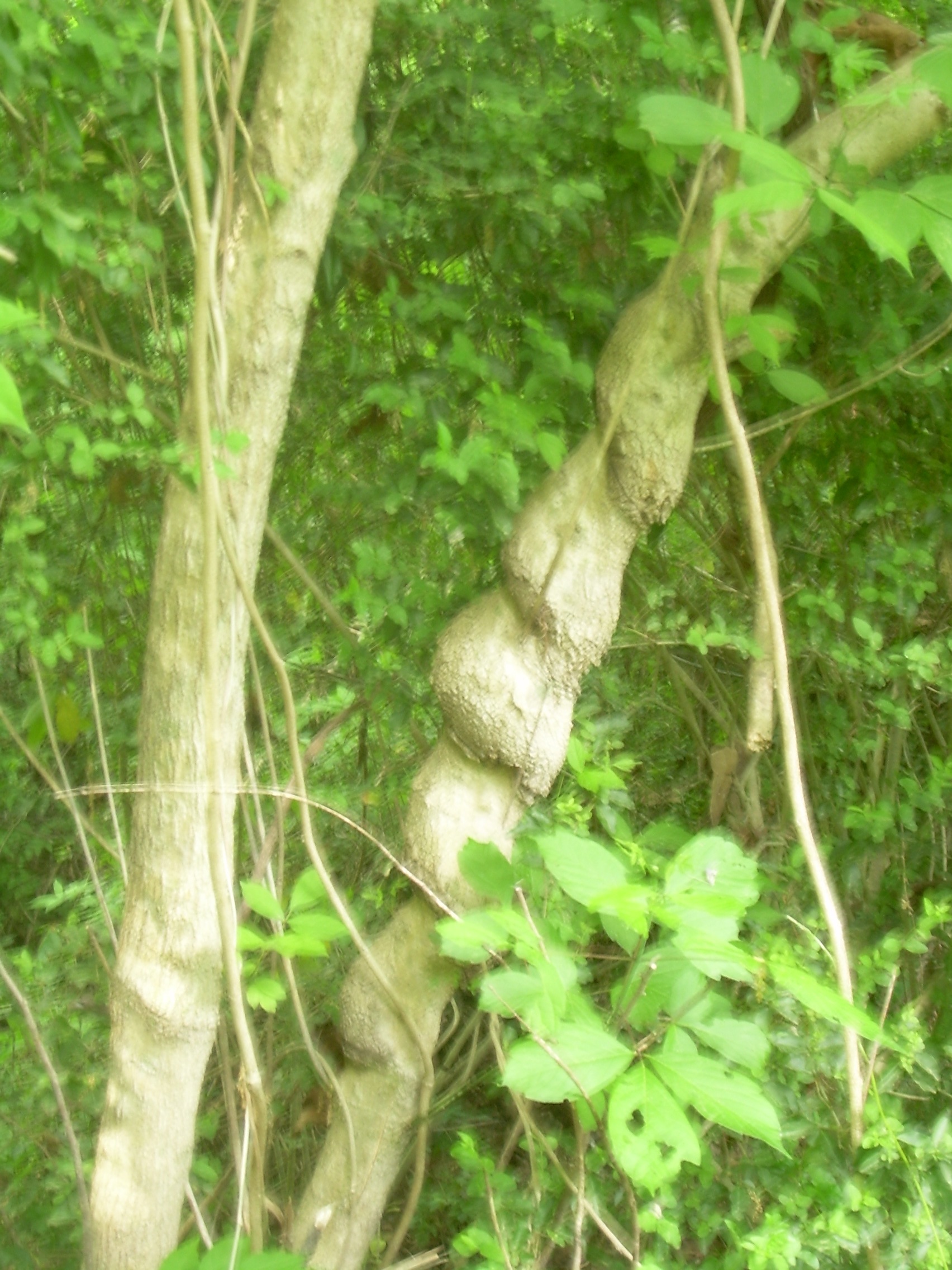 North Carolina is very jungly, and probably was even before the introduction of kudzu, which now blankets and smothers everything, making bushes into tempting dark tents you want to crawl under. The tree on the right has been pythonized by and has fused with some kind of vine. Has the vine replaced the tree, or has the tree engulfed the vine?
 “Bolin Creek” is probably as much a sewer as anything, but it’s pretty anyway. It must swell enormously after a rainstorm, from the height to which its banks are carved out and tree roots like these exposed. We want to walk over (it’s all of about two city blocks from home) someday right after a big rain to witness one of these flash floods.

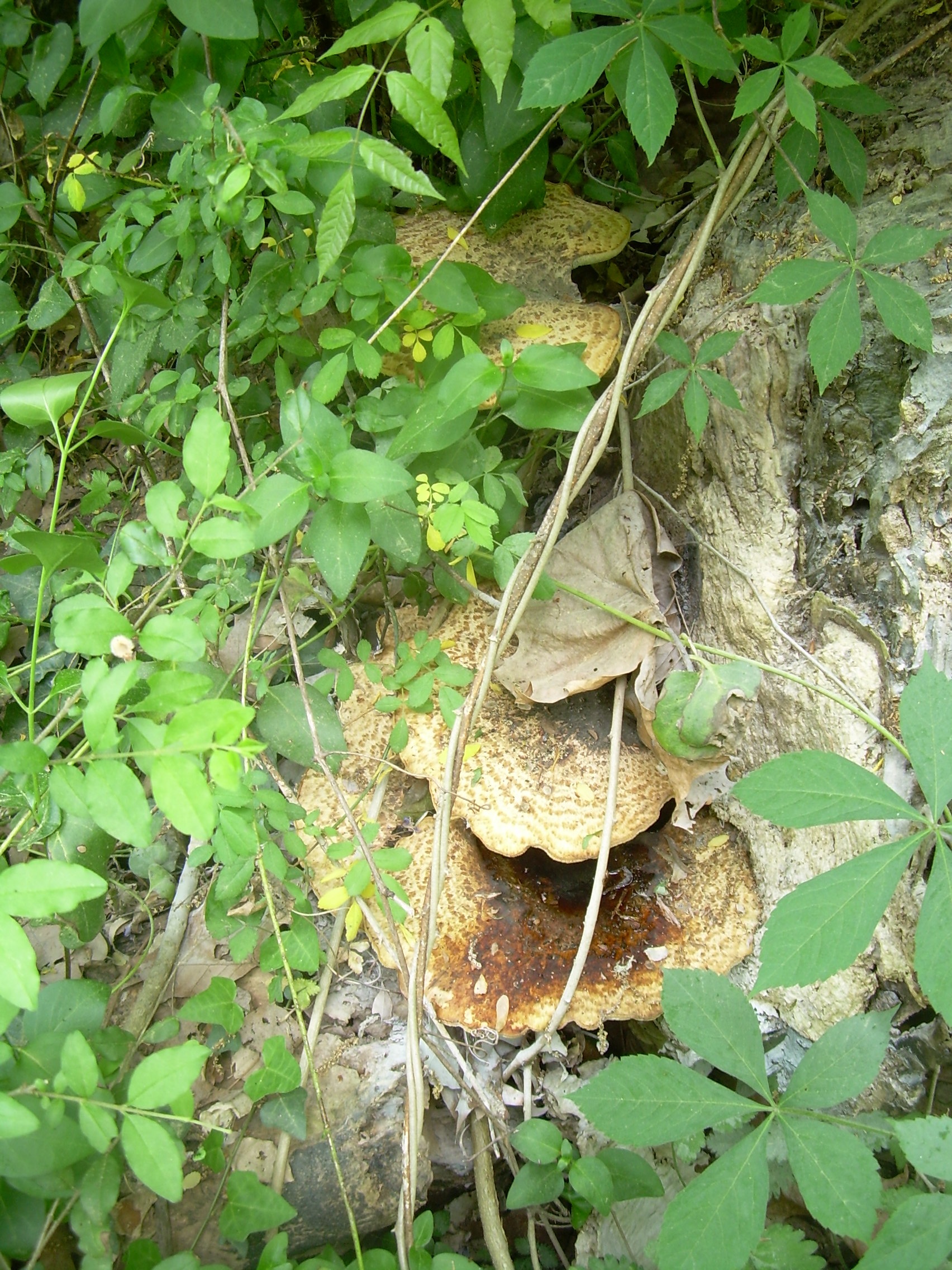 There’s a fungus among us.

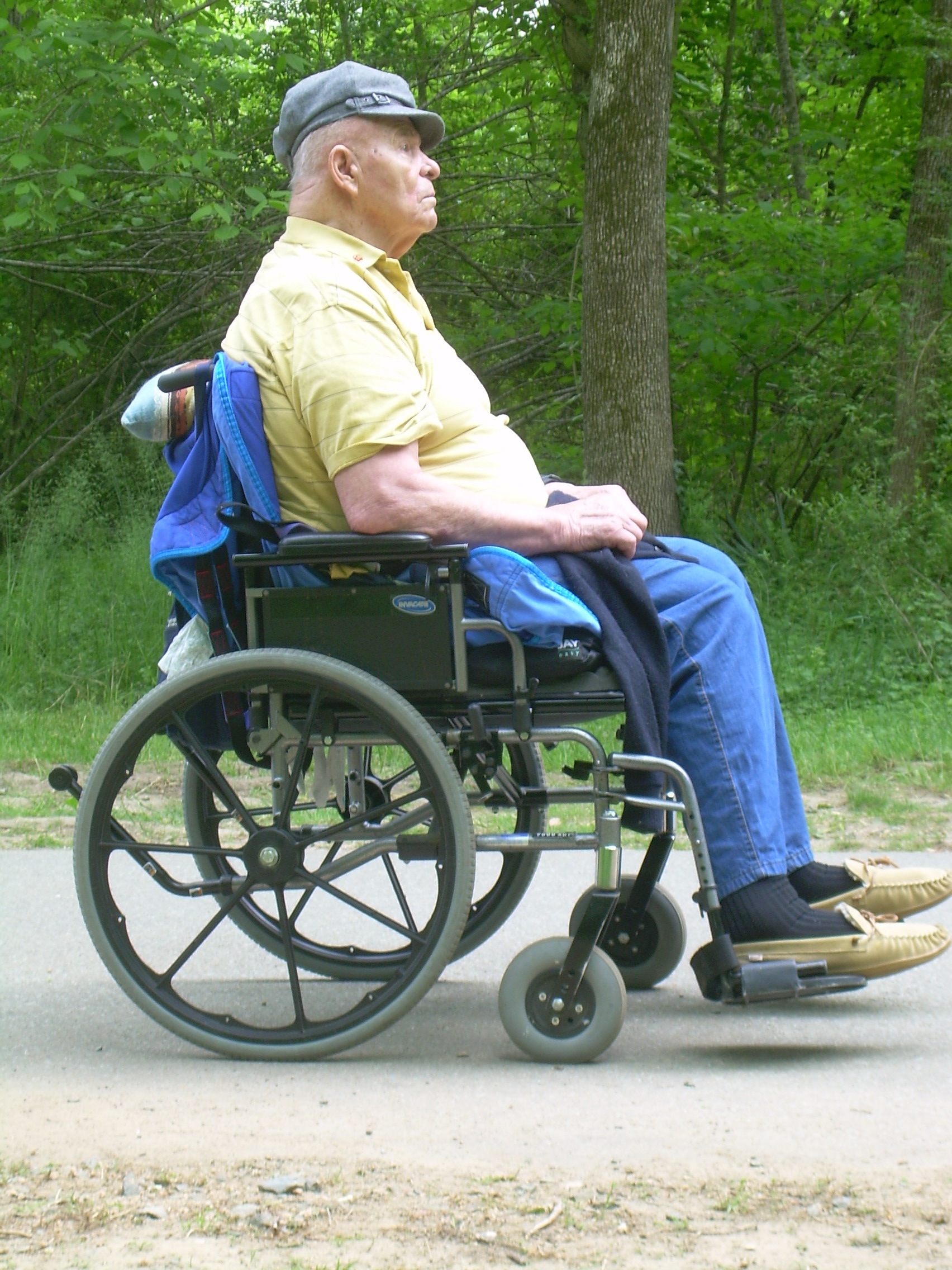


Photographic History
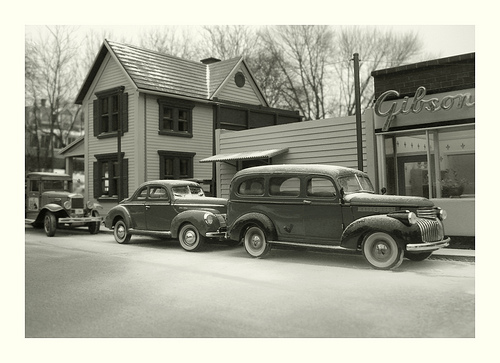
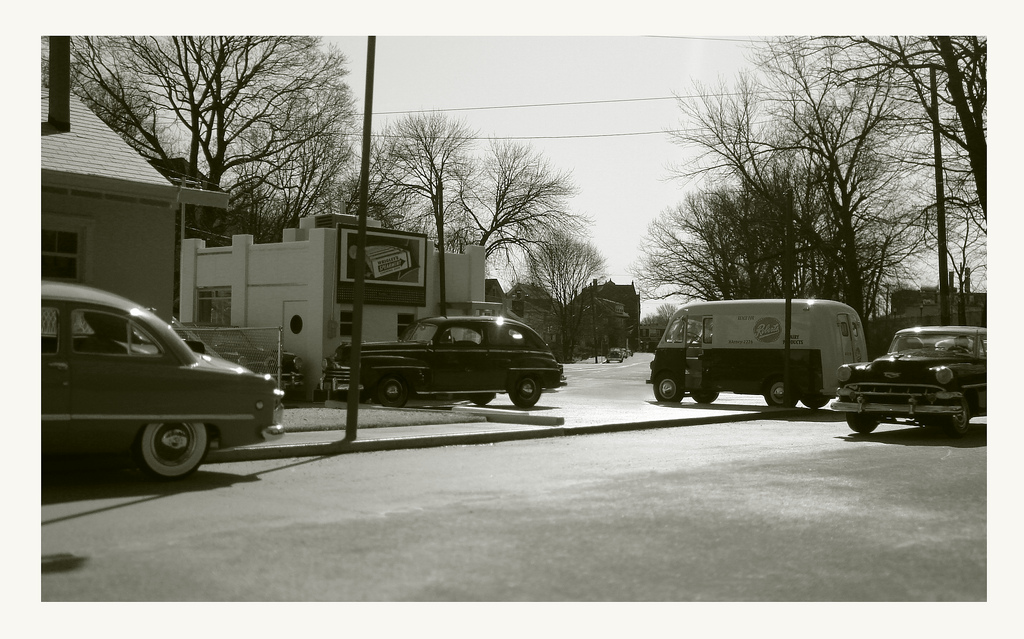
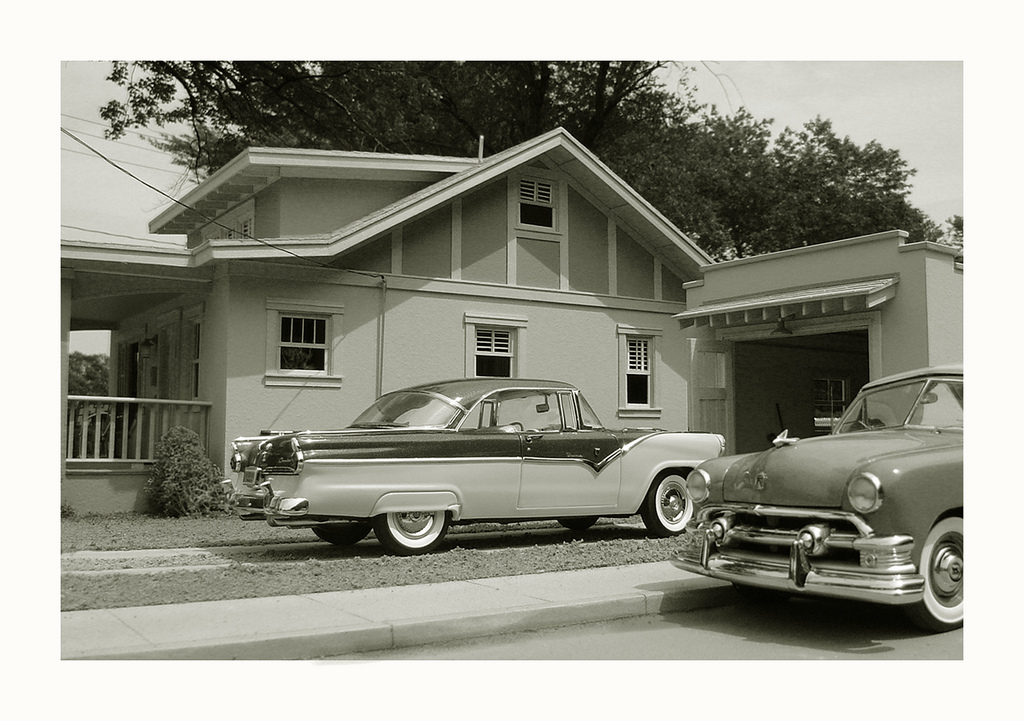
Take a gander at these B&W photos of some cars of yesteryear and then read “the rest of the story” under the fold.

Food for Thought
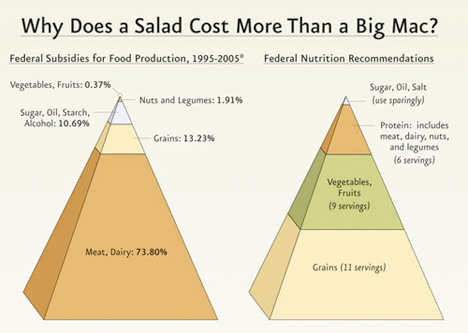
Chart from Physicians Committee for Responsible Medicine (a group that links animal rights to human health), via David Kekich of Maximum Life Foundation:
When you look at federal subsidies for food production, here’s what you find:
- Meat/Dairy 73.8%
- Grains 13.2%
- Sugar/Oil/Starch/Alcohol 10.7%
- Nuts/Legumes 1.9%
- Vegetables/Fruits 0.4%
97.7% for foods that make you sick vs. 1.9% for nuts and legumes and a pathetic 0.4% for the healthiest foods.
Think this has anything to do with why Americans are obese?
The average 18-year-old today is 15 pounds heavier than an 18-year-old in the late 1970s. Adults have put on even more weight during that period. The average woman in her 60s is 20 pounds heavier than the average 60-something woman in the late 1970s. And the average man in his 60s is 25 pounds heavier.
And unhealthy? PCRM quotes the 2006-2007 Annual Report of the President’s Cancer Panel:
[C]urrent agricultural and public health policy is not coordinated—we heavily subsidize the growth of foods (e.g., corn, soy) that in their processed forms (e.g., high fructose corn syrup, hydrogenated corn and soybean oils, grain-fed cattle) are known contributors to obesity and associated chronic diseases, including cancer.
“Not coordinated” is a delicate way of putting it — how about “rampant hypocrisy”? Not even conscious hypocrisy — the federal bureaucracy is itself so obese that its right hand and left hand are no longer remotely in touch.
Scolds on both the right and left blame our lack of self-control and “personal responsibility” for obesity. Sure, that’s a factor, but it’s also a plain fact that many people couldn’t afford to eat healthily if they knew how and wanted to. The next chart shows the direct impact of government subsidies on food and beverage prices: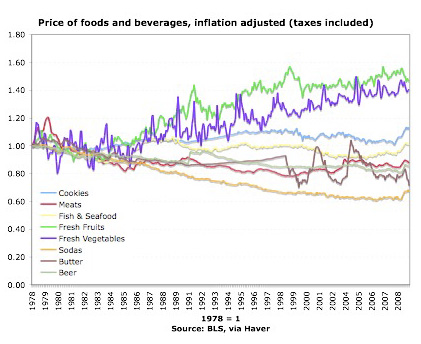 These policies have made simple healthful eating a gourmet experience — a luxury for the affluent, educated elite, who then scold and despise the less affluent for their “lack of self-control.”
(I’m very aware of this problem because I’m in the middle: I insist on eating healthily, but it means I spend way too much on food, even though I almost never splurge on organic unless it’s marked down. I probably spend close to $1500 a year just on romaine lettuce and apples, never mind the whole-grain artisan bread. We used to eat blueberries by the bucket, like bears, in summer when they were 99 cents a pint. I buy them now, maybe, the one week in summer when they get down to $1.50. The rest of the time, they’re an expense I can’t justify — $3.99 a half pint.)
Jeff Nield of Treehugger suggests that the solution would be to subsidize fruits and vegetables too; David Kekich of Maximum Life Foundation counters, “Better yet, let’s just get the government out of subsidies altogether, and let the markets and your health find their natural levels.”
Related: a new study shows that the same metabolic pathways in yeast, fruit flies, mice, and humans respond to calorie restriction in ways that protect against cancer-causing mutations and prolong life.
Luigi Fontana, MD, PhD, and his co-authors . . . write about how cutting calorie intake between 10 percent and 50 percent decreases the activity of pathways involving insulin-like growth factor (IGF-1), glucose and TOR (target of rapamycin), and considerably increases lifespan in animals.Genetic mutations involved in those pathways have the same effect. Those animals have far fewer problems with diseases related to aging, such as cancer, cardiovascular disease and cognitive problems.
“About 30 percent of the animals on calorie restriction die at an advanced age without any diseases normally related to aging,” Fontana says. “In contrast, among animals on a standard diet, the great majority (94 percent) develop and die of one or more chronic diseases such as cancer or heart disease. In 30 percent to 50 percent of the animals on calorie restriction, or with genetic mutations in these aging-related pathways, healthspan is equal to lifespan. They eventually die, but they don’t get sick.”
Unfortunately, many humans are moving in the opposite direction. As obesity reaches epidemic rates in Western countries, Fontana says rather than closing the 30-year gap between healthspan and lifespan, the gap is likely to grow. It’s even possible lifespan may decrease as people develop preventable diseases such as atherosclerosis, type 2 diabetes and certain forms of cancer.
Those growing rates of obesity are a reason some scientists think calorie restriction will never catch on, regardless of its potential benefits.
Severe calorie restriction is no fun, and it has side effects such as loss of muscle mass, “reduced libido because calorie restriction reduces testosterone levels,” and sensitivity to cold, because metabolism slows and core body temperature drops. It gives new meaning to the old joke, “Your life may not be longer, but it will feel . . . much longer.” But the scientists are hoping “it may be possible to develop less drastic interventions or medicines that influence [the same molecular] pathways affected by calorie restriction and help keep people healthy as they get older.”
In the meantime, there is surely a happy medium. But one thing is crystal clear: our government’s preventive health policy is doomed by its own agricultural policy.



 Ambiance