Goodbye, Cousin.
This picture was taken yesterday in the van at the airport, just before Christian went to catch his plane to Philadelphia and from there to Frankfurt.
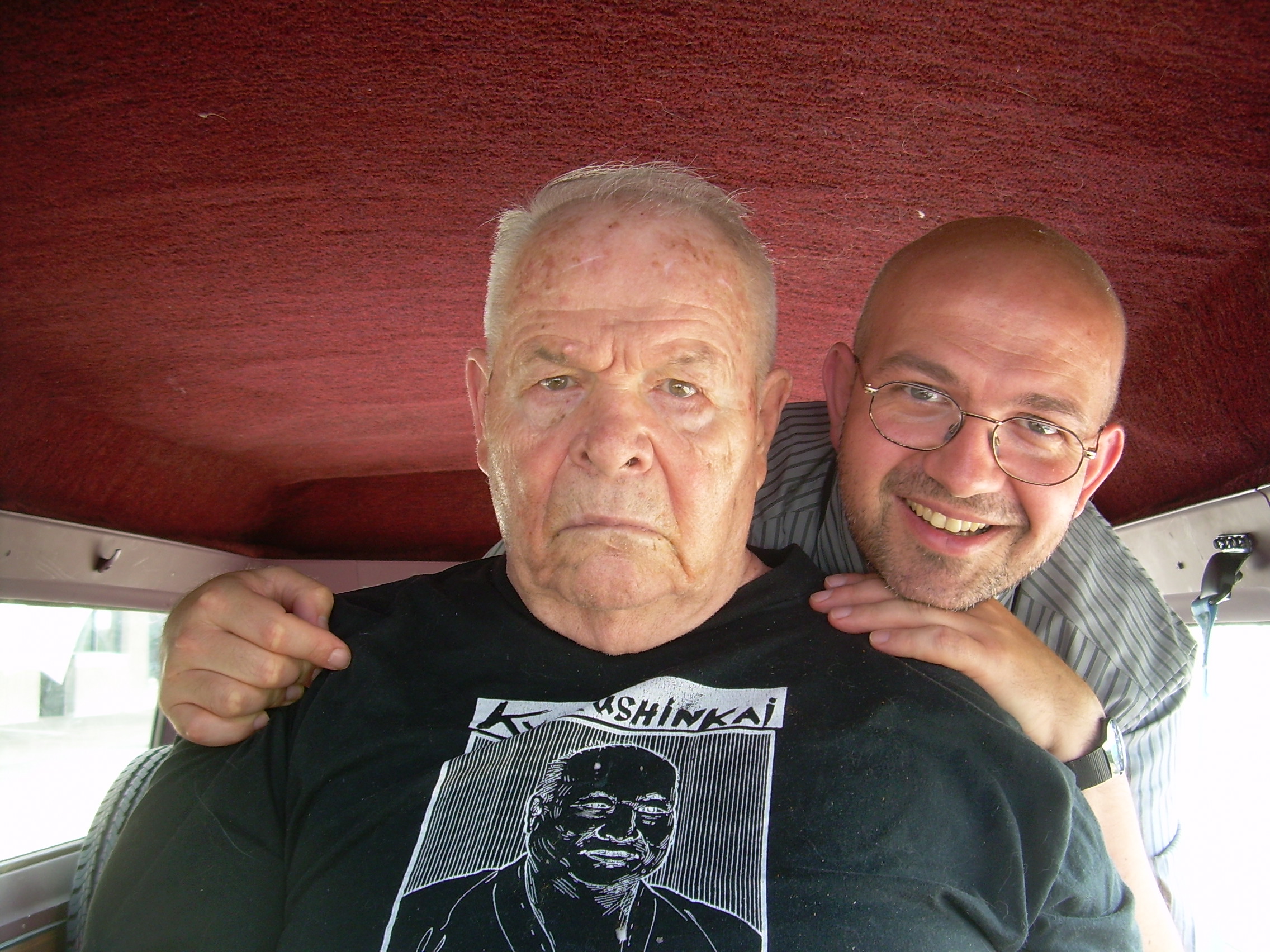
Jacques was a little out of it and didn’t quite seem to get what was happening. Or didn’t want to.
Christian stayed with us for almost two weeks, during which he cheerfully came and went, exploring the town, going salsa dancing, renting a bike and a car, driving all the way to Cape Hatteras on the Outer Banks and back, reporting on his adventures. I cooked, he bought pizza and lasagna, and, as the visit wore on and his early resolve to lose weight gave way to some kind of emotional fatigue and comfort need, he brought home Coke and potato chips and chocolate and Danish. Which I found endearing.
Notice I said “home.” This is the longest continuous visit or proximity we’ve had with anyone in years, certainly in the four years we’ve been in Chapel Hill. (He had one of those lavish European vacations.) Most of our two handfuls of treasured visits have been for a night or two. Probably because Christian is family and we’ve known him since he was a kid, and because he’s a cheerful, energetic, affectionate person as well as (now) a keen and worldly grown man, it seemed completely natural and comfortable — and comforting — to have him here. I woke up this morning assuming that warm wall of presence, shouldering out the infinite, still closed off the far end of the apartment and my consciousness. It felt strange to realize it was gone.
For the most part I don’t get avidly attached, don’t latch on to people. I have too bone-deep a familiarity with the futility of it. (Maybe that’s what aborting your only child can do to you.) It was so unusual to experience something so usual — simply having another person living with us. He didn’t try to be super-helpful with J, though he was in small ways, nor did I ask him to be. That I would not have wanted to get used to. (I have dared to become dependent on the hospice ladies’ three-times-a-week physical help, because it seems like it isn’t going away, though it could.) It was the casual, steady company that was such an unaccustomed luxury.
Only this afternoon, as I was in the kitchen rinsing dishes, did it occur to me that he must be long since safely home. (Air travel is so remarkably safe that on the very rare occasions when anything goes wrong, the whole world hears about it.) I wondered how the trip had been and whether I’d soon get an e-mail from him. Within three minutes of that thought, he called.
What Will People Think?
My mother always advised me not to worry what people think. Of course I questioned her advice — what would happen if I really didn’t care? And of course she didn’t mean what she said. She was really just rebelling against old fashioned conservative ideas. Worrying about what people think used to go without saying, because the social group was always more important than the individual — the whole was more than its parts. And that has probably been true in every society — human or animal — except for our modern liberal society. Now the parts often seem to be valued more than the whole.
But not really. We all care, very deeply, what other people think. We might not worry about it consciously, but our subconscious mind is always hard at work, paying careful attention to the infinitely intricate and subtle details of social life. We must resonate with some kind of social context. When liberals like my mother say they don’t care what the neighbors think, they actually mean they don’t care what the old-fashined conservative neighbors think.
People who really don’t care are the ones who don’t resonate with any social group. And they are, by definition, insane.
An old belief said that each society, human or animal, has its group mind. The group minds, or “over souls,” might exist on every level. Each village could have its group mind, and so could every household. In other words, I am talking about gods. A god is a unifying force that holds societies, and sub-societies, together.
So if you resonate with modern liberal humanism and atheism, for example, your subconscious mind is a devoted worshiper of a god that rules over that belief system and holds its followers together.
Music To Drive By
Retriever asks for recommendations of good driving tunes to keep her and her co-drivers awake and happy.
Here’s the list I posted for her:
Charlie Mingus – Moanin’
Something fast light and airy from one of the elli’s (Locatelli, Corelli, Torelli, et al)
Grateful Dead – Deep Elem Blues
Nitty Gritty Dirt Band – Will the Circle Be Unbroken
Pump Boys & Dinettes – Vacation
Mormon Tabernacle Choir – The United States Marines Hymn
Mormon Tabernacle Choir – Hallelujah Chorus (despite bad video and spelling, it’s pretty good audio)
The Beach Boys – Barbara Ann
Earl Scruggs & Steve Martin – Foggy Mountain Breakdown – be careful… this one tends to encourage speeding!
Another one that triggers lead foot syndrome is the Ventures’ Wipeout.
John Philip Sousa – Stars & Stripes Forever
Janis Joplin – Brand New Key (I’m not sure what the title is… I got a brand new pair of roller skates, you got a brand new key…
Warren Zevon – Werewolves of London
Marty Robbins – Ghost Riders in the Sky
Roger Miller – King of the Road
and… as an afterthought for 55 mph driving: Massenet’s Meditation from Thais.
So…. what’s your favorite driving music?
Also posted at Opining Online.



Visitor
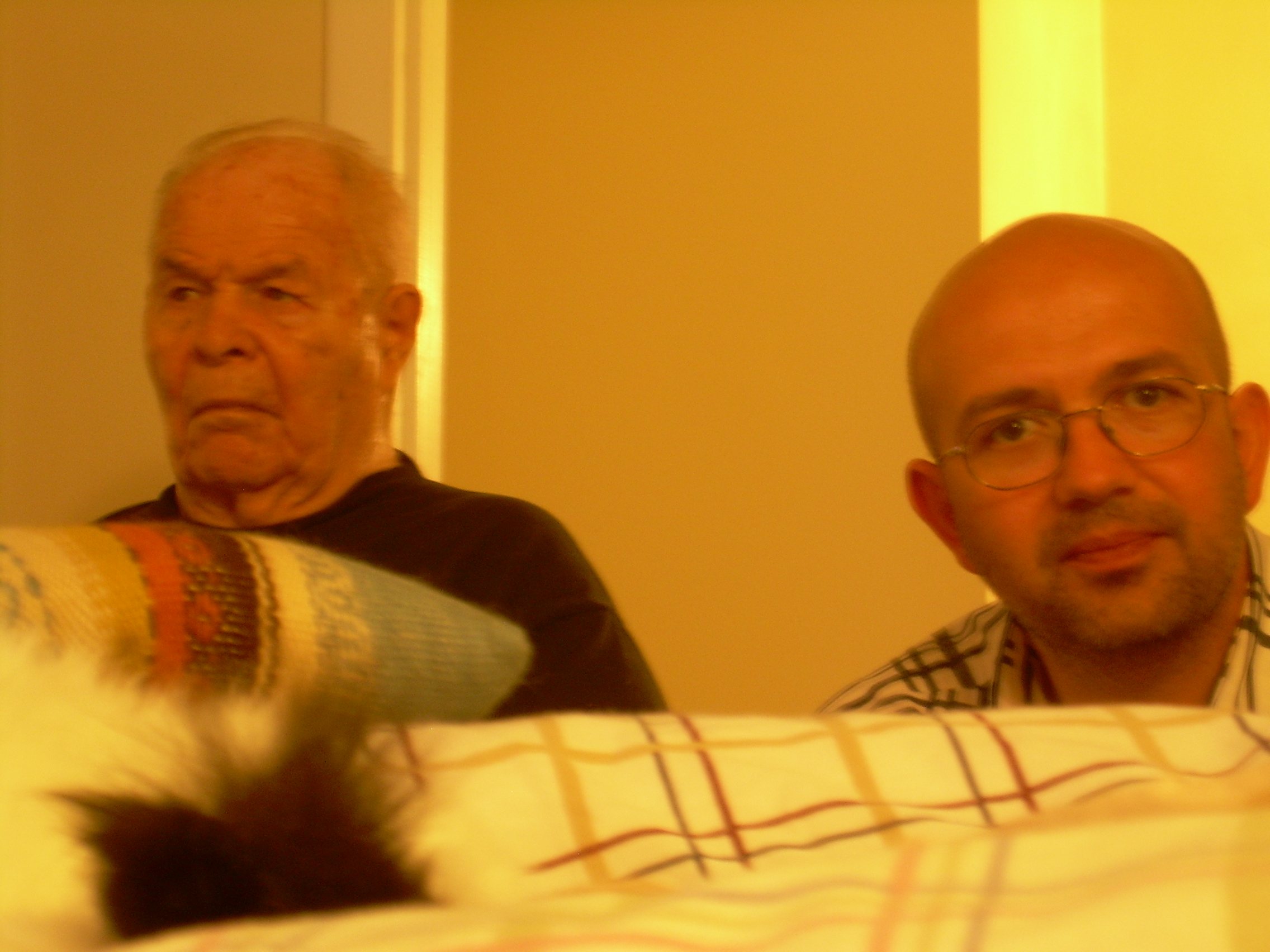
This view from our bedroom window is (*yawn*) absolutely nothing out of the ordinary . . . unless you lived in Manhattan for 40 years.

The Best Advice
The single best protective amulet you can give someone leaving on a long drive is this warning/reminder:
If you get sleepy, DON’T try to fight it. Pull off the road as soon as you can and take a nap.
I realized the importance of the advice when I fell asleep at the wheel just driving J back from a swimming pool less than half an hour away. (I know I’ve told this story before. It made a big impression. And it bears repeating.) I was chronically sleep-deprived in those days, and there was something about having been in the chilly water for an hour and then getting in the warm van, eyes gritty with chlorine . . .
It is amazing how powerful the brain’s drive to sleep can be. It will shut down in complete disregard for the fact that you’re hurtling along in sole control of a two-ton hunk of metal, with others hurtling around you and towards you. The brain HAS to sleep when it has to sleep.
I didn’t believe it. We were only 15 minutes from home! I figured I could have coffee before we left and then pinch my upper lip, slap myself in the face, turn up the A/C, if I still felt sleepy.
WRONG.
Fortunately I felt myself fall asleep. It was like watching myself vanish, like the Rapture: my hands vaporized off the wheel, the driver’s seat was empty . . . the van started to veer into the oncoming lane, and I yanked myself back out of the void before any harm was done. But I vowed never again to ignore the demand for sleep, even if it meant pulling into a mall parking lot ten minutes short of my doorstep.
Our cousin rented a car and drove all the way to Hatteras Light and back today, close to ten hours on the road, getting home at 1:30 A.M. I gave him this advice before he left, and he reported that it was “golden.” Somewhere east of Rocky Mount, he stopped at a gas station and took an hour’s nap. He got home in one piece. I’m not saying he wouldn’t have if I hadn’t reminded/warned him, but it surely upped the odds. This is the best parting gift you can give an automobile traveler you love.
More thoughts on visiting the old and sick

St. Zita, Patron Saint of Housekeepers and Caretakers
I felt sufficiently guilty of my own failings in visiting elderly relatives with various degrees of dementia in the past that I couldn’t quite bring myself to comment on Amba’s last post, Why? Why?. I grew up knowing well many of my great-aunts, my maternal grandfather’s sisters. One was a little “off” her whole life, and the only thing I remember of her from my youth was trying to avoid her, because she would pinch my cheek every time I walked by, and just say very odd and random things. I only learned later that she was a fantastic cook, and I wish now that I had been more willing to face the craziness and follow her around in the kitchen. Another aunt, Le-le, was the only one of the sisters who married. Her husband died long before I was born, and she lived alone in her house for many years. I used to love to visit her house; she was fun to talk to, and she always gave me a cold bottle of Coca-Cola. But she had to go into a home for the last few years of her life. Teenage me, self-absorbed and uncomfortable with death and old people and hospitals, I think I managed to visit her just one time. I’ll always regret that.
My grandmother lived to be 93 years old (1903-1996), and was physically healthy as a horse the whole time. But the last 4 or 5 years she spent in a nursing home far from her own home, in the town where my aunt, her oldest daughter, lives. I was better about visiting granny; I would readily go whenever my mom suggested I go with her. But I was still so selfish; though passing through that town on a regular trip I made several times a year would have only taken me an hour or so out of my way, I think I stopped to visit her by myself only once or twice. I was in law school, then a young lawyer, but it wasn’t that I didn’t have the time — it just made me uncomfortable. She didn’t have full-blown Alzheimer’s. Men tend to have a fairly rapid onset of dementia, a short period of transition before getting pretty bad. Women are more likely to slowly slip down the path; that was my grandmother.
Her husband, my grandfather, was in some ways the opposite. His mind was strong until the end (he died in 1985, when I started college), but his body was confined to a bed for the last 7 years of his life. He had been a strong man all of his life, over 6 feet tall, a small business owner, a man’s man. But stomach troubles followed by a not-fully-successful surgery left him bedridden and on a colostomy bag for 7 long years, weak and dependent entirely on my grandmother for his care.
I did visit him fairly regularly, if only because he stayed at home the whole time, and I visited my granny often. But it was hard to see him like that, so far removed from the man I had once known, the man who would chew on a cigar as he gave me a penny to put in the weight and fortune machine.
Why do we tend to so avoid the old and frail and demented? Selfishness is a big reason, of course. Visiting those folks doesn’t promote our career or better our chances of getting good Christmas presents. We don’t really get the joy one gets from a stimulating conversation.
Visiting them also makes us uncomfortably aware of our own mortality. That could be me lying there, and probably will be one day. We don’t want to confront our own frailty and mortality, so we avoid reminders of it.
But I think there’s one more factor. None of us want to appear sick or weak to other people. We, and men especially, hide our weaknesses, carefully controlling the few people we allow to see them. Whether it’s FDR hiding his wheelchair from the public or a man racing to the far bathroom to vomit his guts out so his kids (and maybe his wife) won’t know how desperately sick he’s feeling, we have an almost instinctive fear of showing weakness. We know that WE would not want to be seen in a state of profound weakness.
So when we see a man like Jacques (whom I’ve never had the pleasure of meeting in real life), a strong and proud man, I think a part of us wonders whether it might not be more respectful to glance away, to choose not to invade his condition, to not view him in a condition in which we know we ourselves would not want to be viewed. This idea that we’re doing it for them joins together with all the selfish reasons for not visiting and takes just enough edge off the guilt we feel for not visiting to make it more tolerable than going to visit.
Of course, the thing is that how we feel when we DO wind up in that condition is probably far different than how we THINK we’d feel about it. Many men might think today that they’d rather be dead than confined to a bed, with a colostomy bag, for 7 years. But when they find themselves in that situation, they wind up clinging desperately to every ounce of life they can hold onto. We thus need to realize that what WE think we’d want in that person’s shoes is probably very different from what that person actually wants, today.
Elizabeth Scalia (aka The Anchoress) has a moving post at First Things about a man who visits his wife at the nursing home every day, even though she doesn’t remember him at all. Would that we all had the strength of character and depth of love that he has.
And God Bless all caretakers and all those who put aside their fears and squeamishness and selfishness to visit their friends and loved ones who need visiting.
Why? Why?
Tell them that is human nature . . .
Jacques has dementia. You could justifiably say he’s not “all there.” But why do many people treat him as if he’s not there at all??
A friend is a physical therapist who works with special-needs kids, so you’d think . . . Yet she came into the house to pick up cousin Christian for a Latino festival she was very kindly taking him to (he’s a salsa freak) and left without even going in to say hello to J, who was sitting up on the side of the bed in the bedroom. If he’s in there, she’ll sit down and talk to me at the dining room table and only go in to greet him if I ask/tell her to. (My fault for not getting him up and into the wheelchair more.)
Does J notice and feel left out? He must, though he doesn’t reason it out or remember it. Even his cousin will cheerfully chatter to me about his obsessions in the kitchen while J sits alone in the other room. (Boy, people around 40, in the thick of life, have intense obsessions. I did!)
I guess dementia makes people uncomfortable. (This could also be why my sister who lives some 3 hours away has visited me once in four years. Or it could be that the less she visits, the guiltier she feels, the less she feels like visiting.) I’m so used to it, it just seems like another variation on the human condition, interesting and exasperating and challenging. To find a successful way to understand, or reach, or amuse a person with dementia is always a little triumph. It’s rewarding! And the rewards aerate the relentlessness a little.
I guess they can’t imagine this life, the way I can’t imagine a life where going to the latest movie and having a conversation about it over dinner is a rightful pleasure they can’t imagine living without.
 Ambiance