Here’s a post I did a year ago. My thoughts haven’t changed.
It’s Memorial Day, which used to be called “Decoration Day,” a holiday begun after the Civil War to honor the dead. It was originally meant both for the sake of the fallen and to promote reconciliation. The month of May was the obvious season, as flowers to decorate graves would be in greater profusion than at the the anniversary of the end of the War in early April. The exact date of May 30 was established in the North, because no battle had been fought on that day. It was settled that Veterans’ graves were to be decorated and civic memorials for the fallen soldiers held.
“Memorial Day” gradually became the more common name as the United States fought more wars, and it became almost universal after World War II. The name wasn’t officially changed, though, until 1967.
Aside from both the official purpose of the day and its popular…
View original post 703 more words

Perseverance Isn’t Everything, It’s the Only Thing.
(Pace Vince Lombardi.) This is a big theme with me. It’s the central tenet of my worldwide karate school, whose all-purpose salutation, OSU! (used rather like “Shalom” to mean hello, goodbye, I hear you, I understand, I’ll try hard), is a contraction of Oshi shinobu, “endure under pressure.” It was the epiphany I had from reading the incredible story of the Hubble Space Telescope (I highly recommend this book) . It is the biggest lesson experience—of not persevering, at least as much as of persevering—has taught me.
But what I want to share with you right now is a very small, seemingly trivial example. A puzzle.
An acrostic puzzle, in last Sunday’s New York Times Magazine, that I worried at like a tenacious terrier all day. I’m usually pretty good at these puzzles, in which crossword-type clues below provide letters to fill into numbered spaces in a passage from a book, above. The initial letters of the solved clues below will spell out the names of the author and the work. As you begin to spot the shapes of words and sentences in the passage and to fill in missing letters, these in turn help to fill in the answers to the clues below. It’s an enjoyable interplay between two kinds of guesswork—solving clues and seeing word-and-meaning gestalts—and I’m much better at the second kind. Often I’ll be able to solve only a few of the clues, but putting just a scattering of letters into the passage may enable me to begin to see what it says. (This is the same autistic-savant talent that once won me a car on Wheel of Fortune.)
So yesterday, when I tackled last Sunday’s puzzle, which my dad had saved for me with one clue filled in, it was an affront to my amour-propre and a challenge to my chops. First of all—no fair!—the answers to three of the clues below (J., “First name of this quote’s author;” Q., “With R., author who wrote about J.”; R., “See Q.”) seemed to depend on having already solved the passage. (It was even worse, and better, than that.) Then, as the passage began to take shape, it didn’t make any sense. OK, that looked like “Young people” at the beginning, but “Young people at the most”? “Young people on the moor”? These young people had something—did it really say “thirty books”?—”in their pouches,” or maybe “in their pockets, or hanging on the pommels of their saddles.” Huh? “Attached books to my ears as pendants”—books? Can’t be. Even more confusingly, as more clues came clear, the “author” of the passage seemed to be a fictional character, Cyrano (J.) de Bergerac, written about, of course, by Edmond (Q.) Rostand (R.). This puzzle was breaking all the rules!
I kept hitting a wall, putting it aside, doing some work, listening to my parents’ delightful anniversary reminiscences about what they were doing on and around their wedding day 70 years ago, and then coming back to the damn puzzle. I couldn’t leave it alone. It was a matter of pride, but far more, a matter of dogged, ornery curiosity. What the hell? Finally, this was it—and it still didn’t make any sense:
Young people of the moon can have thirty books in their pockets or hanging on the pommels of their saddles. They need only wind a spring to hear one. I attached books to my ears as pendants and went for a walk in town.
~ de Bergerac, The Other World
Weirdest of all was that it seemed to be a description of an iPod, as sported by a lunar gaucho, or ???
The payoff for my perseverance (in my experience, it always rewards!) came when I Googled this enigma. Who knew there was a real Cyrano de Bergerac, on whom the fictional lovestruck swordsman was loosely based—a fierce enthusiast of nascent science, a founder of the genre of science fiction? And that, in a book “historically referred to as Voyage dans la lune, ‘A Trip to the Moon,’” but which Cyrano insisted on titling L’Autre Monde ou les états et empires de la lune—a book written in 1650—Cyrano, like Leonardo, had imagined inventions that wouldn’t exist for 350 years? Books attached to my ears as pendants?!
And here is the whole book! And here is a succinct tribute to Cyrano’s “revolutionary spirit.” And here (breaking my usual rule) is a pretty good biography on Wikipedia, in which we learn that Cyrano influenced Jonathan Swift.
Moral of the story: if I had given up on that puzzle, I would never have learned any of this.
I, Weed.
Unknown and therefore unchecked by public opinion, without any ‘stake in the country’ and therefore reckless . . .
That’s how the English anti-Semitic writer Henry Wickham Steed explained the “unfair advantage over the natural-born Viennese” that enabled the successful Jewish businessman or financier, arrived from Galicia within a generation or two, “to prey upon a public and a political world totally unfit for defence against or competition with him.” This is from The Hare with Amber Eyes, a page-turner of a memoir by a descendant of one of those Jewish banking families, who follows the fortunes of a collection of Japanese netsuke he’s inherited to trace his family’s rise and fall in, seeming assimilation into and convulsive expulsion from, Parisian and Viennese society in the 19th and 20th centuries. (Yes—I’m actually finding the time to read a book!!)
Why do I quote this? Because, having been immersed in ecology and natural history lately, I recognized, with a start, pretty much the exact same language that ecologists use to deplore and traduce invasive, opportunistic species.
Not having coevolved with the rest of an ecosystem, these species have no natural constraints on their growth, such as predators, and no “stake in the country”—no dependence on the evolved, stable balance of the ecosystem. Similarly, the Jews who fled Galician pogroms for the cities of Central and Western Europe in the 19th century didn’t “know their place” because they had no place, and this enabled some to be immensely successful. Like invasive plants they thrived and found new niches in soils disturbed by change, and they accelerated change. With invasive plants and animals, ecologists—like the “blood and soil” defenders of Europe’s settled, traditional order—try to restore the status quo ante of an ecosystem by programs of exclusion, confinement, and if that doesn’t work, eradication.
Does this analogy make me feel more sympathy for the defenders of tradition? No, as a Jew—an opportunistic weed myself—it makes me feel more sympathy for kudzu.
The analogy is hardly perfect. Invasive plants, marine organisms, goats, rats, or cats can really overrun an ecosystem, outcompeting or just plain eating unique endemic species ill equipped to adapt. A small minority of Jews can hardly be said to have done the same to Western European civilization—which, if anything, they enthusiastically adopted and arguably revitalized—though it is sobering to realize that that’s exactly how the “blood and soil” nativists saw the financial success and cultural ubiquity of a minority of the minority.
But it should make us question the impulse to try to restore ecosystems or societies to the way they were. Biodiversity is an irreplaceable trove of genetic creativity, but nature itself is quite heartless toward it. Nature’s one constant is change, even though it goes in pulses that our lives are sometimes too short to perceive, and change is never all good or all bad; it destroys as it creates. For further examples, we need look no further than the arrival of Europeans in North America . . . or the emergence of an upstart, upright species out of Africa.
Lagniappe
n [AmerF, fr. AmerSp la ñapa the lagniappe, fr. la + ñapa, yapa, fr. Quechua yapa something added] (1844) : a small gift given a customer by a merchant at the time of a purchase; broadly : something given or obtained gratuitously or by way of good measure
~ Merriam-Webster’s Collegiate Dictionary, 11th Edition. Kindle Edition.
It’s a word readily traceable to the New Orleans area. Quechua, though?? They’re in Peru. How the heck . . . ? If that word could talk . . .
It’s always sounded to me like cream, with a cat lapping it.
It occurred to me just now as a word for this time of my life. Others are optional, light, superfluous, unnecessary. For almost four decades I lived with and was necessary to someone rooted in necessity. After an upper-middle-class American upbringing, I appreciated the way that staked me down and sorted me out. I was never very good at, or very interested in, luxury or frivolity or even fun. Not that I was Puritanically averse to them, they just seemed like a very small and dispensable part of life. (By “fun” I do not mean “humor,” by the way. Humor and necessity share a bloodstream.)
But this part of my life is sheer luxury. It really doesn’t matter what I do with it. There’s great freedom in that, but also absurdity. It’s up to me, at my discretion, to fill this free gift of time. I could rush out and find more necessity to submit myself to (become a nanny to a small child, or a hospice volunteer), but right now I have a strong sense of been there, done that. If it puts itself in my way, that’s something else (I do intend to use my Feldenkrais Method training to design a workshop for caregivers), but seeking it out seems almost like a panicky cop-out from braving another mode and beat of living. I’ve had trouble getting a handle on it.
Somehow, the word lagniappe helps.
Numerology
In a few minutes, I will have completed 66 years on this earth. Add another 6 . . .
turn it upside down . . .
and you have the Mark(down) of the Discount Retailer!
A musical interlude…
Here’s a little something for our cat dancing bloggeress to get those kitties bouncing around the room too! Hat Tip to you, Mighty Amba!
Neoteny, or What’s It All About?
Not long ago, my new little girl kitty was absorbed in the pure delight of play for play’s sake. Watching her I thought, “Maybe this is the ultimate aim of life. Maybe all the struggle and passion and toil is about recreating this state of pure play over and over again, since it can’t last.” Like tossing a ball up into the air again and again just for that moment when the sun gilds the ball at its apogee, its moment of freedom from gravity.
And then it falls, its momentum harvested for the next toss.
Kitty, barely legal at 9 or 10 months, is in the agonies of heat for the second time in three weeks. As young men are drafted into the army before they’re even mature, young females are drafted into the army of reproduction before they’ve had more than an eyeblink to enjoy life and discover their powers. Said powers, barely suspected, will be bent to the service of feeding the next generation as it enjoys its brief moment of consummate freedom to play. This is as true of traditional human societies as it is in nature.
It’s easy to understand why this has been necessary. Life is in a race against death and this was the only way not to lose. The second law of thermodynamics is on the side of death; life is an energetic defiance with a high cost. It can afford only the briefest of escapes from the drag of thermodynamic necessity.
This disproportion between the time spent keeping life going and the time spent enjoying it may be natural, but let’s not pretend it’s noble. It’s brutal. Rilke wrote about life’s mystery that too many of us “pass it on like a sealed letter.” Or, at best, we steam it open and steal a glimpse before guiltily gluing it shut again to get it back in the mail to the ever-receding future.
I propose that traditional societies are misguided in glorifying submission to necessity and trying to keep life confined within its strict forms. I propose that the greatest achievement of human beings (which indeed has come at a high cost of extraction of energy from the rest of the living planet) has been to push back death far enough to prolong that time of pure play. Curiosity, creativity, wonder, pleasure, delight—there can’t be too much time for that. There still isn’t enough. Growing up late, having fewer children later and handing them an opened letter, playing one way or another all our lives—call it narcissistic self-indulgence, call it “failure to launch” or “Girls Just Wanna Have Fun,” call it art, call it witness, call it high praise.
Medical Mythology
I was walking through town today (Sunday) and a woman offered to give me a ride home. I said no thanks, I have a car, I’m just taking a walk. But then I went back and asked how she knew where I live. She said she sees me walking, walking, walking, all the time. I explained that I only walk a half hour before work on week days, which really is not much. I asked if she thought I was a crazy homeless person, just because she sees me walking. I said I have been walking, and doing yoga, all my life and that is probably the reason I am not sick and on drugs, like practically everyone else my age.
(I don’t usually do this, must have been in a weird mood today).
So she replied that the drugs must be doing something right, because we are living longer than ever now. She said there are lots of people in their 90s now, and there never were before.
I said first of all, there were always people in their 90s. And if you ask someone in their 90s you may very well find out they don’t go to doctors or take drugs. I said we are not being kept alive past age 40 thanks to the drugs, that is just propaganda from the drug companies, to make us think we need them.
I tried to explain that average lifespan has increased, mostly because young children are not dying anymore, thanks to antibiotics and vaccines. I tried to explain how the drug companies misuse the statistics to make us think we would all drop dead at 40 if not for them.
She waited patiently for me to give up and leave. If she didn’t think I was a homeless crazy before, she was sure of it after my lecture.
But I am so tired of hearing the same old myth.
Tree & Me
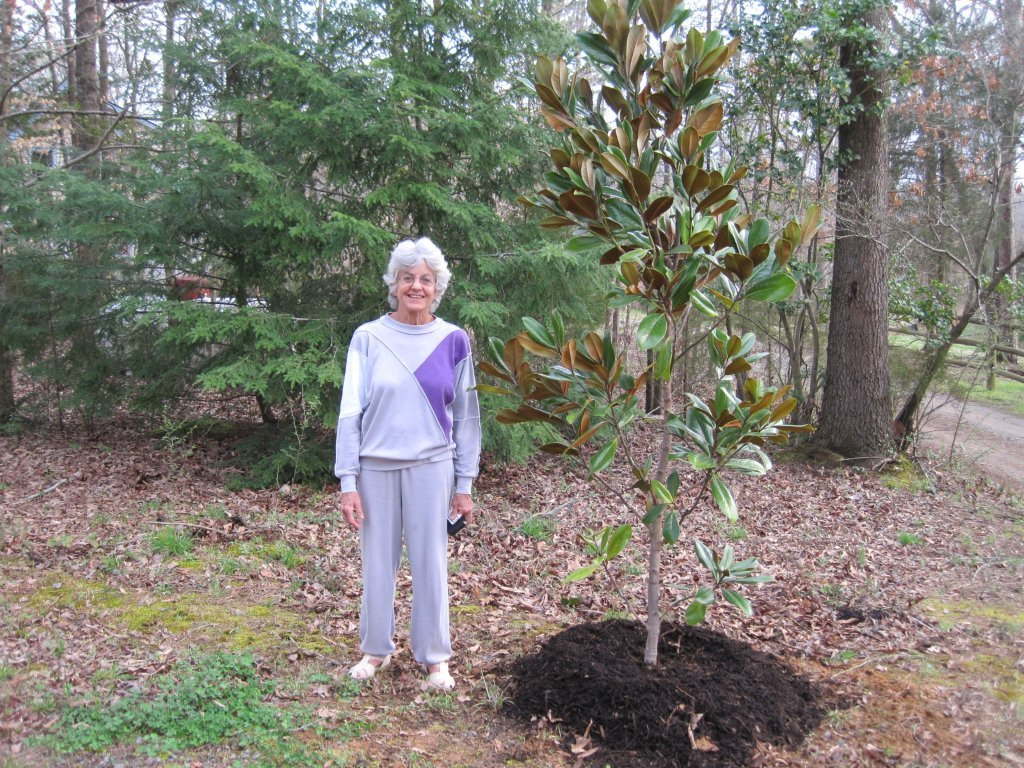
This young Magnolia grandiflora, planted today on my friend Chris’s land outside Chapel Hill, will incorporate some atoms of Jacques and will eventually grow to be 40 to 50 feet tall.
 Ambiance