“There’s An Awful Picture of You Guys . . .”
“. . . on my website,” was what I heard Nathan say. But no: he’d said “awesome.”
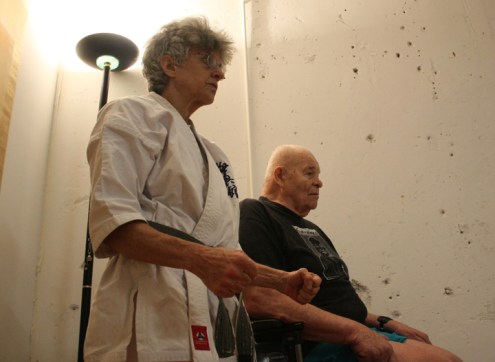
Awful or awesome? A little of both, no? I look like I’m about to pop Toto into my basket. J looks great, though, as always.

Ligo Dojo is growing. It is a nonprofit that serves at-risk kids from the Durham juvenile justice system, seamlessly mixed in with a diverse batch of regular students.


To look at these two, you’d almost think they had a life!
Twitter Guilt
I think I got into my first real Twitter jam session last night — those polyphonic volleys where you have to run and leap and snap each other’s responses out of the air like a dog playing Frisbee or an orca voguing for fish . . . where you have to track the threads of the conversation by weaving like an undercover detective through the throng of unrelated tweets, and where the elements of the exchange overlap like the parts of a fugue or canon. And you’re trying to channel big ideas through a 140-character aperture. It’s a distinctly new kind of mental challenge that takes about eight metaphors to surround and approximate. If it’s most like any one thing, it’s probably playing jazz in a small combo in a noisy club, straining to hear, not knowing what your fellow musicians are going to play next, but all trying to keep the original melody at least distantly in mind.
So if I was having fun and exercising my brain, why do I feel guilty?
For one thing, I kicked off the thread by going over to Anchoress’s and starting a fight with her. A friendly fight; we may disagree some of the time but it is (I daresay) with mutual affection and respect. I felt that my political allergies were getting unbalanced and that I needed to go roll in some nettles on the right. What drives me nuts on both sides is the way demonizing Bush seems to require deifying Obama, and in turn, demonizing Obama seems to require . . . well, gushing over capitalism, lately. (And if you recoil from gushing over capitalism, it must mean you hate capitalism and side with those who want to destroy it and bring on socialism . . . no, no, NO!) The rhetoric itself leads to paranoid black-and-white hyperbole like calling Bush, or now Obama, a “tyrant” poised to end presidential term limits and free elections, and painting an idealized, Norman Rockwell picture like this one of the glories of yeoman free enterprise that airbrushes out the megacorporate excess and fraud. (Or, on the left, a socialist-realist wall mural depicting the Peaceable Kingdom of multiculturalism — Latina lesbians in overalls! — painted on some desolate urban underpass.)
So why do I feel guilty about such an observation? Because I realized that I am not the audience for blog posts of this sort. They’re publicly posted, of course, the way a patriotic brass-band concert might be held in a public park, but it’s not polite to disrupt such a concert; if the oompah of Sousa sets your teeth on edge, just leave. Criticizing such posts is as mean-spirited and irrelevant as fisking some other country’s national anthem. People on the right (and left) write these posts for each other. They’re hymns of agreement, they’re meant to rouse and rally and tune resolve. They’re tuned to a pitch I cannot hear, or can’t hear without distortion. In other words, it’s none of my business, and to go over there just to aggravate myself is rude. Of course, that’s not what I go for; I go for goosebumps, like this and this. I think I should keep my aggravation to myself instead of putting it on gratuitous display.
But there’s another kind of Twitter guilt I’m feeling that’s harder to define. An intense conversation can’t be called a waste of time, so that’s not it. What is it? It feels reckless, irresponsible, heady, to be throwing big ideas around like that. Too much reward for too little work? Shame at having given in to the temptation to hold forth on things I know nothing about? (How grandiose one can be in miniature!) Twits rush in where angels fear to tread? There was a kind of unearned intoxication . . . Ah! I know where I recognize this feeling from!
The hung-over morning after a college bull session.
UPDATE: And now I can pinpoint it a little further: although I write about ideas a lot — in many cases, they’re all I’ve got — I’m wary of them. I have a little bit of a “no ideas but in things” bias. Ideas are like hot-air balloons: they can easily get untethered from the earth and float bloatedly away. Sometimes Twitter is like a collective balloon release.
Good God Almighty, I’m Free and Vast!
The proposed, or threatened, preventive-health initiatives “almost certain” to be part of Obama health reform — “nutrition counseling, obesity screenings […] wellness programs at workplaces and community centers […] more time in the school day for physical fitness, more nutritious school lunches […] more bike paths, walking paths and grocery stores in underserved areas” — are striking some as a nanny-state intrusion on their freedom.
More time in the school day for physical fitness? I’m shocked! Isn’t that what, back in the red-blooded all-American ’50s, used to be S.O.P. under the names of “recess” and “physical education”? Isn’t that the lack whereof is particularly harmful to boys??
As for the rest of it, any attack on the costs of health care has to include, at the very least, incentives for healthy behavior (“though the exact savings are debatable”). As you’ll see in the upcoming post I’m slowly stitching together out of my doctor sister’s e-mails, the current diseases of the American lifestyle are a huge part of what every physician sees.
I am well aware that fitness, slimness, not smoking, and eating organic food are elite luxuries (I myself can’t afford the latter). And I don’t mean to put irony or snark into that. Obama’s finger-shaking-scold quality annoys me when it crops up. (His own lapses are more endearing.) I suppose freedom includes the freedom to behave badly and destroy yourself, or it isn’t freedom. It’s your own damn business, unless you’re forcing secondhand smoke down nonsmokers’ lungs or drunk-driving into a carful of middle-school soccer players.
But Newt recently quoted John Adams as saying only religious people could be trusted with a democratic government. Conservatives, or classical liberals, often quote Edmund Burke’s magnificent words:
Men are qualified for civil liberty in exact proportion to their disposition to put moral chains upon their own appetites…in proportion as they are more disposed to listen to the counsels of the wise and good, in preference to the flattery of knaves. Society cannot exist, unless a controlling power upon will and appetite be placed somewhere; and the less of it there is within, the more there must be without. It is ordained in the eternal constitution of things, that men of intemperate minds cannot be free. Their passions forge their fetters.
How do you practically reconcile the freedom to behave badly with the expectation that bank-breaking medical care should then fix you up? (It’s plenty complicated, because — here comes an understatement — not everyone who’s sick brought it on themselves, nor does abstemiousness guarantee health. Fitness guru James Fixx dropped dead while running, and the founder of Rodale Press croaked right on the Cavett show while bragging about his healthy lifestyle. However, we do know that smoking, inactivity, and diet-triggered diabetes are killers.) I mean practically — not just saying that we ought to have more weight-loss prayer groups. Just because you don’t like Obama, it doesn’t mean he’s wrong about . . . recess.
~ amba
Monetizing Thrift
You might remember that back in 2007, a couple of Democratic congressfolks tried to “survive” on $1/day so as to better understand the eating habits of the underprivileged. It was kind of a silly experiment, but led to some memorable blog posts – see for example here.
Well, a couple of enterprising Americans have come up with pretty thorough, healthy meal plans that come close to meeting that standard – and are making money off of it. Cook for Good is the more prominent of the two, but the Manhattan-based Three Dollar Dinner (written by a producer of Queer Eye for the Straight Guy) seems to be coming on strong.
~ Maxwell
The Tragedy of the Oceans
The noise produced by the global warming debate often overwhelms other environmental issues. I find this unfortunate, because some of these issues matter a great deal and are arguably equally urgent, if in a quieter way. For example, take fish.
There is little doubt at this point that overfishing is greatly impacting the quantity of fish in our oceans, particularly those fish that people actually like to eat. Farmed fish are a long way from being a solution to this problem, being quite inefficient to produce and a source of pollution themselves. They are also arguably unethical to produce, for many of the same reasons as factory-farmed chickens. Once basically a free good, fish in high-development areas have also become prohibitively expensive
In this article, the cookbook author Mark Bittman (who incidentally writes and edits a good and generally fun food blog, Bitten), ruminates sadly on the great difficulty of buying “sustainable” fish. His approach boils down to buying fish very carefully, and eating it a good deal less than he used to. Which has implications he does not address: fish is one of the only reliable sources of the essential fatty acids DHA and EPA, which are crucial for brain development and heart health. As go the fish, so do we.
~ Maxwell
UPDATE: Maybe I should cheer up a bit. Ray Hilborn offers some context.
UPDATE: Regarding amba’s question in the comments: I found it striking that both Hilborn and the activists referred to the same source for their statistics, the United Nations’ Food and Agriculture Organization. The following graphic is from page 51 of the UNFAO’s The State of World Fisheries and Aquaculture 2008.

So the actual picture here is more complex than either the professor or the activists claim. On the one hand, overexploited/depleted/recovering marine stocks seem to have plateaued at 25%, at least for now. But underexploited stocks are on a fairly rapid decline, while fully exploited stocks have hovered around 50% for thirty five years.
So I guess the picture right now seems less depressing, but more tense. Things could break either way, it seems.


Obama and the Real World
The president should read this. Except he won’t get it till after it happens to him.
Some may say it already did, and he’s just setting up our enemies, talking past leaders to amass capital in world public opinion, laying the groundwork for a big “OK, no one can say I didn’t try the high road. NOW . . .”, that he’s got plenty of Chicago mean up his sleeve. That the campus idealist is his preferred veneer, the way the Texas rancher was his predecessor’s.
We’ll see.
(H/T: Sisu)
Hillary on “This Week”
How adeptly she’s put on the diplomat’s ambiguous armor. Every word she utters is designed to keep options open, to hint at pressure under a veneer of ceremony. For example, she says, twice, “There would be retaliation” if Iran nuked Israel, but she won’t take Stephanopoulos’s bait and come out and say the United States would retaliate, as she did during the campaign. It’s a very tricky business, and I have to admire the speed with which she’s mastered that nebulous language; for the most part it comes tripping off her tongue.
She could’ve been president. Maybe she still will, one day. You wonder if she also has her own concealed agenda.
Life as a Boy Toy in Southern China
Jason (the commenter), @BXGD, tweeted this remarkable story this morning by an Argentine writer/photographer about life in a genuine matriarchy, the Mosuo of southern China.
[I]t simply doesn’t make sense to the Mosuo women to solve conflicts with violence. Because they are in charge, nobody fights. They don’t know feelings of guilt or vengeance — it is simply shameful to fight. They are ashamed if they do and it even can threaten their social standing.
* * *
They are strong women who give clear orders. When a man hasn’t finished a task he’s been given, he is expected to admit it. He is not scolded or punished, but instead he is treated like a little boy who was not up to the task.
* * *
For the Mosuo, women are simply the more effective and reliable gender. However, they do say that the “really big” decisions — like buying a house or a machine or selling a cow — are made by the men. Men are good for this kind of decision-making as well as physical labor. The official governmental leader of the village, the mayor, is a man. I walked with him through the village — nobody gre[e]ted him or paid him any attention. As a man he doesn’t have any authority.
* * *
[T]hese are very strong women who give the orders and yell at you as if you were deaf. [You wouldn’t want this one‘s eagle eye on you!] But when it comes to seduction, they completely change. The women act shy, look at the floor, sing softly to themselves and blush. And they let the men believe that we are the ones who choose the women and do the conquering. Then you spend a night together. The next morning, the man leaves and the woman goes about her work like before.
* * *
[T]he women decide with whom they want to spend the night. Their living quarters have a main entrance but every adult woman lives in her own small hut. The men live together in a large house. The door of every hut is fitted with a hook and all the men wear hats. When a man visits a woman, he hangs his hat on the hook. That way, everybody knows that this woman has a male visitor. And nobody else knocks on the door. If a woman falls in love, then she receives only the specific man and the man comes only to that woman.
* * *
When she can talk with a man, have sex, and go out, then she is in love. Love is more important for them than partnership. They want to be in love. The one reason to be with another person is love. They aren’t interested in getting married or starting a family with a man. When the love is over, then it’s over. They don’t stay together for the kids or for the money or for anything else.
* * *
One woman wanted to have a child with me. I told her, no, I can’t have a child with you because you live here in China and I live in Argentina. “So?” was the reaction. The children always stay with the mothers. I said that I couldn’t have any children whom I could never see. She just smiled as if I took it too seriously. When they have kids, the children are theirs only — the men don’t play a role.
* * *
Often, the women don’t know which man is responsible for the pregnancy. So the children also don’t know who their biological father is. But for the women it is usually not important because the men barely work and have little control over things of material value.
Most Chinese citizens prefer sons and suffer from their government’s draconian regulation of the birthrate. But because the Mosuo have ethnic minority status, they are allowed three children. And because women run the family and handle money, “[a] family without daughters is a catastrophe.”
Look at the picture gallery: these people look and dress rather like Peruvian Indians. Their way of life, so utterly alien to us, feels familiar to the nervous system somehow, eh? (I want my own small hut with a hook on the door!) Fascinating food for thought. Now I can say “Read the whole thing” and mean it.
“Wise Woman/Wise Latina” . . .
. . . is a trope it turns out Sonia Sotomayor likes so much she’s used it repeatedly, virtually verbatim. In fact, it could be called her signature line in public speeches.
I’m going to tell you a) why I don’t like it, and b) why I nonetheless think it may be irrelevant.
My dislike is directed particularly at this kind of feminism. The coupled ethnic chauvinism takes the same payback form (“the last shall be first,” the long-thought-inferior are really superior), but is necessarily less essentialist; only crazies like this guy think brains differ predictably by “race,” whatever that is, although such thinking may be making a creeping, and creepy, comeback. (That’s really not a trend minorities want to encourage, by the way, because it’s not going to break their way. I happen to believe that the evidence is biased, but it’s biased towards Euro-Americans.)
And, it’s not primarily men I want to defend from “this kind of feminism,” although I get that men are both demonized and denigrated by it — but I find I believe (perhaps wrongly) that it’s too stupid to stick, to men. No, I think it’s bad for women. The assumption that women are nicer, more caring, more compassionate than men strikes me as both dangerously wrong and nauseatingly cloying. Women are human, and can be mean, nasty, cruel, criminal, physically brutal, and psychologically maiming. In fact they’ve — we’ve — refined that last to a torturer’s art because the cruder physical means of domination are less available to us. Women can also be emotional hacks and manipulators, who’ve worn such overtrodden paths across the terrain of “feelings,” our specialty, that they’ve become muddy ruts where nothing grows, only to be prettied up with toxic therapeutic AstroTurf. Men’s emotions, when not successfully suppressed, can be much more touching, raw, and real.
Ask anyone who’s had a less than cuddly mother how warm and compassionate and empathetic and nurturing women are. I’ll even go so far as to say that the human mean streak in women, used properly, is what enables us to discipline our children, defend ourselves and them, and accomplish things. The notion that we’re these nobly egalitarian, collective, empathetic nurturers is called “difference feminism,” and accepting it, even taking pride in it, is a trap for women because in fact there are many important things you can’t do with those “soft” qualities alone.
Like, judge.
And that brings me to why I think these statements of Sotomayor’s may be irrelevant.
What matters is to examine how she has judged.
Why don’t her public statements, declarations of identity and beliefs, carry the same weight as her decisions? Because people’s personalities are not the same as their working function. Think of how many movie actors are banal a-holes in their personal lives and in interviews, and then they take on a character and deliver a powerful performance. How can such a superficial twit be possessed by a character of such depth and complexity that we are shatteringly moved? I don’t know, but it happens all the time, and it happens to all of us. Writers whine and complain and drink and cheat on their mates and in general behave badly until they settle down to write. Then something else, deeper and impersonal, possesses them and comes through them. Good judges, I suspect, are possessed, when they are working, by an archetype of the law, by the seriousness and impersonality that it calls them to. When they’re off work, they could say any damn thing. There’s not necessarily a connection between a person’s identity and beliefs and his or her work performance.
I’ve had a line in my head for a while that I like: “‘I’ is the noise of an idling engine.”
So what is important is not what Sonia Sotomayor says when she’s off duty. What matters is what she has said and done when she’s “on.”
 Ambiance