Royal Blessing [UPDATED]
Just when I was getting that reclusive, haggard, nail-biting feeling . . . along comes $2,519.56 in royalties from this book! Most of it from this country, where it was brilliantly published and is still selling a decade in.
UPDATE: And now, on the same day, I find out that I’m pretty certainly still gainfully employed, as before. I’m so blessed I’m blitzed.
Thank you to all of you who prayed for us, and to all of you who sent thought beams that became the wind beneath our wings, or twisted Fate’s arm, as the case may be.
Israel: Adamah (land) or Eretz (Land)?
No matter where you stand on Israel, and even if it makes you mad, this is a must read, packed with astonishing insights into Jewish history and identity, the Hebrew language, and the political uses of any language. Just a couple of startling examples to whet your appetite:
For [poet and dissident Yitzhak Laor], the essential truth underlying historical ambiguity can be found only in and through common language, and one wonders, reading him, whether the ultimate synoptic history of Israel and Palestine would not be a poet’s history, a linguistic history — a version that can be all versions, once the vocabulary has been agreed upon: vocabulary having to do with, for example, the sanctity of “life,” or chayyim, a word that in Hebrew is uniquely plural, and so, as Laor reminds us, cannot be lived by one person, or one nation, alone.
What do you know! I’ve been saying “L’chaim!” all my life without ever knowing I was saying “To lives!”, even though I know just enough about Hebrew to know that “-im” is a plural ending, as in the familiar “seraphim and cherubim.”
If the decades following 1948 found Israelis aspiring to Aryanhood [see e.g. the blond, blue-eyed Paul Newman in Exodus], then the roots of that loathing grew from decades previous, from the Nazi desire to cast European Jewry as entirely Oriental — the infamous Der Sturmer cartoons of the fattish Jew with the hooked nose and tasseled fez, the cigar and ruby rings. Laor argues that the Nazi genocide represented a purgation of this stereotype, and that the Jew emerged from the war intensely Westernized, as if Auschwitz’s fires had burnt away all traces of Otherness and now the Jew was fit to be not just a citizen like all Western citizens but the very paragon of a polis, the Western citizen par excellence. In Laor’s interpretation, if the Holocausted Jew is today regarded as the special guardian of Humanism, then the new Oriental Other or Easterner can be said to be the Arab, and especially the rock-throwing, half-literate Palestinian.
This reminds me of the way, when I fill out any form like the census that asks for ethnicity, I always hesitate before checking “Caucasian” or “white.” It just doesn’t seem quite true. (I know, you don’t have to answer that question, and there are libertarians who say you shouldn’t stand up and be counted at all. Filling out forms just appeals to my nit-picky, compulsive-copyeditor side.) This is, of course, a loaded and potentially evil point to make, because it means that Jews can now be accused of being racists and Nazis even as they are, on the other hand, still declared by Arabs and Europeans alike to be a “disease,” no matter how Western we may look and think. (The Nazis, like the segregationists, had a “one-drop rule.”) Despite the evil uses that are made of this point, there’s still some creepy truth in it, a truth that has something to do with the decline in American antisemitism and the embrace of the Jews by Christians who’ve found a new sinister Semite to despise.
You don’t have to be Jewish, or a critic of Israel, to find much in this piece by Joshua Cohen that is mind-blowingly enlightening.
Broke.
All within the last week:
- my cell phone [under warranty, but AT&T is sucking]
- the land-line phone [cheap; old; replaced]
- the windshield wipers (in the rain; fortunately, not on the highway) [replaced]
- the passenger side mirror [actually was duct-taped into holder; duct tape disintegrated. Re-duct taped.]
- J’s hospital bed [repaired, on Medicare]
- the toilet [plastic strap connecting flush handle to flapper; replaced]
What else? We both had a cold for a week [gone now; immune systems not broke]. The water gets shut off for repairs just when we’re getting ready to go out. J has ill-timed accidents. It’s all small stuff. We should be (and are) grateful that if we have to have a run of bad luck and breakdowns, it’s so small-bore. But it’s a little unnerving when it all happens at once. Things of completely different type, material, age, and provenance all choose the same week to break down?? What’s next? Me? I’m fine but frazzled, feeling behind the curve, stumbling over myself trying to get up to speed as the little things around me break down, both demanding my attention and spitefully sabotaging me.
Change of season shaking things up? Transition from hibernation? Adjustment to underemployment? Full moon? Why would duct tape and toilet flappers get drawn in to these things?
Jungian psychologist Arnold Mindell thinks he knows. As Stephan Bodian explains in the intro to an interview with him, Mindell came up with the theory of “the ‘dreambody’ — the unconscious as an active agent constantly expressing itself in our lives.”
Dreams, physical symptoms, relationships, accidents, altered states of consciousness — all are manifestations of the dreambody in action. […] Mindell believes that what happens to us in each moment is exactly what was meant to happen. Our task is to learn to follow this process as it unfolds and thereby help it to reveal its deeper significance. A physical symptom, for example, may force us to deal with a relationship issue, get us in touch with a mythological figure, resolve an old childhood dream, or guide us into a profound meditative state.
Mindell himself says:
There’s a flowing or dreaming process at the bottom of it all. This process manifests itself in many different ways, depending on the channel in which we perceive it. One of the channels is proprioception — you feel things inside your body in terms of temperatures, pressures, pains, aches, joys, sexual stimulation, and so forth. Or you experience things in terms of visual imagery, or in terms of auditory phenomena, like voices, or in terms of movement — the way you trip over your shoelaces or make certain kinds of gestures — or even in terms of relationship processes. Other people can act as sensory channels for you; you can experience yourself in terms of the behaviour of others. And the process also manifests itself through extrasensory or parapsychological channels: The trees do things; the sky appeals to us.
I remember reading Mindell’s book River’s Way decades ago and being particularly struck by the notion of the “world channel” — the idea that apparently unrelated things going on in the world can manifest your own state of mind. That may sound pathologically narcissistic (it’s clearly related to Jung’s famous concept of “synchronicity,” or significant coincidence), but have you ever had a burst of anger just as two cars collided or thunder exploded outside? It’s sort of the poltergeist effect. (Coincidentally — or not! — the Word A Day for April 2 is “poltergeist.”)
Bodian says, “What you’re referring to here, if I’m not mistaken, is what you call the ‘dream field’, in which people and objects take on the qualities of our dreaming process.” Mindell responds:
Yes. We dream up the world around us to behave like our own dream field. […S]ometimes things happen synchronistically that can’t be explained in terms of simple projection. For example, you dream that a huge bird speaks to you, and the next day you’re walking down the street and for the first time in your life a huge bird actually bumps into you. […] The world sometimes does literally behave as if it were a sensory channel, as if it were a part of your dreaming field.
Warning: it gets pretty woo-woo and new-agey, talking about a sort of conservation of the ignored, denied, and repressed:
[I]f you’re a good ecologist, you have to wonder where your signals and processes — the parts of you seeking expression — go when you disavow or let go of them. […T]he negativity doesn’t just disappear. It goes into your body, into a less tractable process, maybe a cellular or metabolic or cancerlike process. Or it goes into your partner, who hates you. Or it goes into accidents on the street corner or into the collective, for you and me to pick up. Devaluing certain perceptions and just letting them go is like tossing wastepaper onto the street. Somebody has to clean it up eventually. […C]ompassion also means having compassion toward all your perceptions, even the unhappy or unfortunate ones, and trying to process them.
Wow, like, quantum, man. I lose patience with the tone of this interview, and particularly with the new-age notion that your cancer is trying to tell you something (other than “Die, motherfucker!”). But there’s something to the “world channel.” We don’t interact with things (much less people) like another thing bumping into them in a straightforward Newtonian way. The observer bends and warps the experiment. We recruit duct tape, windshield wipers, and toilet flappers into our field of dreams.
A Vulgar Miracle
This is what I found when I opened my freezer this morning:
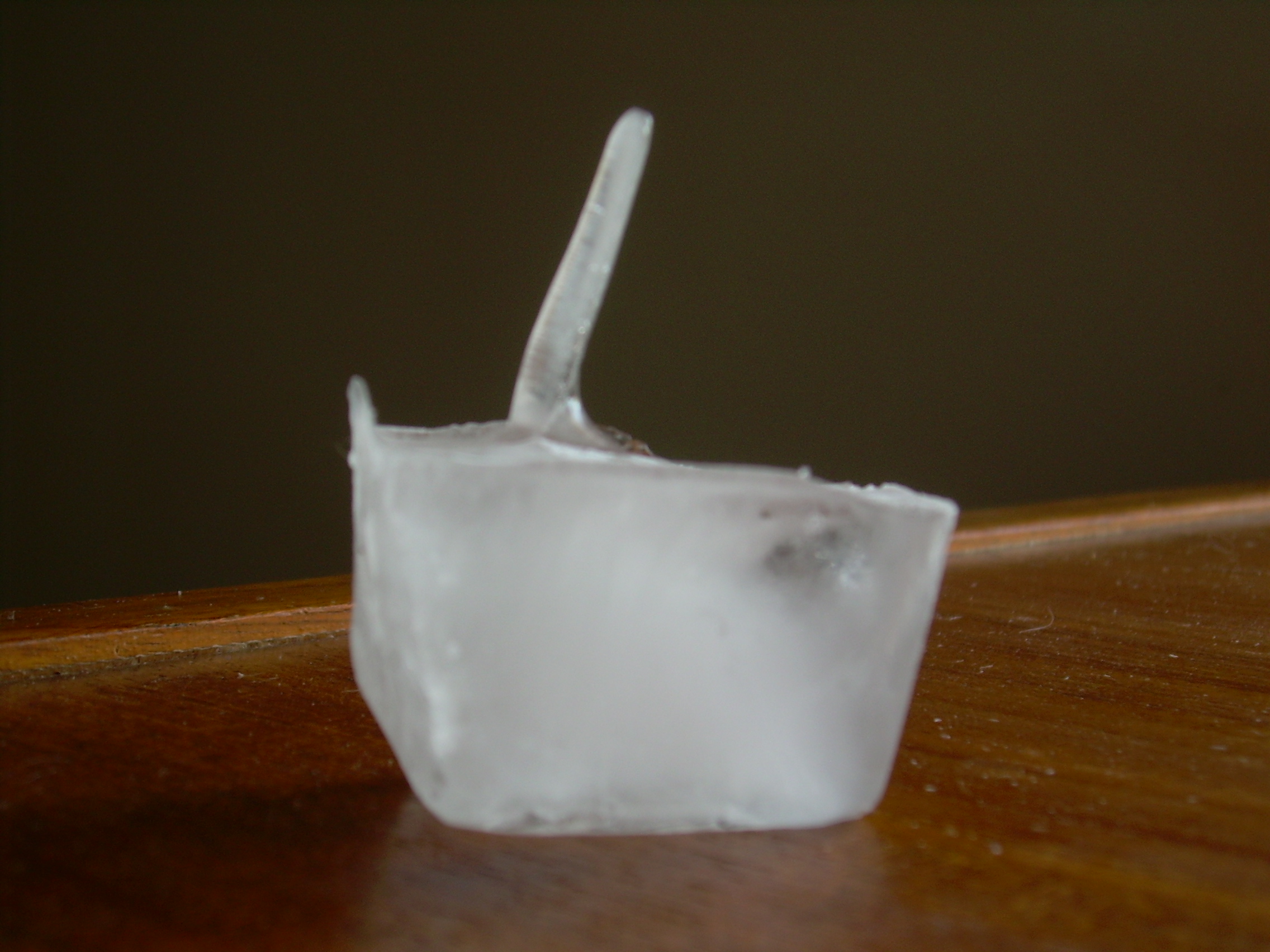
Pilgrims devoted to the god Priapus should be beating a path to my door about now.
And somewhere Ice Cube is saying, “I toldja so!”
If you think you can explain how this happened, have at it. Also: Caption Contest!
P.S. Is there some connection between Priapus and April Fool’s Day? Bet there is. It’s that time of year. But, believe me or not, I didn’t do this. I wouldn’t know how. If it’s an April Fool’s joke, it’s a (micro)cosmic one.
“When the world is down to the last tuna, someone will be willing to pay a million dollars to eat it.”
As noted here, vanishing animals are as good as gold, these days.
Opinion is Social. [UPDATED]
Talking to a dear friend on the left side of the political spectrum today (not far left) was painful, not only because politics is exceedingly painful these days (the temptation to hunker down into a stoical — and possibly armed — private life has never been so great in my lifetime), but because it brought uneasiness and alienation into what has always been a close relationship.
She said, “the stupid people on the right.”
She said Rush Limbaugh wanted Obama to fail, and she wished Rush would make good on his threat to leave the country.
She said that Obama had broken his heart trying to get bipartisanship on health care.
[UPDATE I: I remembered later that she also told me she had just heard that it had now been proven that last year was the warmest year ever.]
I recognized that these were tribal signals meant to elicit ritual agreement from me. Then that would be settled, and we could go on with our personal catching up in a happy miasma of accord.
Except that when she reached out, I wasn’t there. (Imagine! I, who think Rush has done a lot of harm, found myself restoring the context of his “fail” remark, explaining that it wasn’t about race but about ideology.) Instead, I found myself numbly trying to tell her about the different reality that was there behind the scrim of her assumptions. I felt stupid having to explain why people on the right fiercely resent being lumped together and smeared as “stupid.” I refrained from telling her what a stupid thing that had been for a smart person like her to say. But she wasn’t thinking when she said it. She was bonding. When I didn’t bond back, it was shocking and disorienting. Suddenly we were stumbling in this weird, mined DMZ.
It struck me as profoundly anthropological and even biological — like worker ants or naked mole rats comparing scent badges when they meet in tunnels underground. We touch antennae and find out if the other person is safe and approved and “one of us.” If not? We drive them out the nest, or kill them. If so? Nest solidarity is reinforced.
What business does this crap have between human friends? What bewilders me is that the signals that are exchanged (and on the right they would be: “the elitists and freeloaders on the left,” rah-rah Rush, and something about Obama’s leanings toward treachery and tyranny; I have close friends who reach out to me with those signals, and I can’t return them, either) are the crudest and most stereotyped and involve the least thought. They are knee-jerk, groupthink slogans precisely because their function is tribal identification in an era when the old identifiers like class and religion have become muted and muddled.
This is so hard to talk about.
Only if you’re jolted out of your original identification can you catch a brief glimpse of the whole picture. Class is the river that runs through it, class and family history. If you’re upper middle class and economically secure, a kind of noblesse-oblige indignation on behalf of the disadvantaged is part of your heritage. (I speak from experience.) You may be cosmopolitan and Jewish, or descended from the highly educated abolitionist and pacifist strains of Christianity. If your family was working class but unionized, part of the labor movement, you may have inherited a more collective common-man tradition that once carried a stirring idealism (if it also, in its heyday, veered uncomfortably close to idealizing the Soviet Union). And if you’re a member of a minority group, you may feel you, or your less fortunate cohorts, started life under a historical handicap that must to be redressed. On the right, you’re probably from the fiercely independent smallholder/yeoman/tradesman/craftsman class, and the “millionaires next door” that are so many of its sons and daughters; your ancestors’ lives were rooted in skilled labor or farming and hunting, homestead, church, and clan. (You can see that I still have a much more detailed picture of the left than the right.)
I think the one smart thing Karl Marx ever said was, “The conditions of existence determine consciousness.” That probably struck me so hard because the conditions of my own existence have changed so much, and because I’ve traveled so much, not only in space, but between worlds. “Determine” is a little strong, but it’s close.
I suppose it’s natural that these groups of Americans should be set against each other; in many ways, their interests are. And I can see (having grown up on the left) what drives the right crazy about “us”: our interests are not direct and forthright. We always purport to be doing things on behalf of others, often with admirable dedication; but insofar as we didn’t have to struggle to establish ourselves, our self-interest is in our self-image.
(To my friend, the opposition to Obama is self-evidently racist. It would be crazy to deny that any of it is. But to me, now, it seems evident that the convenience of being able to tar all opposition as “racist” was a major strategic weapon in the Democrats’ bid for power. Race jiu-jitsu. How racist is that?)
I’m going to have to leave this inconclusive. I need some sleep. My instinct is to reconcile, to find common ground. And there is some: it’s called America. The divisions are real, but those who exacerbate them for sport or profit, on both sides, will deserve the blame for what’s to come. Right now everybody feels warlike and heroic. Hardball is admired. Revolution is commended. Unyielding enmity is intoxicating. Compromisers who actually want to accomplish something that everyone can grumble and accept, rather than rant about some never-never-land Utopia of the pure left or right, are booed off the field. These are the signs of a country that hasn’t had a real war in too long.
UPDATE II: Sure enough, today I had to cut short a close friend on the right by saying that talking about politics makes me sick. While I could almost agree with her on “Throw the bums out — all of them,” she was seeking my agreement with the suspicion that the election of Barack Obama was only possible if “there was a plan” — a sinister, global plan, was the implication.
The Greatest Drug of All
People might have in the past loved sex; I think they now love indignation more. Indignation seems to thrill. So a media storm is often driven beyond all reason, people taking offense or people huffing and puffing.
Ian McEwen (via Althouse).
I’ve had much the same thought, ne’er so well and tersely expressed.
(11/09) People will go again and again to have their fears, rages, and preconceptions reliably stimulated and serviced. It’s our human equivalent of a rat pressing a lever. It’s a way of getting off, as predictable and sterile as porn. In fact I’m going to coin a word for the pull of political invective: zornography (from the German Zorn, rage or fury).
Righteous outrage is a big part of what drives the blogosphere, and there are a lot of repeat customers. It may be a physiological addiction; Rush pushes the most refined brand, with citrus overtones of intellectual satisfaction. Addiction is a brain reward system rapid-cycling because the reward has become detached from the actions it is meant to motivate and reinforce. Maybe we’re built to be chased by a sabertooth tiger every once in a while to clear out our pipes, and in the absence of natural threats to give us that limbic workout, we seek to escalate our sympathetic nervous systems by any means necessary.
Non sequitur: Another true line from McEwen’s interview:
The rhythm of walking can generate fresh ideas.
The Last Year of the Tiger [UPDATED]
Asia is celebrating the Year of the Tiger by finishing off what’s left of its decimated wild tiger population, for discredited aphrodisiacs and anti-arthritis potions, floor throws, and . . . tiger-claw jewelry to celebrate the Year of the Tiger.
There’s also now a flourishing wildlife conservation movement in Asia, which distributes these articles, but it seems almost totally impotent compared to the ruddy lust of commerce. Wild tigers’ rarity, now that they’re poached near extinction, has driven up their parts’ price, and almost certainly sealed their doom.
Tiger parts sold openly as jewellery
Some unaware of ban and penalties; AVA seizes 320 items from 30 shops
Grace Chua, The Straits Times, 20 Mar 10;JEWELLERS and antique dealers here are openly selling jewellery and amulets made from tiger claws, skin and teeth, an animal welfare group said yesterday.
The Animal Concerns Research and Education Society (Acres), which investigated 134 jewellery or antique shops between December and last month, found 59 selling body parts of the highly endangered big cat.
And of the 59, only seven knew of the ban on trade in tiger ornaments; they produced the objects from under the counter, or from a safe, in front of undercover Acres investigators.
One shopkeeper advised: ‘When you take it out of Singapore, just say it is a talisman. Don’t say it is a tiger part.’
Another admitted to having ‘just stocked up’ for the Chinese New Year because of hotter demand for the items this Tiger year.
These retailers either do not know or are ignoring the heavy penalties that come with selling, advertising or buying the parts of such an endangered animal.
The Agri-Food and Veterinary Authority (AVA) subsequently checked 161 retail outlets, including Acres’ 134, and seized 320 items from 30 shops.
It was the biggest seizure of alleged tiger parts here to date, in terms of quantity netted.
The AVA is now examining the items for authenticity.
Selling tiger parts is banned. All six tiger species are protected under Appendix I of the Convention on International Trade in Endangered Species of Wild Fauna and Flora (Cites).
Singapore ratified the Cites convention in 1987.
Under the Endangered Species (Import & Export) Act, importing, exporting, re-exporting or possessing any Cites species without a permit can land one a fine of up to $50,000 per species, with a cap of $500,000, and/or two years in jail.
And here is the rub: Even if the parts are fakes, the same penalties apply.
This is because trading even in fakes drives up the demand for tiger parts, said Acres executive director Louis Ng.
In Asia and some parts of the world, amulets or ornaments made of tiger claws, teeth and skin are carried or worn for protection. Tiger skin, for instance, may be inscribed with prayers and rolled up in glass capsules. Some people believe that wearing such ‘lucky charms’ gives them power and authority.
The demand for tiger parts for ornaments and traditional medicine, coupled with tigers’ loss of habitat, have caused wild tiger populations to plummet worldwide.
By some estimates, only 3,400 to 5,140 tigers were left in the wild in 2008, down from 5,000 to 7,000 in 1999.
Animal conservationists deem this critical, and yet, the continuing demand for tiger parts is fuelling its supply.
Shopkeepers told Acres that they sourced the tiger parts mainly from Thailand, India and China.
The prices for these charms ranged from $3 for a tiger tooth, to $350 for a piece of skin, to $4,800 for a tiger claw set in gold.
Given the rising demand and shrinking supply, these prices can only go up.
Acres’ investigation targeted clusters of jewellery shops and antique dealers in Little India, Chinatown, Geylang and Bugis.
The actual size of the market for tiger parts is unknown, since their sale is not limited to jewellery and antique shops, said Mr Ng.
AVA spokesman Goh Shih Yong said the agency has an ongoing programme to check shops for the sale of illegal Cites species and to educate traders and members of the public.
He said: ‘We must acknowledge Acres for being our eyes and ears on the ground.’
The number of people nabbed for selling alleged tiger parts has been on the rise. There was one case in 2007 and another in 2008, but four last year.
All turned out to be fakes made of materials like horns or hooves and the sellers were fined between $100 and $500.
Those with information about shops selling tiger parts and other endangered species may call the AVA hotline on 6227-0670 or Acres’ hotline, 9783-7782.
As one of Clarence Day’s supercilious super-cats in This Simian World might say: humans are envious, greedy monkeys who too often think they can appropriate magnificence by destroying it.
UPDATE: Meanwhile, captive tigers starve on Chinese tiger farms and parks as owners continue to breed and feed them at prohibitive expense, hoping for a reversal of the 1993 ban on the sale of tiger parts, which cramps the style of tiger farmers (! what an oxymoron) but not of poachers. A profound shift is underway in China’s attitude toward animals:
The back-to-back tiger[farm] tragedies have been followed closely in China, spurring calls for greater legal protections for animals. Meanwhile, lawmakers have been drafting the country’s first regulations on animal abuse. The government is considering, among other things, a ban on the consumption of dog and cat meat, a culinary specialty in southern China. Under the proposed law, companies or restaurants that sell cat or dog meat could face fines of up to $73,000.
“Harming animals hurts the spirit of the people, especially the younger generation,” says Chang Jiwen, a professor of law at the Chinese Academy of the Social Sciences and one of the key drivers of the legislation. “A ban on abusing animals generally would illustrate that China has reached a new level of civilization.”
But the gears of change grind slowly, and all too often the intended beneficiaries are getting ground up in them.
“Are we now in a world where there is absolutely no recourse to the tyranny of the majority?” [UPDATED]
Because that’s what we’ve just seen — the tyranny of the majority, eked out by bending rules, making deals, breaking arms, buying votes. As many problems as I have with parts of the health care reform bill, my major problem is with the way it was passed (not that the two are unrelated). “Majority rule” does not mean that 50.8% of the people(‘s representatives) can simply overpower the other 49.2% without real damage to the country. (And that’s if the representation were representative, which the polls indicate it is not.) McArdle spells out the form some of that damage is likely to take: Republican retaliation. I guarantee you, tonight’s exulting Democrats won’t like it when they’re on the short end.
As Toby Harnden puts it in the Telegraph:
Never before had landmark legislation – the bill reshapes one-sixth of the American economy – been passed without even a smidgen of bipartisan consensus.
And here are the consequences: “the beginning, not the end, of a grinding, all-out war.” Conservatives and tea partiers believe they’re fighting the second American revolution — against the narcotizing fate of a soft tyranny, an enervating European-style socialism — and that is a thrilling and energizing mission. They’re not going to be lulled out of it.
It so happens that in the course of a work assignment, I just reread James Madison’s Federalist X. Good timing! Read the whole thing, but listen to this! How utterly contemporary it is:
The latent causes of faction are […] sown in the nature of man; and we see them everywhere brought into different degrees of activity, according to the different circumstances of civil society. A zeal for different opinions concerning religion, concerning government, and many other points, as well of speculation as of practice; an attachment to different leaders ambitiously contending for pre-eminence and power; or to persons of other descriptions whose fortunes have been interesting to the human passions, have, in turn, divided mankind into parties, inflamed them with mutual animosity, and rendered them much more disposed to vex and oppress each other than to co-operate for their common good. So strong is this propensity of mankind to fall into mutual animosities, that where no substantial occasion presents itself, the most frivolous and fanciful distinctions have been sufficient to kindle their unfriendly passions and excite their most violent conflicts. But the most common and durable source of factions has been the various and unequal distribution of property. Those who hold and those who are without property have ever formed distinct interests in society. Those who are creditors, and those who are debtors, fall under a like discrimination. A landed interest, a manufacturing interest, a mercantile interest, a moneyed interest, with many lesser interests, grow up of necessity in civilized nations, and divide them into different classes, actuated by different sentiments and views. The regulation of these various and interfering interests forms the principal task of modern legislation, and involves the spirit of party and faction in the necessary and ordinary operations of the government. […]
The inference to which we are brought is, that the CAUSES of faction cannot be removed, and that relief is only to be sought in the means of controlling its EFFECTS.
If a faction consists of less than a majority, relief is supplied by the republican principle, which enables the majority to defeat its sinister views by regular vote. It may clog the administration, it may convulse the society; but it will be unable to execute and mask its violence under the forms of the Constitution. When a majority is included in a faction, the form of popular government, on the other hand, enables it to sacrifice to its ruling passion or interest both the public good and the rights of other citizens. To secure the public good and private rights against the danger of such a faction, and at the same time to preserve the spirit and the form of popular government, is then the great object to which our inquiries are directed. […]
By what means is this object attainable? Evidently by one of two only. Either the existence of the same passion or interest in a majority at the same time must be prevented, or the majority, having such coexistent passion or interest, must be rendered, by their number and local situation, unable to concert and carry into effect schemes of oppression. If the impulse and the opportunity be suffered to coincide, we well know that neither moral nor religious motives can be relied on as an adequate control. […]
From this view of the subject it may be concluded that a pure democracy, by which I mean a society consisting of a small number of citizens, who assemble and administer the government in person, can admit of no cure for the mischiefs of faction. A common passion or interest will, in almost every case, be felt by a majority of the whole; a communication and concert result from the form of government itself; and there is nothing to check the inducements to sacrifice the weaker party or an obnoxious individual. Hence it is that such democracies have ever been spectacles of turbulence and contention; have ever been found incompatible with personal security or the rights of property; and have in general been as short in their lives as they have been violent in their deaths. Theoretic politicians, who have patronized this species of government, have erroneously supposed that by reducing mankind to a perfect equality in their political rights, they would, at the same time, be perfectly equalized and assimilated in their possessions, their opinions, and their passions.
A republic, by which I mean a government in which the scheme of representation takes place, opens a different prospect, and promises the cure for which we are seeking. Let us examine the points in which it varies from pure democracy, and we shall comprehend both the nature of the cure and the efficacy which it must derive from the Union. . . .
You’re going to laugh at me; but putting this together with what McArdle said, I just really got for the first time why the Democrats are called the Democrats and the Republicans are called the Republicans.

