Smart Salarycat
This is actually an ad for a hotel reservation service. (“Salaryman” is a Japanese term for white collar workers that, these days, has negative connotations.)
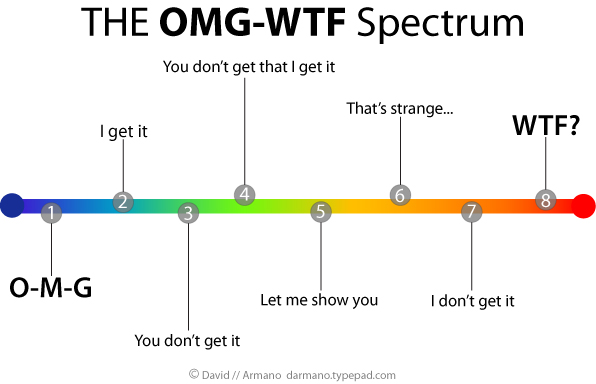
Decisions, Decisions…

… whether my next pair of shoes should be white, black, dark, French, Sesame or sourdough. Available here.
( Buttering/toasting not recommended.)
Opening Day!

He won 300 games. He pitched from 1939 to 1963, with a brief interruption due to WWII. He even pitched, at the end for awhile, with gout! But he’s here because what could be a better name for a pitcher then Early Wynn?
The Economist: You Gotta Love It . . .
. . . when you read this:
Why is it anonymous? Many hands write The Economist, but it speaks with a collective voice. Leaders are discussed, often disputed, each week in meetings that are open to all members of the editorial staff. Journalists often co-operate on articles. And some articles are heavily edited. The main reason for anonymity, however, is a belief that what is written is more important than who writes it. As Geoffrey Crowther, editor from 1938 to 1956, put it, anonymity keeps the editor “not the master but the servant of something far greater than himself. You can call that ancestor-worship if you wish, but it gives to the paper an astonishing momentum of thought and principle.” […]
What, besides free trade and free markets, does The Economist believe in? “It is to the Radicals that The Economist still likes to think of itself as belonging. The extreme centre is the paper’s historical position.” That is as true today as when Crowther said it in 1955. The Economist considers itself the enemy of privilege, pomposity and predictability. It has backed conservatives such as Ronald Reagan and Margaret Thatcher. It has supported the Americans in Vietnam. But it has also endorsed Harold Wilson and Bill Clinton, and espoused a variety of liberal causes: opposing capital punishment from its earliest days, while favouring penal reform and decolonisation, as well as—more recently—gun control and gay marriage.
Lastly, The Economist believes in plain language. Walter Bagehot, our most famous 19th-century editor, tried “to be conversational, to put things in the most direct and picturesque manner, as people would talk to each other in common speech, to remember and use expressive colloquialisms”. That remains the style of the paper* today.
*Why does it call itself a newspaper? Even when The Economist incorporated the Bankers’ Gazette and Railway Monitor from 1845 to 1932, it also described itself as “a political, literary and general newspaper”.
It still does so because, in addition to offering analysis and opinion, it tries in each issue to cover the main events—business and political—of the week.
Royal Blessing [UPDATED]
Just when I was getting that reclusive, haggard, nail-biting feeling . . . along comes $2,519.56 in royalties from this book! Most of it from this country, where it was brilliantly published and is still selling a decade in.
UPDATE: And now, on the same day, I find out that I’m pretty certainly still gainfully employed, as before. I’m so blessed I’m blitzed.
Thank you to all of you who prayed for us, and to all of you who sent thought beams that became the wind beneath our wings, or twisted Fate’s arm, as the case may be.
Public Employees Bankrupting Public
“…Take a look at California, where the teacher’s union spent over $211,000,000 over the last decade on elections. That’s more than twice as much as the next-biggest spender, which was also a union [probably prison guards’ union]….”
Israel: Adamah (land) or Eretz (Land)?
No matter where you stand on Israel, and even if it makes you mad, this is a must read, packed with astonishing insights into Jewish history and identity, the Hebrew language, and the political uses of any language. Just a couple of startling examples to whet your appetite:
For [poet and dissident Yitzhak Laor], the essential truth underlying historical ambiguity can be found only in and through common language, and one wonders, reading him, whether the ultimate synoptic history of Israel and Palestine would not be a poet’s history, a linguistic history — a version that can be all versions, once the vocabulary has been agreed upon: vocabulary having to do with, for example, the sanctity of “life,” or chayyim, a word that in Hebrew is uniquely plural, and so, as Laor reminds us, cannot be lived by one person, or one nation, alone.
What do you know! I’ve been saying “L’chaim!” all my life without ever knowing I was saying “To lives!”, even though I know just enough about Hebrew to know that “-im” is a plural ending, as in the familiar “seraphim and cherubim.”
If the decades following 1948 found Israelis aspiring to Aryanhood [see e.g. the blond, blue-eyed Paul Newman in Exodus], then the roots of that loathing grew from decades previous, from the Nazi desire to cast European Jewry as entirely Oriental — the infamous Der Sturmer cartoons of the fattish Jew with the hooked nose and tasseled fez, the cigar and ruby rings. Laor argues that the Nazi genocide represented a purgation of this stereotype, and that the Jew emerged from the war intensely Westernized, as if Auschwitz’s fires had burnt away all traces of Otherness and now the Jew was fit to be not just a citizen like all Western citizens but the very paragon of a polis, the Western citizen par excellence. In Laor’s interpretation, if the Holocausted Jew is today regarded as the special guardian of Humanism, then the new Oriental Other or Easterner can be said to be the Arab, and especially the rock-throwing, half-literate Palestinian.
This reminds me of the way, when I fill out any form like the census that asks for ethnicity, I always hesitate before checking “Caucasian” or “white.” It just doesn’t seem quite true. (I know, you don’t have to answer that question, and there are libertarians who say you shouldn’t stand up and be counted at all. Filling out forms just appeals to my nit-picky, compulsive-copyeditor side.) This is, of course, a loaded and potentially evil point to make, because it means that Jews can now be accused of being racists and Nazis even as they are, on the other hand, still declared by Arabs and Europeans alike to be a “disease,” no matter how Western we may look and think. (The Nazis, like the segregationists, had a “one-drop rule.”) Despite the evil uses that are made of this point, there’s still some creepy truth in it, a truth that has something to do with the decline in American antisemitism and the embrace of the Jews by Christians who’ve found a new sinister Semite to despise.
You don’t have to be Jewish, or a critic of Israel, to find much in this piece by Joshua Cohen that is mind-blowingly enlightening.
 Ambiance