An Invitation
This post was prompted by a thread Amba started concerning the seasons. Several of us wrote about the climate where we live or used to live. It was a little like a Travelog of personal views. So I am asking all who wish to write about a place in which they live or have lived. Mine will be posted as a comment.
You Get the President You Deserve.
I’m going to say this quick because I don’t have a lot of time.
Is Barack Obama really motivated by a bone-deep statist agenda? Is he most motivated by his own political survival? By a psychological need to reconcile conflicting viewpoints? By idealism? Or some combination of all of the above?
We don’t really know. What we do know is that he’s the democratically elected President of the United States and we’ve got a minimum of three and a third more years of him. (I hope that those of us who are still sane can all agree that a violent end to his presidency would be a catastrophe for this country we profess to love.) Rather than fantasizing about paralyzing him, or on the other hand, denying that he needs any improvement, how do we the people minimize the harm and maximize the benefit that we can get from these years?
It’s a truism of operant conditioning — a science of animal training that was applied to people in dolphin trainer Karen Pryor’s book Don’t Shoot the Dog, about which I once wrote a magazine article — that you get the best results by negatively reinforcing behavior you don’t want and positively reinforcing behavior you do. (Another good tactic in some situations is “extinction” — getting rid of behavior by ignoring it, because some behavior is designed to get attention and is fed by even negative attention. This might be the tactic of choice to apply to crazies at both extremes.)
Let’s be cynical and assume that Barack Obama’s deepest motive is his own political survival (although I don’t think that’s his only motive). If that’s the case, he is teachable. Never mind whether his coming to his senses about the Nancy Pelosi and Hugo Chavez agendas is motivated by a moment of illumination, a profound change of heart — we’re guessing his ideology is not much deeper than a chameleon’s skin anyway — or by a desire to stay in office (and we’ll cross that bridge in 2012). Motivations don’t matter nearly as much as actions — doing the right thing for the wrong reasons is better than doing the wrong thing, and in fact motivations often fall in line with actions, because we don’t like cognitive dissonance.
My point is that we can get something closer to the president we want for the next 3.33 years, and the way to do it is, yes, by loudly shaming the behavior we don’t like (Van Jones is gone!), and also rewarding with praise the behavior we do — such as exhorting fathers to be fathers and kids to stay in school. That may be part of what clever Newt, possibly because he knows a lot about animals, is up to, as he tweets about the text of the education speech:
newtgingrich Just read President Obamas speech to students.white House posted it. it is a good speech and will be good for students to hear
newtgingrich Remember that Presidents Reagan and Bush also talked to students nationwide. As long as it is non political and pro education it is good
By contrast, there are many on the right for whom this president can do nothing right from the get-go. And distortion is the stock in trade of partisans of both sides, for whom their side defeating the other side is more important than the health of the country. Cap’n Ed Morrissey at Hot Air does a word count on the text of the school speech and tries to paint it as an exercise in narcissistic self-promotion:
Update II: I’ve run the speech through a word frequency counter and found the following results:
- 56 iterations of “I”
- 19 iterations of “school”
- 10 iterations of “education”
- 8 iterations of “responsibility”
- 7 iterations of “country”
- 5 iterations each of “parents”, “teachers”
- 3 iterations of “nation”
In other words, Barack Obama referenced himself more than school, education, responsibility, country/nation, parents, and teachers combined. And to think that people accused Obama of self-promotion!
One assumes that many people will not read the speech but will take Rush’s word for it when he inevitably picks up this meme. However, many of the “I”s in the speech occur in such innocuous contexts as “I know that for many of you, today is the first day of school,” or “I’m here with students at Wakefield High School in Arlington, Virginia.” In a 44-short-paragraph speech, there are 5 short paragraphs about Obama’s own story, focusing mostly on his single mother and absent father and how such circumstances don’t have to stop you. Finally, there’s a little word that Cap’n Ed disingenuously “forgot” to include on his list: “you,” and its variants “your” and “yourself.” You find a word-count engine and apply it; I did a rough hand count. It’s over 160.
So do you want the demon socialist president of your political fever dreams — because he’ll be easier to defeat in 2012 — or do you want a president we can live with till then?
Fingers Crossed!
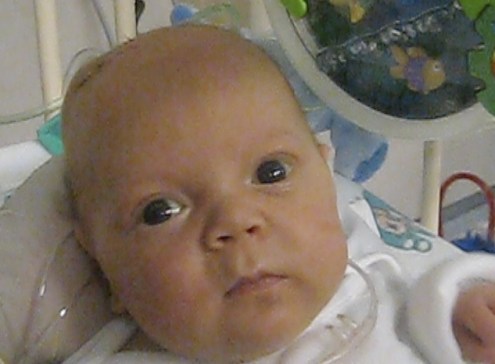
Mr. Charles Oliver Thomas Miller will be entertaining visitors at home next week!
(P.S. His “old man” just turned 50.)
Preferring Seasons to Reasons
I’m filled with remorse now for uttering on Twitter the blasphemy that I was bored with the seasons — always the same ones, in predictable order, year after year after year. “Couldn’t the planet tilt another way for a change?” I tweeted. In the movie, presto! Midas gets his wish, we all go flying into space, or icecaps clang down on Ecuador, or the weather just goes bonkers — hell, we already have cause to be nostalgic for predictability (insofar as the weather ever was predictable; nostalgia lies).
Maybe I was really just lamenting how fast the seasons revolve by now (like the sun and moon in the classic George Pal/Rod Taylor movie of H.G. Wells’s The Time Machine, which we watched on TCM last night), or protesting my own sensory remove from them, indoors most of the time and bent over J or the computer. Because no sooner had I said that stupid thing than I got all excited because for the first time all summer, cold water came out of the cold water tap. Then I had the first really crisp apple in six months. I fell for our planet’s temperate trick all over again.
When I was in high school we did a “voice-speaking choir” performance of Stephen Vincent Benet’s John Brown’s Body. Someone had cut that wonderful book-length poem (you can get a good old copy for pennies) about the Civil War down to a spoken and sung chamber piece (there used to be a recording of it). I still remember a lot of it, including this:
Autumn is filling his harvest bins with red and yellow grain,
The fire begins and the frost begins
and the floors are cold again.
The floors are cold again.
When you’re a child, the seasons are a huge sensory drama, so much bigger than you — like the acts of a really grand opera. The revolving transformation of the scenery alone makes you gasp with awe. And it’s total immersion, not just visual: the smoke smell and fire color of leaves, the sugary burn of snow. Seasons make synaesthetes out of everyone; each one is an inextricable complex of color, texture, sound, and smell — you can taste cold, smell color, be smothered in humidity’s sweaty-breasted embrace. And each season is topped by a holiday, the cherry on the sundae, that concentrates it to its conscious essence: if fall is an apple, Hallowe’en is apple brandy. I adored holidays for the way each one summed its season up and made it consumable, a communion.
Habit, responsibility, introspection, and “development” — the razing of woods and selling of fields to build malls and suburbs — are all great estrangers from the senses. All four may have something to do with the way time has speeded up as we’ve gotten older. (I can’t even imagine what it’s like to be a kid now — what marks the seasons? Corporate fruitings like the release of the new American Girl or Wii? You don’t even wait for the floors to be cold again to go back to school. You go back in brusque violation of the laziest, sleepiest, most mindless days of summer. That’s symptomatic of some way the human world has spurned nature.)
The senses are roots: they tether you to the earth and keep you turning in time with it, inexorable but unhurried. La vida es corta, pero ancha. Life is short, but it’s wide.
Communism — Why Not?
I keep hearing progressives use the word “communism,” and they obviously are not afraid of the idea. Certainly not these days, now that we “know”capitalism doesn’t work. They explain how happy everyone is in Scandanavian countries, and what a crime it is that the richest country on earth, America, does not take care of its citizens. If you tell them communism has been tried and it failed every time, they say it never was done correctly. If you tell them the Scandanavian countries are actually capitalist, they change the subject. If you tell them communism is not compatible with individual rights and freedom they won’t believe it. Or they’ll say we aren’t free anyway, in a country owned by giant corporations.
So why not give communism a chance, now that we don’t seem to have much to lose anyway? We’re being strangled by too-big-to-fail monsters, in league with a government full of crooks. How could communism be any worse than this? Aren’t we smart enough by now to create a system that is fair and efficient and logical, and compassionate?
You would think so, with all the noble prize-winning scientists and economists we have here. How hard can it really be?
What they don’t see is that creating a functioning economic system is one of those things that seems like it should be possible, but isn’t. Scientists have never created a living organism, they have never created a computer with anything like human intelligence. And for similar reasons, they will never create a functioning economic system (not to mention a functioning system that is also fair and compassionate).
Progressives have not ever been able to see the limits of science and human intelligence. If humans can build rockets and split atoms, they should becapable of anything.
I won’t try to prove my point in this short post. I’ll just say, for now, that human intelligence and science have limits. We can make progress in certain ways but not in other ways. And our progress always has unforeseen consequences. Conservatives generally know this, or at least are much more likely to know it than progressives. Progressives don’t know it, won’t believe it, and can’t see it.
Gang Sign of the Times
I mentioned that I worked out with Icepick the salutation for the times: “Glad to hear things could be worse!”
Ron then said, “We need a gang sign, too.”
So now we have one. Icepick:
I see Ron wants a gang sign to go with the salutation. I suggest an outstretched middle finger pointed at ones own temple, shorthand for “Still fucked.”
Does the VA Nudge Seniors Toward Death?
I didn’t buy the “death panels” rhetoric, but based on this, I’m reconsidering.
Note that neither Hot Air nor the WSJ actually links to the VA booklet. When you do, the first thing you get is this disclaimer:
Your Life, Your Choices was officially retired from use in VA in 2007, and an expert panel was convened to review and comment on an online module version of this document that was under development at that time.
Ha! So there are “panels.” Expert panels. Doesn’t that make you feel better?? God, I’m so sick of the fucking “experts.” What does that word cover anyway? Psychologists? Economists? Are there any combat-disabled veterans on the panels? The only “experts” on this subject are the patients and families who’ve been there, and the good doctors and nurses who’ve been in the trenches with them.
The Your Life, Your Choices online module is currently being revised based on suggestions from the expert panel members and from chaplains representing eight different faith groups. The revised online module is scheduled to be released on the My HealtheVet Web site in the spring of 2010.
Please note that portions of this document have been interpreted by some to be negative in tone and insufficiently balanced. The revision process is addressing these concerns. Also note that some of the links contained in the document are no longer active.
Hey, wait, I found the Expert of Experts! His name is Robert A. Pearlman, he’s the author of the VA booklet, and in this photo at least he bears an uncanny resemblance to Tim Geithner. (Purely rational Vulcans all?) He studied ethics at Harvard. How much more expert does it get?
He received post-residency training as a Robert Wood Johnson Clinical Scholar, a Fellow in the Ethics and the Professions Program at Harvard University, and a Faculty Scholar in the Project on Death in America. He joined the [National] Center [for Ethics in Health Care, apparently part of the VA] in the summer of 2000. His interests and expertise pertain to empirical research in clinical ethics (especially end-of-life care) and organizational ethics. His research has explored euthanasia, the role of quality of life in decision-making, the validity of life-sustaining treatment preferences, medical futility, advance care planning, physician-assisted suicide, and relief of patient suffering. He is the author of two books and over 100 publications in medical journals and book chapters. His most recent book, entitled Your Life, Your Choices, is an interactive workbook to help patients and family members with advance care planning. Your Life, Your Choices will be available to veterans through MyHealtheVet in 2007.
Forget Ezekiel Emmanuel: is this the government’s Dr. Death?
But now I’m really confused. The preface to the online booklet now says “Your Life, Your Choices was officially retired from use in VA in 2007.” Made available and retired in the same year?? Or am I misunderstanding?
Here’s Jim Towey, creator of what he calls “the most widely used living will in America,” “Five Wishes” (not unlike Your Life, Your Choices, “introduced in 1997 and originally distributed with support from a grant by The Robert Wood Johnson Foundation”), being vague about exactly when the workbook was instated (I’m trying to figure out whether the dates need to be jiggered to make Democratic administrations solely to blame for the thing and Republican administrations the blameless heroes who questioned it):
Last year, bureaucrats at the VA’s National Center for Ethics in Health Care advocated a 52-page end-of-life planning document, “Your Life, Your Choices.” It was first published in 1997 and later promoted as the VA’s preferred living will [VA “Fact Sheet” rejoinders that it is “not an advance directive or a living will.”] throughout its vast network of hospitals and nursing homes. After the Bush White House took a look at how this document was treating complex health and moral issues, the VA suspended its use. [VA “Statement” says “The document was developed under a federally funded research grant over a decade ago and in 2007, the Veterans Health Administration convened an outside panel of experts to review the tool and assess its merits. Overwhelmingly, the panel of experts, which included a diverse group from the faith based and medical communities, praised ‘Your Life, Your Choices’ and endorsed its use.”] Unfortunately, under President Obama, the VA has now resuscitated “Your Life, Your Choices.”
Who is the primary author of this workbook? Dr. Robert Pearlman, chief of ethics evaluation for the center, a man who in 1996 advocated for physician-assisted suicide in Vacco v. Quill before the U.S. Supreme Court and is known for his support of health-care rationing.
Here’s a perfectly decent handout on advance directives which, however, refers people to Your Life, Your Choices at the end.
So the booklet was “developed” with federal money during the Clinton years; it’s unclear when the VA began using it; and it’s unclear what happened to it in 2007 and whether its use has now been reinstated without input from “faith panels.” (The booklet encourages its users to consult religious advisers.)
Looking at the booklet, it certainly hits you right between the eyes with some gruesome though not unrealistic scenarios, and there is certainly a none-too-subtle bias in the discussions against taking heroic measures — or even antibiotics — to prolong a life clearly near its natural end:
Chris Larsen [age unspecified] never told his family what kind of medical measures he’d want if he became critically ill. He is in a nursing home after having suffered a severe stroke 9 months ago. He is paralyzed and unable to take care of himself or communicate in any way. Now he has pneumonia and will probably die unless he goes to the hospital to receive intravenous antibiotics. He also may need to be on a breathing machine for a week or so. The doctor says that his chances of returning to normal are remote, but that he has a fair chance of getting over the pneumonia. His family members disagree about what they should do. His son Bill says, “Dad was never a quitter. He’d want to fight to the very end, as long as there was the slightest hope.” His daughter Trudy disagrees. “Sure, Dad wasn’t a quitter, but he wanted to die naturally—he would be horrified to be kept alive this way.”
In fact, Trudy’s views were the closest to Mr. Larsen’s true opinion. But the family never had a way to find this out. They treated his pneumonia and he lived another year in the nursing home without recovering his ability to communicate or care for himself.
This is on page 5. It’s offered as an example of why you need to think and talk about these issues while you can. The trouble with such hypothetical scenarios is that not only do people differ in their values and beliefs, but each case is unique and often unpredictable in its particulars. After we got to Chapel Hill just about exactly three years ago, J declined both mentally and physically, until in December 2006 he ended up being taken to the hospital with pneumonia. He certainly would have died if he hadn’t been treated. His doctors and I agreed that a DNR order (do not resuscitate, i.e. no ventilator or defibrillator) at least was appropriate, and a woman resident asked me if I didn’t think it was time for “placement outside the home.” However, IV antibiotics was all it took to resurrect J — in a matter of hours, he went from virtually comatose to sitting up in bed talking coherently on the phone to my mother — and it turned out that most of his steep mental decline over the autumn had been due to incipient pneumonia, not accelerating dementia. The rest is history. If he were in a late stage of neurological disease, contracted in a fetal position, uncommunicative, and uncomfortable, IV antibiotics would not be appropriate.
(No, he doesn’t have a living will. Probably the best course for him is to ask him to sign a health care power of attorney. Though actually, I just learned from this very booklet that if you trust your spouse, that’s who will be consulted in the absence of a POA. Either way, it will someday be up to me, who knows J best, to decide whether, based on his mental status, responsiveness and awareness, he who loves food so much would want to be kept alive by a feeding tube. J is also the kind who might well look me in the eye someday and say lucidly, “Let me die.” But if something happens to me first?)
Naturally, the VA booklet is being quoted selectively by conservative culture warriors. (The exercise on “What makes your life worth living?” on p. 21, however, doesn’t need selective quoting to be every bit as bad as they say it is.) Towey in the WSJ notes that “There is a section which provocatively asks, ‘Have you ever heard anyone say, “If I’m a vegetable, pull the plug”?'” In full, that section merely notes that people sometimes do actually say things like that without being very clear about what they’re talking about:
Have you ever heard anyone say, “If I’m a vegetable, pull the plug”? What does this mean to you? What’s a vegetable? What’s a plug? Even people who live together can have very different ideas about what the same words mean without knowing it. When you say, “pull the plug” it could mean a variety of things:
•Stop the breathing machine
•Remove the feeding tube
•Don’t give me antibiotics
•Stop everything
The booklet’s central question is, “For you, is there such a thing as unacceptable quality of life? Where would you draw the line?”
It’s not that these are bad questions. It’s, why is the government asking them? (A far more important question than “Did a Democrat or a Republican administration ask them?”) Or, for that matter, why is an insurance company asking them, or a nursing facility which makes money when patients’ lives are prolonged? All of these parties have classic conflicts of interest — as, for that matter, can family members eager to be rid of a burden or to collect an inheritance. Families are not always havens in a heartless world — as Your Life, Your Choices rather ghoulishly acknowledges when it invites you to check “Yes,” “Not Sure,” or “No”:
I believe that my loved ones should take their own interests into consideration, as well as mine, when making health care decisions on my behalf.
I believe that it is acceptable to consider the financial burden of treatment on my loved ones when making health care decisions on my behalf.
The ultimate question is rather like that about sex education: is this a private matter, even if it inevitably means some kids will be kept in barbaric ignorance or misinformed? Do you really want some nanny bureaucracy with a “rational” agenda to impose its one-size-fits-all values on the intimate lives of your kids? Can the transmission of information about such issues ever be value-free?
It’s doctors who should be educated, in the most humane possible way (I mean they should read the humanities, philosophy and literature, as well as psychologists and other “experts”), on these issues, and doctors, together with trusted family members and chosen religious advisers, who should be working out the decisions. Family doctors used to do this, and no doubt plenty still do. Yes, it’s a priestly function. People do look up to their doctors that way in life-and-death situations, so doctors might as well live up to it.
You are Always Near
Poignant sand animation telling the story of Ukraine during World War II by the artist Kseniya Simonova.
 Ambiance