On Marshmallows and Willpower
Amba’s recent post on the elements of a successful life, along with Pat HMV’s response, put me in mind of this New Yorker article I read while at the doctor’s office. Here’s a taste:
In the late nineteen-sixties, Carolyn Weisz, a four-year-old with long brown hair, was invited into a “game room” at the Bing Nursery School, on the campus of Stanford University. The room was little more than a large closet, containing a desk and a chair. Carolyn was asked to sit down in the chair and pick a treat from a tray of marshmallows, cookies, and pretzel sticks. Carolyn chose the marshmallow. Although she’s now forty-four, Carolyn still has a weakness for those air-puffed balls of corn syrup and gelatine. “I know I shouldn’t like them,” she says. “But they’re just so delicious!” A researcher then made Carolyn an offer: she could either eat one marshmallow right away or, if she was willing to wait while he stepped out for a few minutes, she could have two marshmallows when he returned. He said that if she rang a bell on the desk while he was away he would come running back, and she could eat one marshmallow but would forfeit the second. Then he left the room . . .
Carolyn was in the thirty percent of the test subjects able to hold out until the researcher returned fifteen minutes later. But most of the kids couldn’t. They either ended up ringing the bell, or scarfing down one or more of the pieces of candy outright.
The initial goal of the experiment was to identify the mental processes that allowed some people to delay gratification while others simply surrendered. After publishing a few papers on the Bing studies in the early seventies, Mischel moved on to other areas of personality research. “There are only so many things you can do with kids trying not to eat marshmallows.”
Well, so he thought at the time. Actually, it turned out that there was a lot he could do with the kids trying not to eat marshmallows. In 1981, Mischel began to follow up with his test subjects of old, and found that the “high delayers” who were successfully able to hold out for two treats were also largely more successful than the “low delayers” in terms of academic and career achievement, and were considerably less likely to have suffered from behavioral problems. Self-control, it turns out, is significantly more important than even raw IQ in predicting success in life. Score one for M. Scott Peck.
Since then, he and his collaborators have continued to track them through their adulthood, for a while relying on self-reporting, but recently also adding MRI’s and brain imaging technology to the mix, in the hope of producing a neurological map of the parts of the brain involved in self-control. Even more interestingly, their research has already begun to hint at what the essence of self-control actually is:
At the time, psychologists assumed that children’s ability to wait depended on how badly they wanted the marshmallow. But it soon became obvious that every child craved the extra treat. What, then, determined self-control? Mischel’s conclusion, based on hundreds of hours of observation, was that the crucial skill was the “strategic allocation of attention.” Instead of getting obsessed with the marshmallow—the “hot stimulus”—the patient children distracted themselves by covering their eyes, pretending to play hide-and-seek underneath the desk, or singing songs from “Sesame Street.” Their desire wasn’t defeated—it was merely forgotten. “If you’re thinking about the marshmallow and how delicious it is, then you’re going to eat it,” Mischel says. “The key is to avoid thinking about it in the first place.”
In other words – to have willpower is to have some knowledge about how your brain works, and to be able to effectively distract yourself from being overwhelmed by desire or fear. The journalist likens this to Odysseus, tying himself to the mast of his ship in order to hear the Sirens’ song without committing suicide.
The implication of this is that what we think of as “willpower” or self-control may not actually be a force of mind so much as a kind of creativity that relies on self-knowledge and shows itself under duress. If true, I think this thesis would go some way towards reconciling liberal and conservative views over the importance of, and effective approaches towards, teaching ourselves and our children how to self-discipline and delay gratification.
The article ends by noting that the researchers have begun a partnership with KIPP, arguably the most successful of the charter schools, to see if such an approach to self-discipline can be effectively taught in the classroom. Read the whole thing.
UPDATE: I neglected to mention that the article is by Jonah Lehrer, who has a nifty science blog. Thanks, Donna!
Summer Fun
Bruno Kammerl’s Megawhoosh, a 35.2 Meter Slip-N-Slide in action
(Via within the crainium)
Scary Reading Material. [UPDATED YET AGAIN]
A web forum on Lewy Body Dementia, which is probably what J actually has. Sample post:
I have just had a few days break from it all, I will pick R. up tomorrow from respite. I am dreading starting back into it all again. I phoned him every day, and yes I had the same thing, who are you with? I love you? when will you pick me up? what time exactly? It is so hard for them, but it is so hard for us as well. I believe one must try and have some life for oneself, if you don’t the disease will destroy you, we have a duty to ourselves as well. All the nurses, doctors, and aides that I deal with have finally convinced me that I must look after myself, it may sound heartless, but I admit that I am beginning to believe them. They tell me they have seen so many carers go before their LO, that is not what God wants. We are all on a journey, and sadly this is our LO journey, we cannot change that. Believe me when I say that I have cried an ocean, I miss the old R. so much, I have all the best care for him,but I do want to survive this, and I don’t feel guilty for feeling this way anymore.
Something else sticks in my head: I forget who told me a common piece of folk wisdom is, “He got sick and she died.”
I try not to haunt such places, to accept that this is the real community to which I now belong. But what I see when I do go there is that this is a very long haul, and that the disease can in fact be fatal — to the caregiver.
UPDATE: Another woman on the forum who’s taking care of her husband did a kind of “intervention” on me, saying that when you respond to every suggestion with “That won’t work,” it’s a sign of “severe burnout.” She then made about eighteen suggestions, sixteen of which — excepting bankruptcy and antidepressants — I’m going to check out starting tomorrow.
When I said that, she kind of leaned on me a little bit to take antidepressants. “Better living through chemistry — your husband is on drugs to improve his quality of life. Why would you not take advantage of the same for yourself right now? If you were cold, would you insist on continuing to run in place to try and keep warm rather than accept a blanket?”
I wonder what that’s about. I am pretty anti-drug, and karate workouts are a very effective antidepressant for me. Why wouldn’t someone say “Great, more power to you”? Why would they try to convince you that you ARE depressed (I’ve been depressed, I know depressed, this ain’t it! fatigue, stress, frustration, loneliness, yes; depression, no) and SHOULD take medication? To validate their own choices? Or just on the assumption that everybody is like them and will benefit from the same things? It’s scary to me, the medicalization and medication of ordinary unhappiness. Take a pill when things get rough??
Many of these women have more help than I do and seem more unhappy. (Maybe I should urge them to take up karate?) Their husbands sound generally more mobile than J, but also more demented. Some of them have been at this already for half a decade longer than we have. They are giving me a preview of what’s ahead.
UPDATE II: A part of the advice I received was to have J evaluated for hospice, because they can give you some in-home care relief paid for by Medicare, a nurse who knows the patient well who’s on 24-hour call, etc. I never tried that because I figured he wouldn’t qualify: he’s so not terminal, God bless ‘im. I thought hospice was for terminal care only. But it turns out the criteria are somewhat elastic. What could disqualify him is that he can still communicate pretty well. What could qualify him is that he’s so immobile and utterly dependent — in the doctor’s words, “degenerative disease and basic care dependency needs.” Hospice can come and go: if the person stabilizes and is doing pretty well they may kick you off it until you really need it again. But even to have that kind of help for a while . . . I can hardly imagine.
And — this is big — the doctor is for it. For my sake, I know. That could count for a lot.
Duke Hospice has a residential respite care facility. That means if I ever needed to, say, have surgery, or just visit my family for a whole week, he could go in and stay there for the duration.
I can’t count on this, because he may not qualify. If it doesn’t work out, we’ll try something else.
I was thinking that the relentless incontinence, day in and day out, is one of the things that wears you down, especially when combined with dementia (which insures that the carefully placed urinal will be removed to a spectacularly useless location — like the Statue of Liberty’s Torch — just in time). And then I thought, maybe they ought to have a special, nonterminal branch of this service called “Hoss Piss.”
UPDATE III: Took J to the swimming pool. He’ll never get into hospice — nor should he. He’s doing too well. I’m the one who needs it — LOL.
Rather like people who fall into the gap between Medicaid (too rich for it) and private health insurance (too poor to afford it), (though that’s not literally our problem, thanks to J’s Screen Actors Guild), J falls into the gap between sick enough for hospice and well enough to walk, wash, whiz, and wipe for himself. In that gap, the considerable burden must be borne by a family member — physically or financially.
You can liquidate your assets and be cared for in a nursing home, but you can’t hardly get help being cared for in your own home, even though it’s cheaper for all concerned. I can’t figure out if this is nutty or simply as it should be. It’s “the natural way” (as I witnessed in Eastern Europe where they didn’t have nursing homes), except that we don’t have extended families living together any more and sharing the chores.
By the way, the county social worker told me about a five-star nonprofit nursing home out in the country to investigate just as backup (were I to get sick or something), and then insinuated if I checked it out I might like it . . . Like antidepressants, nursing homes are pushed on you. “Placement,” they call it. Placement in the basement. “Save yourself!” is the cry. She also urged me to come to a caregivers’ support-group meeting August 20.
If I go, it will be to see if the other caregiver I’ve seen here and there in Chapel Hill goes to them. He’s a soft, stoical man my age or a bit younger, patiently accompanying a ruin of a beautiful woman with some kind of wild, high-stepping palsy. You can see that before she got sick she must have been proud and temperamental in the good sense, like a thoroughbred Tennessee walker. I’ve seen them in an outdoor café and in UNC’s neurology waiting room. He and I both avert our eyes when our paths cross, poignantly and paradoxically together in this salute to each other’s privacy. I’ve seen her, exhausted by her wayward body, lean her head on his shoulder.
Speechless (Appropriately enough, it seems)
I just watched the “don’t do a lot of talking” snippet via Breitbart via Drudge. I don’t think I’ve ever seen or heard its like. Where to begin? There’s the snarky tone in which he declares “I’m President”; there’s the apparent command (I don’t know what else to call it – whatever it was, it wasn’t a “suggestion”) to his political opponents – “don’t do a lot of talking”; there’s the muted, baffled crowd response immediately following (it required an “Am I wrong, Virginia?” from the One. Well, at least he didn’t tap the microphone and say “is this thing on?”).
Here is the most generous spin I can put on this: he wasn’t talking about citizen protesters but about Republican Rep.s in the House and Senate. As I say, this is the most generous, least scary reading. But it’s still pretty scary (question: has any other President actually voiced the opinion that his opposition shouldn’t speak?)
It is also nonsensical. As others have pointed out, the Republicans can’t do a damned thing to stop him from doing whatever he wants in either the House or the Senate.
Scary. Weird.
Tweet Defeat: Twitter Sputters
I’m not the only one to have problems with Twitter today. I’ve been unable to post on it at all tonight; I don’t even get the fail whale, it just tries for some period of time and then quits. (Fortunately, I have been busy with other things and have not wasted a lot of time trying, but I’ve left the little wheel spinning in various tabs and returned to find my tweets still lying there raw and unposted.)
If I were a boofer doofus conspiracy theorist, I’d say the Obama admin is jamming it (ask not how) because they don’t want people talking about their mediocre-to-failing grades on CNN’s second-hundred-days “report card” tonight.
That was the subject of one of my tweets: someone on CNN’s panel said that in contradiction to his stated objectives “Obama is polarizing the country,” and the panel itself demonstrated that: the two conservatives, Alex Castellanos and Bill Bennett, both gave him a D, Donna Brazile gave him an A- including an A for just showing up! (Maybe in the age of Sarah Palin, that is praiseworthy??) His score with the public, averaging out the poles, was C-. (Yes, I actually said the essence of this in 140 characters. What I miss about Twitter: the enforced concision.)
Another lost tweet was a quote from Darwin, which I think has cultural resonance as well (echoing someone’s comment on creative destruction that I now can’t find):
“It is not the strongest among the species that survive nor is it the most intelligent. It’s those that are most adaptive to change.” – Charles Darwin
(I’m fact checking some utterly mind-blowing stuff about how retroviruses have incorporated themselves into the human genome and could even have catalyzed our becoming human, diverging from the line that led to chimps. To make it worse, I’ve lost the source that said that, which makes me feel as if I dreamed it. Apparently this is leading the Intelligent Design folks to say “junk” DNA is God’s tool kit. That is not helping the dizzy feeling.)
Oh, OK, here’s one version of it. What next??!!
OMG! [UPDATED]
This is one bandwagon I had to jump on.
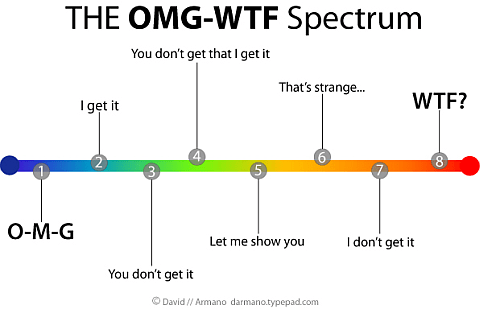
UPDATE: Last night Donna commented: “I don’t get it. Seriously.”
I wrote back: “I’m not sure there’s anything to get!”
This morning the dialogue continued, one-sidedly, in my head before I could get to the computer:
“That is, somebody just thought it would be funny to have an OMG-WTF spectrum, and stuck any old nonsense in between.”
[To Donna] “That just means you’re at the WTF end of the spectrum. If you posted this thing, your post title would be ‘WTF?'”
“OMG! This thing is entirely about itself! It’s a closed universe!”
“I GET IT!”
. . . “I think.”
“Which puts me right back at WTF?”
“It’s not a spectrum, it’s a continuum! Like political R and L, or a Möbius strip!”
“O-M-G.”
What It Takes
The three most important characteristics for success in life, it seems to me, are (in no special order)
- temperament
- entitlement
- perseverance
So what does that mean?
Everybody understands “perseverance,” and it is probably the single most important, and most broadly applicable, prerequisite for success. This was driven home to me when I was writing about the Hubble Telescope. (I know! You’ve read it already! But do read this book.) More than forty years from inception to execution, and then — already a billion and a half over its projected budget of $500,000,000 — finally launched — with a fatal flaw! The pressure to cut losses and leave the thing up there as orbiting space junk was strong. But, no! It took three more years, but they went up and put glasses on it! And it changed the world. Trust me, there’s a similar story behind everything — from vaccine to blockbuster — that changes the world. As @weirdralph said recently on Twitter, “Every giant oak tree is simply the result of a nut that decided to stand his ground.”
Perseverance can probably be acquired, although some people persevere by temperament (i.e. they have an obsessive streak), and having a sense of entitlement helps. The three are intertwined.
Temperament, I think, is a matter of nature and entitlement one of nurture, although certainly nurture can modify temperament (give your child too much of a sense of entitlement, and given the requisite temperament, you may create a narcissistic diva; too little, and you can quench a fire); and different inborn temperaments elicit different nurturing, as any parent of more than one will tell you. But without the inborn drive and some early approval of your using it, all the gifts in the world will just sit there like unbaked dough. Without drive, whether for creation or recognition or whatever, you won’t try hard enough. Without entitlement, you’ll give up too easily.
I Hate This.
It’s like hunting ghosts. It’s like eating in dreams. It’s like climbing a mountain and still being at the bottom, and then doing it again just in case it’s different this time.
Online. Isn’t that a prison term? Or is that “walk the line”?
This is not a life. It’s barely even the mirage of a life. It sucks the life out of life in exchange for an empty promise.
# # #
I wrote a post late last night and deleted it because it was churlish, ungrateful, insatiable, and inhospitable. If someone saw it at that late hour, and I hope not, know that it was intended for you least of all.
Damned with a Painted Phrase!
Proving that to get older is to get more outrageous and outspoken,
My old friend Barry Casselman is smokin‘!
Although some of the new president’s critics have tried to apply a number of sensational epithets to his domestic policies, especially as radical, socialist or quasi-Marxist, the reality is much more conventional and undramatic. In short, Barack Obama, rhetoric notwithstanding, is a classic academic liberal of a type, and from a milieu, which blossomed on elite university campuses and in parvenu liberal salons in the aftermath of the Great Society in the 1970’s. […]
Thwarted in the Reagan/first Bush years, and even during the Clinton years, and certainly during the second Bush years, these aging liberals have accumulated a constipated energy to pass a whole bookshelf of legislation which, in effect, “reforms” nothing, but does further redistribute the resources of taxpayers. Unfortunately, this redistribution is not from the rich to the poor to the benefit of the latter, but a transfer from all taxpayers to the most inefficient bureaucratic tangle of all times, an outcome so ultimately destructive that it is apparent, before the fact, to anyone who has basic mathematics skills. […]
The Democratic leaders understandably speak about their hurry to enact their liberal domestic legislation. [… The failures of the Bush Administration are discussed] The proposals, now being advanced by the administration and the Democratic leaders in Congress, and making their way toward enactment, are legislative zombies, i.e., they are walking but not breathing. Perhaps by intimidation, some of them will be passed into law, but only at the cost of a great political reaction in 2010 and 2012.
Who says centrists can’t be passionate and scathing? To me, Casselman’s indictment is far more devastating (because of its ring of truth) than fantasies of all the birfers and socialism scaremongers put together. Read the whole thing!
 Ambiance