Why the Professional Political Class are Parasites on Us All
[S]trategist James Carville became the first leading Democrat to suggest publically that there might be political advantage in letting Republicans “kill” health care.
“Put a bill out there, make them filibuster it, make them be what they are, the party of no,” Carville said. “Let them kill it. Let them kill it with the interest group money, then run against them. That’s what we ought to do.”
Govern These Ventages with thy Fingers and Thumb, Give it Breath and it will Discourse Most Elequoent Music.
I’ve been very busy the last few weeks preparing for and attending the National Flute Association’s annual convention, this year held in New York.
This is a not-to-be-missed event for serious American flute players and makers. It also attracts a large international following. It may seem strange to have a convention for devotees of a musical instrument, but every year 3,000-odd flutists and flute makers cram themselves into a hotel in some sweltering city in August to hear concerts, go to lectures and workshops, and attend a trade show with every conceivable type of flute and flute-like instrument on display.

I realize this may sound to many, especially to musicians who don’t play the flute, like a particular circle of hell. But flute players have always been highly social creatures, seeking, I think, more than other instrumentalists, both to compete with and to be approved by their peers. It’s been this way for a long time. The first periodical journals devoted to a musical instrument were early 19th century British flute magazines. The flute has been a popular amateur instrument for a long time, so it isn’t surprising that music magazines aimed at this particular audience sprang up in the era of the rise of the middle classes, many members of which now had the leisure to devote to doing things like learning to play the flute or the new piano in the parlour.
The flute makes players insecure because it is, of all the woodwind instruments, the one with the greatest tension built into its very concept. Other woodwinds use mouthpieces and/or reeds that the player interacts with to produce the basic sound. These are ephemeral things that constantly need renewal, and over which players can exert considerable control and personalization. There is also an intimacy to making a sound with something vibrating in your mouth that is different than that experienced with any other musical instrument.
But the flute is oddly extrinsic. The sound is to a very real degree built into the instrument, and the job of the player is to discover it, shape it, and bring it out. Although this is extremely personal, it resembles the interaction of the player with practically every other musical instrument, and not the intensely internal kind of relationship other woodwind players can have with their instruments. The slightest physical problem, especially with the lips or mouth, can make it almost impossible to play the flute, but at the same time, there’s always something out there, just beyond the player’s grasp, that needs the best posible physical control. The tensions inherent in this situation tend to make players insecure. So it’s very common for flutists constantly to be seeking new headjoints (the top part of the flute, where the pedal hits the metal, so to speak), or to be on the lookout for a new instrument.
This is a very good situation for flute makers, but highlights another tension in flute playing: The instruments are expensive.
I’ll get into this in more detail another time with one of my usual musical instrument posts, but the basics of the situation are that the modern, metal flute was invented in 1845 to be made, not of just any metal, but of silver. The techniques used in making it are variants of silversmithing methods, and those alone, combined with the price of the precious metal, tend to produce instruments that are costly. The best flutes are also made to a very high standard of craftsmanship, which has been the tradition of flutemaking since the days of boxwood and ivory flutes in the 17th century. Related is the problem that the post-1845 Boehm flute (named after its inventor, Theobald Boehm) has a very difficult-to-make mechanism, whose complexity and subtlety of interaction with the player are found nowhere else among woodwind instruments.
Here’s a picture of old Theobald, looking very determined, and holding the wooden version of his new toy (developed AFTER the metal one):

A good, professional modern flute will start at about $10,000. There are usually a number of options of precious metals and variants of mechanism that most makers offer, so it is not uncommon for a player to spend $15,000 or more for a fine instrument. The reasons are, of course, the high cost of silver, gold, and platinum (the metals used to make flutes and/or various bits on them), and the fact that a truly well-made instrument can take hundreds of hours of skilled craftsmanship to produce.
There are perfectly good cheaper instruments, but the reality is that it’s necessary to spend at least $3,000 to get a flute made of silver that approaches professional standards. You can get $149.95 flute-shaped objects at Target, usually made in a sweatshop in China out of some dubious nickel alloy, which may or may not be radioactive because of the medical waste in it. But you can depend on these excuses for shipping toxic waste from China to ultimately end up at the bottom of a pile of junk in the basement or forgotten in some closet, long after poor Buffy has given up playing the damned thing. It just was a lot harder to play and so much more out-of-tune than anyone expected, especially the unsuspecting kid on whom it was foisted.
That is not to say that decent instruments are not made in China. But, while they may be cheaper than similar instruments produced elsewhere, for reasons that Chinese goods are always cheaper these days, the fact remains that you get what you pay for, and you are going to have to spend upwards of a minimum of $1,000 to get something functional and which resembles a musical instrument.
So there you have some nice reasons for insecurity: The nature of the instrument, the player’s interaction with it, and the expense.
If those don’t make you want to seek help, I don’t know what would. And what better place to find it than among 3,000 of your best flute-playing friends?
(Cross-posted from A Quiet Evening)

A Visitation [Updated]
In one of my involuntary micro-naps during sleep-deprived work (during which I can type a long one-letter string or paragraph into a footnote — I call them “sleepos” — and am in some danger of falling face first into, or drooling on, the keyboard), I saw Max, plump, shiny, groomed to youthful perfection, leap in a light arc under the dining room table and pounce on something.
UPDATE: Meanwhile, Max’s earthly part was buried by friends today on their land. You see him here with Dusky, whose body has actually been in my freezer ever since he died in March 2008. (Notice that I handled it — or not — almost exactly the same way. How comically consistent we are.)

This sounds grotesque and ridiculous till you get that it’s an arrested vestige of our former life (and maybe even then). Jacques, having been a prisoner in a very cold place, and buried corpses of his friends stacked in the snow till springtime when the permafrost melted (even as I write that I know I can’t begin to imagine it), could not bear the thought of his “kittens” (as he calls them lifelong) being buried in cold ground. He knew perfectly well that when they were dead they wouldn’t feel it, but he would. So I had to take them down to our family’s house in Florida and bury them there, three feet deep in the sand. Ironically, in order to preserve their bodies until I could get down there, I had to freeze them. I guess that was okay because it was necessary and only temporary: the end justified the means, or something. We had many cats over the years (my first e-mail address ever was manicatz@aol.com), and I dug many deep holes and buried many cats around that house in Florida where my parents now live. Someday a hurricane may exhume a mysterious trove of feline skeletons, scoured to a polish by Florida’s busy subterranean life.
When Dusky died, I reflexively put his body in the freezer, even though I knew that Jacques would soon mostly forget and would not be able to sustain a wish or plan about Dusky’s body. I knew I could bury the body near here, or have it cremated, or whatever I saw fit, but I froze, unable to quite let go of my end of our bargain, even though the other end was slack and it was no longer practical for me to do things the old way even in J’s honor. This paralysis was probably a typical expression of ambiguous loss.
So today I asked our friends to bury the two cats together, and explained that we weren’t going to be there because I didn’t want to break the news to J that Dusky had spent a year and a half in the freezer, even though his comprehension would probably have been slow and incomplete and his upset fleeting.
They looked like yang and yin. They looked way too touchable and vulnerable until our friends threw flowers on them.

Letter From A Dairy Farmer
I have no idea what (if anything) should be done about this, but it’s hard not to be concerned. Thoughts?
Addendum: Here’s some background.
Thoughts on Euthanasia — In a Cat.
(an essay in thirteen tweets — first to last for easy reading)
- Thoughts on euthanasia–in a cat: more I think abt, more I don’t like this “sedate first” protocol. It’s not for the animal, it’s CYA 4 vet.
- Vet is worried abt havg trouble shaving/finding a vein on a sick, dehydrated animal, causing the animal & thus the owner visible distress.
- Understandable, but a lack of skill & confidence. I’ve seen good vets w/good touch simply inject euthanasia solution. Instantaneous painless
- Sedation shot defeats its own purpose: 1) it’s ketamine or another “dissociative” maybe plus valium. We don’t kno what animal experiences.
- Vet sd to me “he won’t experience anything.” oh yeah? then why some vets trip on ketamine?? cd be MORE scary exp., but OK ’cause paralyzed!
- In other words, if the owner can’t SEE the distress it doesn’t exist. Bullshit! 2) Sed.shot hurts like hell! Has “salts” in it that sting.
- Max’d been calm; at “sedative” shot he growled, tried to bite. Giving fluids under skin w/needle never hurt like that-kinda defeats purpose!
- Bottom line: really skilled & confident vet wd just DO it & animal wd respond to some vets’ trust-inspiring touch & phlebotomist-like skill.
- I’ve seen it! I had vet friends that good. One is dead & one is semiretired in SC They’d even shoot euthanasia sol. directly into heart-best
- I did that once myself, on a cat so emaciated I could feel her heart between her ribs & couldn’t miss.
- Discussion w/young vet: “We gotta go through it all the way to the end. They don’t.” We can understand & maybe must learn, right up to death
- Animals often die with a beautiful stoicism & appearance of understanding. But I’ve seen 2 struggle to run away as if death were a predator.
- Death just seems wrong. Very puzzling: how can something that always wins be wrong?? Are we wrong?
On Wyden-Bennett
Like President Obama, if I could wave a magic wand and create an all-new healthcare insurance system for the United States, I would probably choose single-payer. Yes, it can create rationing problems, but with proper incentives to expand supply this can be managed reasonably well (as it is in Canada, France, and the Netherlands). It is inherently more cost-efficient – as Nate Silver argues, health insurance competition, particularly the sort of mini-monopolistic competition we have here, does little to control costs or improve services. It would cover everyone. And it has the attraction of being simple and easy to understand.
But, that’s not the world we live in. Most Americans don’t agree with me; they don’t want single-payer healthcare. And increasingly they don’t seem to want the “public option” either, either because they think it will constitute single-payer by stealth, or that it will turn into another Fannie Mae. So it goes.
And yet healthcare reform remains necessary. Healthcare costs have been rising at an unsustainable rate for decades now. Those costs will bankrupt Medicare in just a few years if nothing is done. We also have de facto rationing by the market, along with priviliged care for the wealthy who can jump lines the rest of us cannot. And for all that we spend on healthcare – 17% of our GDP – we don’t get quality of care that is especially good when compared to peer nations.
So with all that said, I’d like to put in a few kind words for the other healthcare bill floating around Congress – the Healthy Americans Act, or Wyden-Bennett.
Wyden-Bennett strikes me as a definitive example of radically moderate legislation. It’s radical because it breaks the key feature of our current insurance system for people under 65: the tax break on health insurance when it’s paid for by your employer. It’s moderate because it achieves near-universal health insurance while actually increasing market competition. And according to the Congressional Budget Office, not only would it be budget-neutral by 2014 (as of 2008), but in time it could actually reduce our government’s expenditures.
How does it work? Wyden-Bennett mandates that all Americans and permanent residents (other than the elderly and the military) must purchase private health insurance through a state-based pooling system. This purchase would be facilitated by a large tax exemption ($6000 for individuals, up to $15,000 for families) that decreases as income rises, eventually disappearing for earners in the top tax bracket. People under a certain percentage of the poverty line would be eligible for a voucher on top of that. The premiums you would pay for your insurance would be community-rated on the basis of your pool – i.e., sicker people would not have to pay higher premiums.
For most people this would replace their employer-based insurance; it would also replace Medicaid and SCHIP programs, as well as the individual insurance market.This is of course the most radical aspect of it, since the conventional wisdom is that most Americans like their current insurance and want to keep it. Of course, that conventional wisdom was formed in 1993 during the Clinton attempt at healthcare reform; things have changed since then.
For example, portability of healthcare insurance, has become far more important. Very few of us keep the same job our whole lives. And very few of us remember the last time our country approached 10% unemployment. If you would resist Wyden-Bennett on this basis, it’s worth asking: if you were to lose your job, how quickly do you think you could get a new one in this economy? What kind of job could you replace it with? The simple fact is that for anyone who does not have tenure, relying on your employer for your health insurance is considerably more risky than it used to be.
Wyden-Bennett would establish standards for the new plans offered through the pools that would be actually equivalent to the Blue Cross/Blue Shield plan that is currently the standard for federal employees. It would control costs by offering incentives for insurance providers and healthcare providers to improve efficiency, and for purchasers to engage in preventive care. It’s not perfect by any means – and it desperately lacks a constituency to get behind it. But it’s the best option currently on the table.
For further reading:
Here is a balanced analysis of Wyden-Bennett by the Center on Budget and Policy Priorities.
Here is a tool from the Kaiser Foundation that allows you to compare the current health care reform plans side-by-side.
Here is an interview between liberal health care policy wonk Ezra Klein and conservative senator Lindsey Graham on Wyden-Bennett.
Hyperbole and Hysteria: Immune System of the Body Politic?
I’ve never heard the word “fear” used so much on television. “Do you fear a government takeover of health care?” The conservative and Republican strategy has been to block this bloated reform package by frightening the citizenry with unfounded rumors about “death panels” and the like.
Maybe, in the fog of Too Much Information, scare tactics are the only way to get citizens involved.
I know that what I feel for that 1,000+-page bill I’ve read only bits of isn’t fear; it’s loathing. Prove to me if you can that big government bureaucracy isn’t the most inefficient, wasteful, and unaccountable way to do most things. (Exceptions like the CDC, which facilitate a swift, centralized, coordinated response, often turn out to be subsets of defense — and I’d hate to start reading about what’s wrong with the CDC. FEMA should have been a subset of defense, too.) Government can play an excellent role in establishing ground rules and incentives that reward economic efficiency and quality care — learning from the best private innovations and creating circumstances that make it easy to study, adapt, and reproduce those best practices (which cannot be assumed to work exactly the same way in different places).
I like this image and so will repeat it for about the third time: government is meant to fine-tune the engine, not to be the engine — as such, it’s a gas guzzler with tailfins!
But that isn’t fear. I’m very struck by the way conservatives see the federal government as sinister and inimical, as if it were some alien cancer on the body politic, while liberals tend to view it naïvely as just “us” — a basically healthy organ of the will of the people. If representative government has mutated into a cancer, it isn’t alien — it’s one that arose from within. In my view, it’s really more like a large benign tumor: more burdensome than toxic. Yet there’s always been a suspicion, which flared up in the Red Scare of the 1950s and is baa-aack in the claims that Barack is “furrin,” that alien ideas are being injected into the system and causing some citizens to mutate into aggressive enemies of freedom. On this analogy, fear is inflammation. “Inflammatory” rumors, or humors, are arousing citizens to surround and attack “un-American” ideas, as white blood cells recognize and destroy anything in the body that’s “not-me” — and sometimes, in their zeal, turn on the body itself.
You tell me whether the town hall shouting matches are a healthy immune response or a runaway autoimmune disease. Then I’ll tell you what I think.
Max’s Last Meal [UPDATED]
I feel like an idiot, just like I knew I would.
I knew I was going to break and spend several hundred dollars I can’t afford to hear a vet tell me what I already know: that our cat Max is at the end of his life. And sure enough . . .
Max has been failing: losing weight, sleeping by the water bowl despite the subcutaneous fluids I had begun giving him. He was eating hungrily, but that was one of two things: Max has always loved food more than anything, and it was his last pleasure (I can relate); and/or he was feeding a cancer. He came to us as an adult so I’m not precisely sure of his age, but seventeen is a good guess. When a seventeen-year-old cat starts to go downhill, it’s usually kidney failure, cancer, or both
The last couple of days, Max was unable to eat much (though still interested), drinking less, breathing a little fast, a little labored. Two days ago his belly began to swell with fluid. He just lay in a corner, and I thought it was time to have a vet come to the house and euthanize him.
Then he got up, ate, drank, washed his face, scratched himself (staggering a bit), and came over to hang out with me. He still seemed interested in living, so (after consulting my beloved vet friend Rick from New York who now lives in SC) I decided I had to look into the slim chance that it was something treatable for a little while, like heart failure.
This always happens. And it never ends well.
* * *
Max was given to us in the mid-’90s, along with his portrait, by the artist Bill Adams (an old family friend of the Love Goddess), who was about to marry a video artist who was allergic. (Freed from reality, the cats in Bill’s art have gone on to become quite fantastic, even a little scary.) A few months after the transfer, Bill came over to visit. As we sat across the table from each other, Max went and lay down on the table in front of Bill. As the time approached for Bill to leave, Max pointedly got down from the table and lay down on my feet. He could not have made himself clearer. I was greatly touched.

The editorial asssistant.
It’s a rare cat that can walk into a household of strange adult cats and not cause a ruckus. Max was that cat. It’s the territorial terror of the newcomer, the stink of fear, that usually sets off aggression from the homeboys. Max simply walked in calmly like he owned the place, so the other cats shrugged and guessed he did.
He was just a Humane Society kitten, but he had the air of a portly and faintly melancholy gentleman, and the tastes of a reincarnated gourmet chef. Max doesn’t just love food, he loves well-prepared food with spices and sauces, much preferring it to raw or plain cooked meat. Dinnertime approaching? He ‘s on the table, purring with anticipation. We let him, because it’s usually just us. Our occasional guests either roll their eyes and tolerate it or remove him gently to the floor, where he is consoled with his own plate in the kitchen.
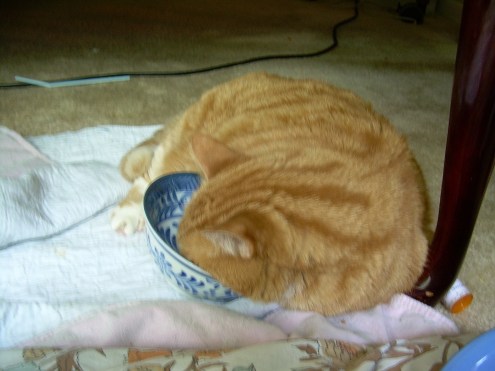
Max is deeply kind. Lucky, the cat we rescued from Romania, who had been a tom for many years, used to attack him. And yet, when Lucky was blind, deaf, and dying of kidney failure, Max lay down touching him. Again he made his meaning clear. There was no other way to understand it than as an attempt to comfort and orient. Since then I’ve called him Dr. Max. Other effanineffable nicknames; Perp (from “he’s so orange he’s almost purple”) and Roadie (from “Roadblock,” because he’s always right where you want to go).

* * *
The vet cut to the chase, doing an x-ray and a tap of the fluid in Max’s abdomen as the best way of getting the big picture. The x-ray showed fluid in his chest as well as belly, probably making him feel as if he’s suffocating. The tap showed lymphocytes in the fluid. Probable lymphoma.
We could either do more tests to be sure, plus some palliative, temporary fluid removal, or put him to sleep. Only the latter made any sense, and not just financially. I was prepared for this. I hadn’t wanted to cry and get the professional comforting, but of course I did that too.
I wasn’t tough enough to have him put down right then and there in the vet’s cold, bright office. I wanted J to see him again and I wanted Max to be at home, comfortable and happy. So I’ve arranged to have one of the vets come over tomorrow morning. Costs more, but what the hell. It’s the diagnosis I should’ve skipped. This is the good part of my folly, the part that’s not negotiable. The vet gave Max a lasix shot to reduce the fluid and keep him comfortable. He’s much more able to purr and express his relief at being home. (And of course J is saying, “Maybe you shouldn’t be in too much of a hurry to put him to sleep.”)
So now I’m pondering what to make for dinner tonight. Tilapia, I think, dusted with flour and cumin and browned in a mixture of canola and toasted dark sesame oil. Max loves that. So do we. He’ll be on the table, and we’ll eat together for the last time.
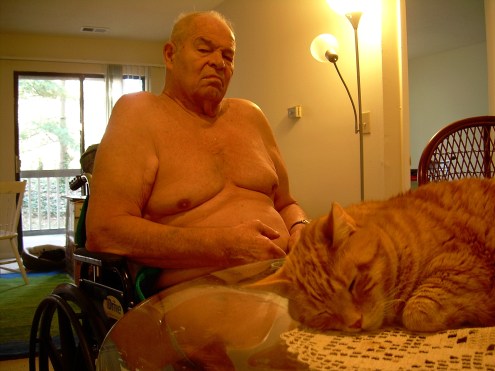
One year ago
UPDATE: We did make the fish; and as the aroma of cooking circulated through the apartment, Max did indeed appear.
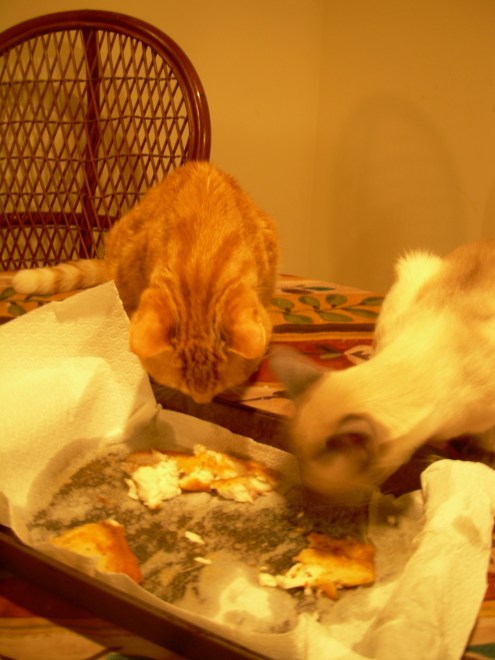
Max's last meal.
But he didn’t lie down on the table and purr afterwards the way I hoped he would. Instead, he hurried back to the bathroom to lie down behind the toilet — a cat’s way of saying “I feel like shit.” (I’ve actually seen a sick cat express this by lying down in its litterbox.) He reappeared twice more tonight asking with rueful eyes for more fish, ate, and after eating, retreated back to the bathroom rather than lying down comfortably and companionably. While that was a disappointment, it was also a heavy-hearted confirmation that we’re on the only possible path.
There’s been a change in J from a year ago, too.
THURSDAY MORNING: Ave atque vale, Max. He came out and spent the better part of an hour purring with me before the vet came.
Exactly
What E.D. Kain said. I don’t think I’ve seen a blog post on healthcare reform that I agree with more.
I am increasingly of the opinion that the president made a major mistake when he came out swinging for the public option. The core problem for the insured and uninsured alike in this country is that quality health care is increasingly unaffordable. Universal coverage is important, but more for its portability than for the myth of efficiency that surrounds it. Obama should have come out for any health care plan that a) rewards innovation and efficiency in the delivery of healthcare services, b) disentangles coverage from employment, and c) provides an affordable subsidy to support the unemployed or otherwise uninsured. He decided to name the means instead of the ends, and that was a serious unforced error.
 Ambiance