Heirs of the Conquerors
The surfacing of the full extent of racism (into white recognition), like Atlantis rising, is amazing. Shocking what separate lives black and white people still lead, what separate countries we live in. The complacency with which the white country has lived with its knee on the neck of the black. Police forces are the point of the knee, but all the weight behind it is the history of the theft of labor to build the wealth the white country enjoys.
Heirs of the conquerors. All white people partake of being this, to varying degrees (the white working poor, because they sold their souls to have someone beneath them, to participate at least symbolically in the pillage). And when you bring it up to them, they basically say, “Why not?”
Aren’t all of us the heirs of survivors, that is, of the successful crimes of our ancestors? Jacques used to quote one of the French novelists, I forget which: “At the root of every great fortune lies a crime.” This must be true collectively as well. Yes, there may be lineages of honest yeoman and craftspeople but the structure of history remains basically feudal: To which warlord did you swear your fealty in exchange for protection?
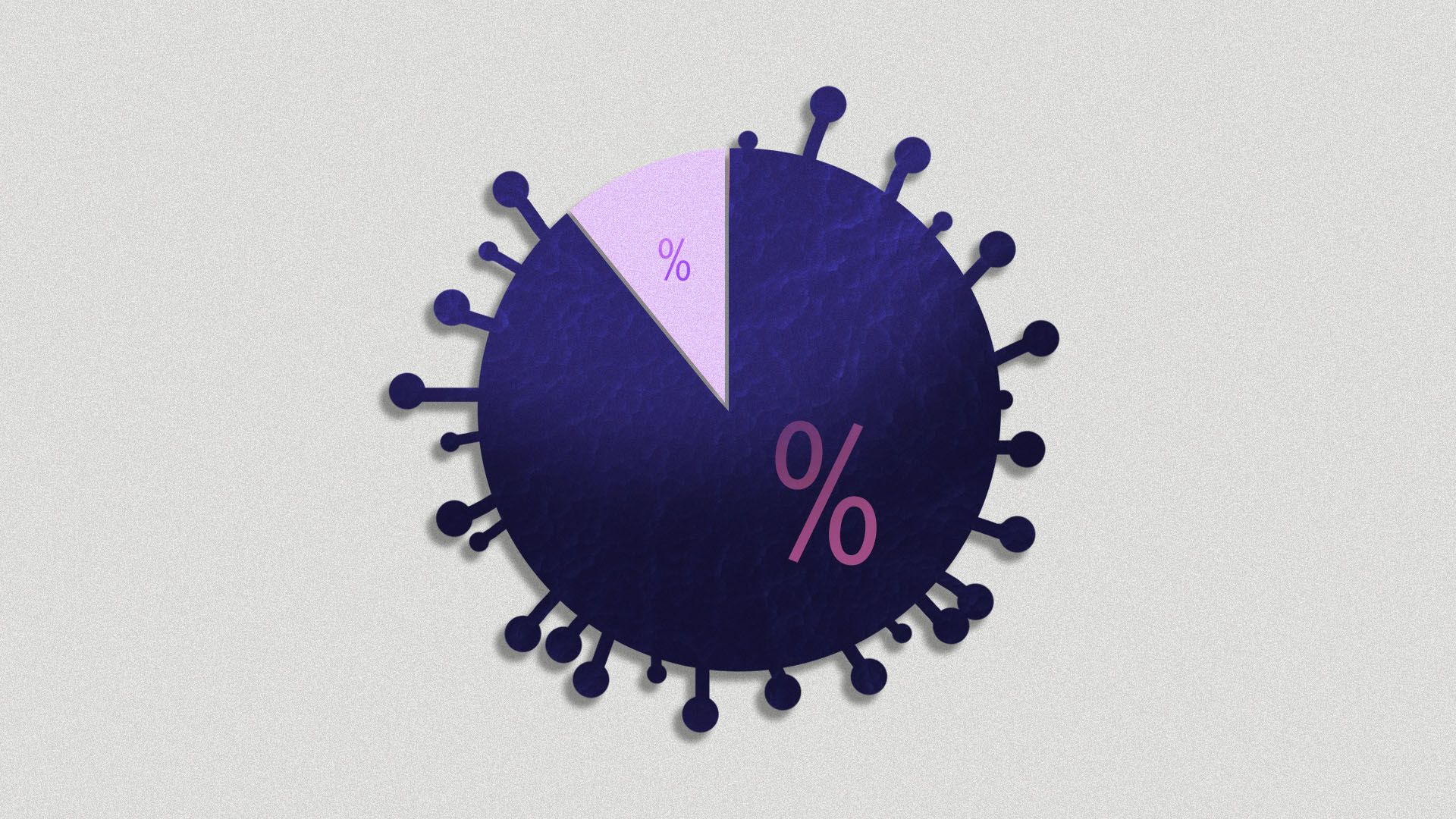
“Coronavirus hits people of color harder.”
 |
| Illustration: Sarah Grillo/Axios |
| Communities of color and low-income families are bearing the brunt of the coronavirus, Axios’ Sam Baker and Alison Snyder report. Why it matters: The virus itself doesn’t discriminate. But it’s beginning to reflect the racial and socioeconomic disparities of the cities where it’s spreading and the health care system that’s struggling to contain it. The big picture: There’s no nationwide data on the demographics of coronavirus cases or deaths. But preliminary data from several large metro areas seem pretty clear. Black residents make up about 33% of Mecklenburg County, N.C., which includes Charlotte, but account for roughly 44% of its coronavirus cases, according to The Charlotte Observer. Milwaukee County, Wis., is 26% black — yet African Americans account for almost half of the coronavirus cases and 80% of the deaths, according to ProPublica. The hardest-hit neighborhoods in New York City have large immigrant populations, per the Wall Street Journal. Statewide data from Michigan show that African Americans make up a plurality of both cases (35%) and deaths (40%), but just 14% of the state’s population. What they’re saying: “It puzzles me that none of our responses at the federal or state level has talked about race,” said Lehigh University’s Sirry Alang, who studies health disparities and inequities.“There’s been no focus on the ways in which our policy decisions might have unintended consequences for these populations.” Between the lines: This apparent inequity in coronavirus cases reflects a slew of other, pre-existing disparities.African Americans are more likely to have several underlying health conditions, including heart disease, diabetes, hypertension and some cancers that can make COVID-19 infections more severe. Lower-income areas — which tend to have larger nonwhite populations — have less access to health care services.Substandard housing, multiple families living together, and homelessness all facilitate the virus’ spread. |
* * *
Consider this a companion piece to this post.
Do you think Trump and his followers feel at all badly about this? Or are they (quiet or out loud) somewhere between “act of God” and “serves them right”? It’s horrifying how this serves their agenda.
A Trump supporter I know in Chicago said to me in that “just between us white folks” side-of-the-mouth sotto voce that the majority of COVID-19 cases there are concentrated “on the South Side” (code for “Black”) and it’s because “they’re careless . . . [in a mocking simper] ‘The government will take care of me.'” Then she *shrieked* “I’M SO SICK OF SOCIALISM!!!”
I simply copied an Axios story with all its links, because it won’t let me link to just this part of the newsletter, and Facebook won’t include the links.
But I’ll relent and say, Do read the rest of Axios’s “deep dive.” The next section is headed, “… and its economic impact is unequal, too.”
The bottom line: “It’s a precarious time for people who are already vulnerable.”
Together alone: The virus and the phone
National trauma. I read those words in The Atlantic and I think: Where is this “national trauma,” exactly? Is it located somewhere in the spaces between people, a fluid we’ve all been swept struggling off our feet by, like a toxic tsunami? Or is it granular, stuck as unique, angular shapes inside the hearts of individuals who can’t breathe or can’t pay the rent? It’s all around us but not within us, or it’s within us but not transmissible from one to another even though the virus is nothing but. We can’t get a grip on the trauma and make it real unless we get sick. And then we’re alone, in a basement or an apartment, or on a ventilator. Or shoulder to shoulder in a packed ER, where instead of our phones we’re now siloed by “social distancing” and respiratory distress. When we can’t hold and comfort our friends, rallying cries to drum up a “We” ring false. The only thing uniting us is fear, and fear is the most isolating of feelings.
“Nothing will ever be the same,” but so far it is all too much the same. We are 21st-century virtual people hologrammed into a brute 19th- or 15th- century reality. Not enough has changed yet. We’re meeting the new reality with the old tools: words, pills, takeout and streaming entertainment services. Maybe the “national trauma” is located in the yammerings of pundits, and I’d have to add us micropundits on social media. We’ve had words, words, words, decades of words, we expended so much vehemence and eloquence on much lesser ills, and the real thing hasn’t yet struck us dumb. We still have the same kinds of words and so we have no words. The words reduce this to just more of the same virtual unreality that we’ve been consuming for years in the floods of TV and op-eds and superhero movies and commercials and “social.” The silence of misery hasn’t yet engulfed the luxury of commentary. Note to self: We won’t get it till we shut up.
And we won’t shut up till we get it, and can’t breathe.
An uneasy suspicion gathers
like an unformed storm.
I’m posting this tweet mainly so you can see the thread below it—a lot of “die, New York, die, LA” sentiment.
In the absence of an early smart response, bluer states are generally hit sooner, harder, faster (is this a new Olympics?) by the virus than redder states because of large cities with high population density.
And, the MAGAs would be sure to point out, diversity. Queens is full of working-class people who are being hard hit, but that very population is also, I think, the most diverse in the U.S. Immigrants and their descendants from all over the world—Romania, Thailand, the Dominican Republic, Barbados, you name it.
It’s almost as if . . . well, you can see where I’m going. Maybe better than I can. I’m not sure where I’m going.
The more thinly populated and less-diverse red states that preponderate in the Electoral College are also being hit later and less intensively by the virus. If nothing else, they will use this to tout the superiority of their way of life.
But they are not invulnerable either; the virus, unlike the species it infects, doesn’t discriminate. What will happen when MAGA communities begin to lose loved ones?
“Others” will be blamed, for sure. That’s one of the things that will happen. Blamed and possibly attacked.
Trump’s delayed and addled response will not. Wasn’t that really a smart chess move, or a lucky break, or an act of God, to decapitate and depopulate blue (and multicolored) America?
A Case of . . . ?

Until . . .
3:30 a.m. Fell asleep with the lights on in a strange tumbled position, and woke up feeling weird: slightly nauseated, shaky, palpitations. Is this “it”? It’s not quite 14 days since I saw [a friend who later got sick].
7:05 a.m. That was very strange. My heart was going double time and palpitating; my head felt light, dizzy, achy, my muscles were quivering, my body not quite shaking, although I didn’t feel hot or cold. It felt as if my body was alarmed. Not my mind: this did not feel like it flowed from fearful thoughts or bad dreams. It felt very specifically as if my body was alarmed, independently of “me.” I didn’t know how to get comfortable or fall back to sleep. I could understand how people with the new disease could stand up and pass out. I wondered colorfully if I’d have to crawl to the bathroom.
My understanding is that the immune overreaction to something unfamiliar and proliferating is what kills you, not so much damage from the virus itself. So I tried having an unafraid, curious, and receptive, even welcoming attitude toward it, even though I also felt my mind was beside the point. “Hello, little virus. Welcome to the neighborhood. I hear you’re going to be living around here from now on. We’re going to get to know each other, so we might as well get started.”
For whatever reason, the physiological alarm gradually subsided. I felt floaty for a few moments, as if my horizontal body were weightless and starting to levitate. I thought, “Maybe one way to look at this is as a trip.” My heart had calmed. My quads and jaw muscles stopped quivering. I gradually relaxed and fell asleep.
I woke up several hours later feeling pretty normal.
I think this is what’s called “a case of overactive imagination.”
It serves a purpose, though. It gives me a concrete excuse not to go out and help [a stranded elderly neighbor], just in case. This thing notoriously comes and goes. You never know.
Hospital Hell is for Heroes
This is from Teresa Hanafin’s Boston Globe newsletter “Fast Forward.”
From the Globe:
At Massachusetts General Hospital, 41 members of the staff have tested positive for COVID-19, as have 45 employees at Brigham and Women’s Hospital. At Tufts Medical Center, 31 workers have the virus, and at Boston Medical Center, 15 have tested positive.
Yesterday, an internal medicine resident at Columbia named Meredith Case wrote on Twitter:
I feel I must tweet because the press does not reflect our reality. The deluge is here. Our ICU is completely full with intubated COVID patients. We are rapidly moving to expand capacity. We are nearly out of PPE. I anticipate we will begin rationing today.
Today was the worst day anyone has ever seen, but tomorrow will be worse. We are on the precipice of rationing. Needless to say, these decisions run counter to everything we stand for and are incredibly painful.
Staffing these beds requires incredible resources. Hard to say which will run out first — staffing, physical beds, ventilators, or other life support devices, e.g. CRRT machines to run continuous dialysis for the many patients developing renal failure.
Tough day. Floor beds were converted to ICU beds on the fly as a cascade of patients in the ED and on the floor required emergent intubation. Inspiring to watch RN, NP/PA and MD administration come together to find a way to care for these patients.The number of cases in Louisiana is surging. Michigan hospitals are reaching capacity. Infections in the US are rapidly approaching 70,000, and the number of deaths raced past 1,000 overnight. New Jersey, population 9 million, has the second-highest number of cases in the country — 4,400 — likely because of its adjacency and connections to New York, where cases now have surpassed 33,000.
It’s getting bad out there, folks, especially for our health care workers — not just those in the hospitals, nursing homes, an other care facilities, but also the EMTs, paramedics, police, firefighters, home health aides … They all are risking their health and their lives, working frantically to keep the rest of us safe.
Because that is what they do.
Don’t talk to me about athletes or entertainers being heroes because they toss around a football with a sick kid. That’s really nice, and very kind, but it’s not heroic. I know a hero when I see one, and she’s wearing a surgical mask.
Eye of the Storm
It is surreal being “in the city but not of it.'” I’m reading about the trouble beyond my walls same as you. I have no direct experience so far of the crisis reportedly overwhelming NYC’s health care facilities. I’m sitting here in my timeless little apartment in the middle of white silence, like Dorothy when her house was spinning through the air. I wouldn’t be surprised to look out my window and see Margaret Hamilton pedaling by.
Someone I saw 11 days ago has had symptoms for 6 days. It sounds just like the CV but so far he’s not sick enough to get tested, may it stay that way. We met outdoors on a windy day and we both felt healthy. I still do and am optimistic that I’m virus free, but concerned about him. He’s not old enough to be high-risk but has had a load of stress.
I sometimes help a friend in her mid–late 80s in the neighborhood (who also lives alone in a 4-story walk-up) with shopping or doctor appointments when she can’t get an aide. She has a fresh leg injury (a calf muscle tear from a cramp in her sleep? the timing could not be worse) and what appears to be a worsening infection. She’s at risk of falling, has an alert button. Her twice-a-week aide took a photo of the leg and she got an emergency supply of antibiotics, which make her feel sick. She’s trying to get into a rehab facility but, depending on the delay, may need me to shop and bank for her. Other friends normally help her too, but I’m the last one left now who’s still in the city, healthy, and mobile.
Online live karate classes 3x a week from the empty, shining Karatedo Honma Dojo are already a lifeline, bringing refreshment and structure to what could otherwise slump into a shapeless, listless mess. It’s so much easier to ride a wave of group energy from an inexhaustible ocean of tradition than to impose discipline on oneself. I even vacuum beforehand to make the space worthy, which makes it a lot nicer the rest of the time.
Only two days ago . . .
and it’s old news, burned up, bypassed, trampled under the stampede of events. New York’s more strictly locked down now, and karate classes have gone virtual. (Sensei and his wife drove all the way in from Westchester to the empty dojo to beam that dedicated space into our heads and homes, especially important for the kids.) It was a revealing conflict for a moment, though—revealing of my own contrary arrogance as well as of various aspects of various coexisting cultures. So I’m copying my journal entry about the question—go to the dojo while I still can, or start staying home?
3/19 I showed up at the dojo last night in defiance of being berated and pleaded with by Mom, Sara [infectious disease doc sis]. and what seemed like half of Facebook, who, in effect (if not in so many words), either said I was going to die, or that I was going to kill somebody. I’ve never been the target of a mob shaming before: they differed in their tactics—some expressed coaxing concern for me, others compared me to selfish spring breakers—but they were united shoulder to shoulder, a phalanx letting no light through, in the conviction that it was irresponsible to go out, that in this we ALL had to be As One, and strays had to be driven into line. I’ve never seen Americans so unanimous, never see them enact a uniform consensus, like the Chinese army, breaking away only to act as border collies nipping stragglers back into the sea of units, all individuals choosing to subsume themselves in a unified action. I didn’t know we had it in us. It was impressive (if also oppressive).
Well, there was an exception: the martial artists, a couple of them, who understood the importance of training, and even training together, in defiance of consensus and even common sense. It’s belonging to that culture that drives me in the other direction. Yes, there is pride: I’m expected to be an example and a role model, someone demonstrating the benefits of matter-of-factly continuing to be “a karateka” rather than meekly submitting to the straitjacket of “old age.” Sensei relies on me for this mute demonstration, and I don’t want to let him down, even now, when it goes directly against the overwhelming tide of fear and epidemiological prudence. I am hoping that the city goes into lockdown and spares me this conflict.
It doesn’t help that I read a diversity of voices on the internet, including the right-wing point of view that the lethality of the virus is being overblown for either political or nefarious governmental ends. The people who were scolding me were all progressives or moderate liberals (well, not all: Ann Althouse is a center-right independent and contrarian). Many if not most conservatives tend toward the other extreme, or did (they haven’t quite caught up with Trump’s head-spinning pivot from scoffing Ostrich-in-Chief to “Wartime President”). But not Newt Gingrich: he lives in Italy and has seen the virus do its worst.
There’s that self-sacrificing recklessness in karate culture (which I dubbed “maso-machismo”) that gets guys so brutally banged up (ripped knees, perma-dislocated shoulders, broken bones) that their older age is a torment of disability. I avoided that not because I had any brains, but because sexism and Jacques protected me from my own zeal and vanity. I am paradoxically a tribute to the benefits not only of karate but of not too much karate.
Mom takes our temperature
My mother, who is 96, lived through the Depression (which began just before her 6th birthday), World War II (as a 20-year-old bride whose new husband was in the South Pacific), and all that came after.
She says this is the worst she’s ever seen. And she said that BEFORE the virus.
But she remains a sharp chronicler of the day-to-day, even as the days melt and grow warped and surreal. Here’s a text she sent me today (with her permission). Tell me if it doesn’t put its finger on something about this day.
How’s stuff? We’re OK here. Sorta tippy-toeing around: may or may not
go out: hands off elevator buttons, door knobs, why does my face perversely want me
to keep Touching it? To make sure it’s still there?
Not listening to the news is restful, but also an anxiety magnet: what’s the recent folly, stupidity, or catastrophe that’s been perpetrated? In the silence of no iPhone or other electric hookup, I hear the occasional sparrow: it’s warm enough for them. Are you OK? Everything seems to have slowed down. That has to
be an illusion: must be rocketing along along on a collision course with
Fate.
What you up to?
Love you
♥️
Urban Barbarian’s Pandumbic Prepper Advice
In The Graduate, a movie you may know of even if you’re too young to know it—for its portrayal of Mrs. Robinson, a 40-something cougar preying on a fresh college grad, and its Simon & Garfunkel soundtrack featuring the song of the same name—Dustin Hoffman’s character is taken aside by a friend of his father’s and given this portentous career advice:
Mr. McGuire: I want to say one word to you. Just one word.
Benjamin: Yes, sir. . . .
Mr. McGuire: Plastics.
As the tsunami of COVID-19 bears down on us, I have just two words for you:
PAPER TOWELS.
If you didn’t drive to Costco for a flat of toilet paper and now you can’t find any, I’m guessing you can still get a whole bunch of paper towels. Any brand, any size
You may not know this, but paper towels are the original substance, the Prima Materia, the stuff the world was created from.
I know this because I have not lived a normal American life. I’ve never owned a house, I never bought a new car (I’ve owned a new car just once—I won it on Wheel of Fortune, as I can prove if you have a dusty old VCR in your basement; I’ve never had a basement). I had a dishwasher and a washer-dryer only for the four last years of my husband’s life when we were renting a normal American apartment in Chapel Hill, NC. This is not because I was a back-to-the-lander or heard the words “carbon footprint” in a prophetic dream in 1971. It’s because I was an early adopter of the gig economy and I live in New York City, specifically in Greenwich Village, in a tiny old building that is just barely wired even for A/C. New York City houses millions of normal and supernormal American lives, but it is also a reversion to a Stone Age jungle. We walk everywhere. We have a hunter-gatherer’s alertness to our surroundings.
So I have never understood why there has to be a different paper good for every purpose. For instance, I’ve never gotten why, in America, strong emotion is associated with Kleenex. (Somebody finally clued me in. I was bragging about how when I cry, I like to feel the tears running down my face. There was a pause, and then they said, “. . . And your nose doesn’t run?”) Instead of holding and comforting someone (I get that your therapist shouldn’t do that), when they start to cry we hand them a Kleenex. What a triumph of Puritanism and brand placement! But seriously, why do we need toilet paper AND paper towels AND napkins AND Kleenex? In our skylight walk-up we did have toilet paper, usually the plainest 1000-sheet, 1-ply kind, but for everything else? Paper towels. Setting the table? Tear off a few sheets of paper towel, fold ’em—voilà! napkins! Nose running? Grab a paper towel!
Well, I’m here to tell you that in a pinch, paper towels can be toilet paper, too. (You’d have figured this out, if you haven’t already—the last time you ran out of toilet paper.)
Paper towels are thick, and there is a real danger of clogging your plumbing—not a mess you want to get into when you and the plumber are both quarantined. So here’s what you do. Virtually all brands of paper towel are 2-ply. So while you’re sitting there, you find or finagle a little separation along the edge and then you gently pull the two layers apart. You have two sheets of about the thickness of 1-ply toilet paper, ready to fold or wad. And: It lasts twice as long!
When this is over, returning to our ordinary lives, we may find them very strange, overstuffed with cumbersome unnecessaries. Maybe, in that new world, some entrepreneur of minimalism will even invent and market the one paper good that does it all.
UPDATE
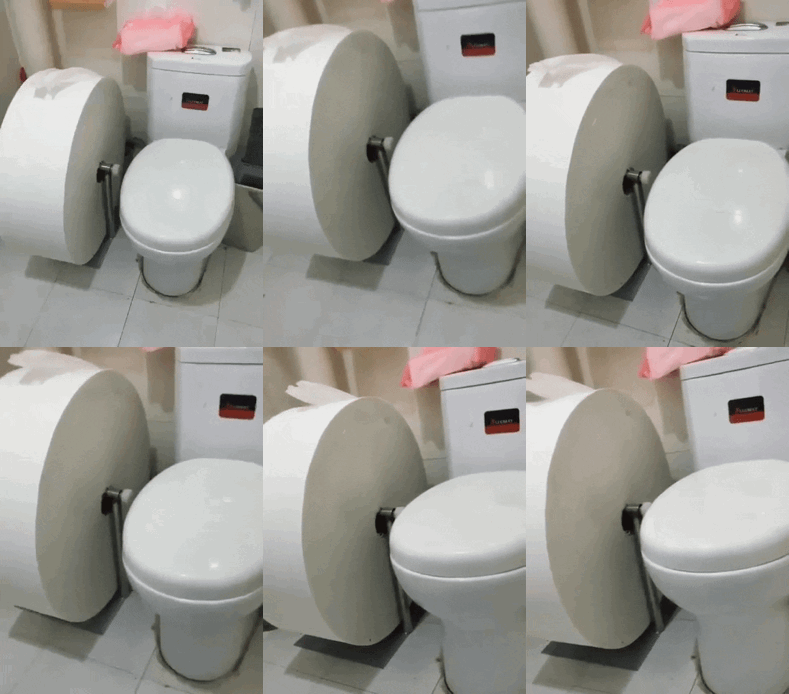
Here’s a clever variation on this very theme. It isn’t necessary, but it is comforting because it looks more like the real thing. I’ve clued him in about the 2-ply deal.

 Ambiance