Balance the Budget
Here’s a mildly entertaining way to while away your Sunday, courtesy of the New York Times:
Budget Puzzle: You Fix the Budget
Today, you’re in charge of the nation’s finances. Some of your options have more short-term savings and some have more long-term savings. When you have closed the budget gaps for both 2015 and 2030, you are done.
I disagree with the last sentence above as someone sometime has to begin reducing our national debt. Anyway, I came up with $893 billion in savings and tax increases for 2015 and $2,765 billion for 2030. Doesn’t have a hope in Hell of happening, and my draconian calcs reflect my mood at the moment (and may not be an accurate representation of my opinion 15 minutes from now).
Why not try your hand at it?

American Plutocracy? [UPDATED]
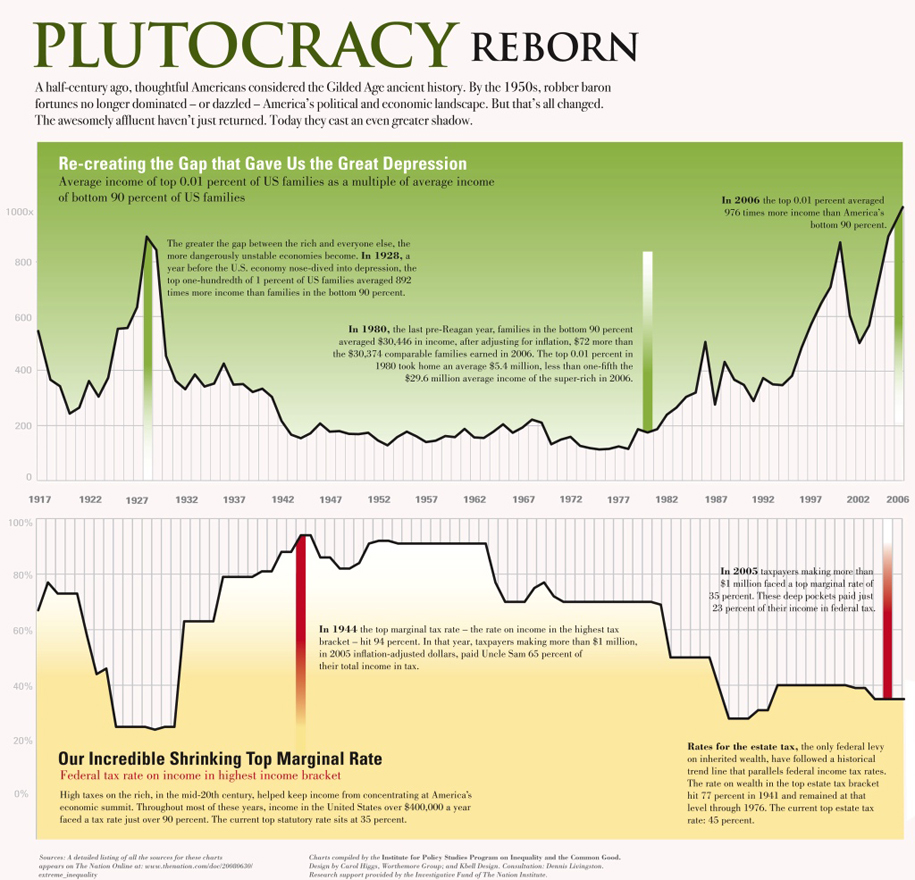
(Click on graphic for more readable version)
A plutocracy is a government which is ruled by the wealthy, or controlled by wealthy individuals. The term is usually used pejoratively, as it implies a lack of democratic freedom and social mobility. Numerous historical governments were plutocracies, controlled by an oligarchy composed of the wealthy ruling class, and some modern governments have been accused of being plutocracies, including the United States.
The term comes from the Ancient Greek ploutos, for “wealth,” and the suffix -kratia, for “ruler.” Many nations have experienced a state of plutocracy at some point, since wealth often comes with immense power, especially in the formative stages of a new country. Countries with valuable natural resources like oil and precious metals have also experienced government in the form of a plutocracy, as the entities which control these resources generally want to maintain conditions which are favorable to them.
Subsidizing Oil Consumption
The amount spent on highway construction and maintenance in the U. S. is about twice what gasoline taxes bring in as revenue. The difference is a subsidy to oil consumption.
-Dave Schuler at The Glittering Eye
Shirky Principle
Institutions will try to preserve the problem to which they are the solution.
Economy in Government [UPDATED]
Thought now was an appropriate time to pass along this clip of Calvin Coolidge, said to be the first ever film & sound recording of a sitting President. [Yes, I know, Coolidge is standing while speaking ;-)] Coolidge talks about the cost of government in 1924. Total expenditures of all governments within the United States were $7.5 billion, of which the federal government share was $700 million $2.9 billion or less than 10% 39%.
Obviously, times have changed. According to Wikipedia, as of 2006, total spending by all governments within the United States was $4.704 trillion dollars, about half of which was spent by the federal government.
According to the website Measuring Worth, in 2006, the relative worth of $700,000,000 $2.9 billion from 1924 is:
| $34,200,000,000.00 | using the Consumer Price Index | |
| $28,500,000,000.00 | using the GDP deflator | |
| $77,900,000,000.00 | using the value of consumer bundle | |
| $113,000,000,000.00 | using the unskilled wage | |
| $139,000,000,000.00 | using the Production Worker Compensation | |
| $171,000,000,000.00 | using the nominal GDP per capita | |
| $447,000,000,000.00 | using the relative share of GDP |
Banana Republic?
The richest 1 percent of Americans now take home almost 24 percent of income, up from almost 9 percent in 1976. As Timothy Noah of Slate noted in an excellent series on inequality, the United States now arguably has a more unequal distribution of wealth than traditional banana republics like Nicaragua, Venezuela and Guyana.
C.E.O.’s of the largest American companies earned an average of 42 times as much as the average worker in 1980, but 531 times as much in 2001. Perhaps the most astounding statistic is this: From 1980 to 2005, more than four-fifths of the total increase in American incomes went to the richest 1 percent.
(Nicholas Kristof in the New York Times)

 Ambiance