Doomed planet, tragic species
We’re 4 days into 2020 and my New Year’s resolution—”Resist Despair!”—is proving even more impossible to keep than pledges to lose weight or improve “productivity” (hate that word: so willingly we install the factory floor overseer in our own psyche).
A friend sent me the link to this interview, which is basically a hawkish conservative and a formerly American Israeli exulting (while ducking and covering just in case) that “America is back, and American deterrence has been restored.” (I would be very interested to hear your reactions to it.)
I wrote back:
My reaction to this (still just partway through it) is “Trump has just sealed his re-election.”
As much as his base thinks they want us out of furrin wars, they enjoy seeing Trunp and Amurrica kick ass even more, especially when the “red line” is touching a hair on an American’s head. There are [suddenly] a lot of born-again hawks [in his camp].
Of course, it depends on the [scale of the] consequences. Some are saying Iran, having lost its “head,” [or “arm,”] will kind of fade away, with only a few minor and marginal retaliations on obscure embassies or the like. Of course, those too will have to be punished—if and perhaps only if there are American casualties. A larger attack on an ally—Saudi or Israeli—might also require a response. Or not, considering the record.
I’m reading various points of view and I don’t know what to think.
People adore strength, they worship it. It makes them feel safe, and it makes them feel powerful by proxy. The default state of humans, ever since agriculture made accumulation and “civilization” possible, seems to be to shelter under the skirts of (you hope) the strongest warlord, trusting that he will keep the other warlords and their mercenaries from taking your food and raping your women and girls (or you, if you are a woman or girl). (I put my own kind in parentheses because this is all men’s business, a certain kind of men, the plunderers and pussy-grabbers, in armor or in suits. As long as they rule the world, anyone else of any gender who begs to differ, welcome to our parentheses!)
Those of us who fancy ourselves more interested in wonder and pleasure than in power are delusional, in this view. Our scraps of freedom to pursue such delicacies are entirely provisional upon our warlord being strong enough to kick the other warlords’ butts, or force or bribe them into alliance or submission.
Now the warlords have nukes, so maybe this tragic farce, which began with painted faces, poison darts, and kidnapping each other’s sisters (lest anyone be nostalgic for a hunter-gatherer Eden), will finally be over soon.
Gee, I’m doing great with my New Year’s resolution.
To paraphrase Joseph Conrad . . .
The blandness! The blandness! (A line from his lesser-known Heart of Whiteness.)
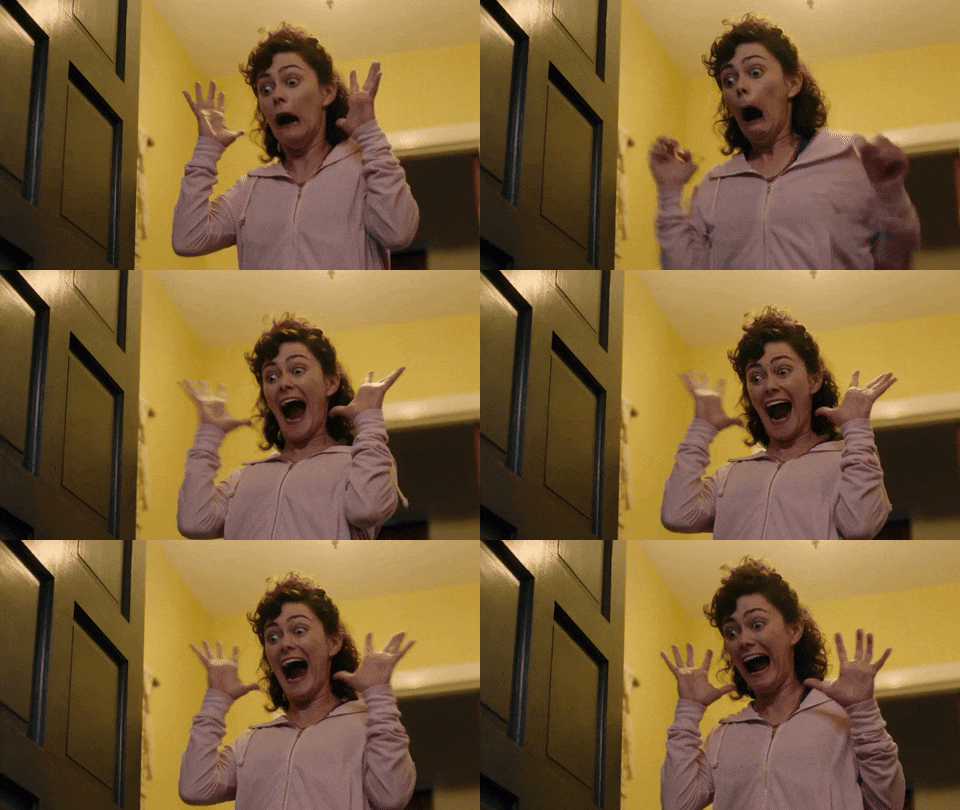
Doggie Wag
In regard to the conversation Tom Strong and I were having in the comments of an earlier post, Peter Nicholas wrote in The Atlantic:
Typically, when the U.S. is threatened—as the Trump administration says it was with an “imminent” Soleimani-planned attack—voters have tended to stand behind the president. George W. Bush’s approval rating jumped about 40 points, reaching 90 percent, in the days after the September 11 terrorist attacks, according to Gallup. (The good feeling didn’t last: As Bush’s Iraq War soured, so did his approval rating, though he won a second term.) His father, George H. W. Bush, enjoyed 74 percent approval in 1990 after he sent troops to the Middle East following the Iraqi leader Saddam Hussein’s invasion of Kuwait. (Two years later, Bush lost his reelection bid to Bill Clinton.)
Trump, though, is a unique case. His approval rating has never cracked 50 percent in Gallup surveys, and experts on the presidency have rated him the most polarizing chief executive in history. Trump’s handling of the crisis will test the reflexive loyalty Americans show in such fraught times. It’s not at all clear that, outside of Trump’s base, people will trust his motivations, especially when he’s under serious political pressure. He is up for reelection in November, and he’s facing a potential impeachment trial in the Senate. Tweets he sent out years ago show that he’s well aware a president’s popularity spikes in wartime: In 2011, a year before Obama won reelection, Trump claimed, “In order to get elected, Obama will start a war with Iran.”
Trump’s critics suspect that he’s inflaming tensions with Iran to suit his own needs, deliberate preparation be damned. They see a “wag the dog” scenario—the term for presidents who manufacture overseas crises to divert attention from embarrassments at home.
A long war of terror and attrition—
with proxies, allies, assets, and US citizens all over the world at unpredictable risk, and potential to flare out of control at any moment—is a likelier consequence of the drone assassination of Qassem Suleiman than immediate all-out war, opines this Guardian article.
One conclusion you might draw from this is that it’s Barack Obama Trump is killing, over and over again. Someone just give him a goddamn voodoo doll.
Another is that he is, inevitably, wagging the dog. Here we go. We don’t change presidents during a war or under an elevated state of threat.
“I think they’ll probably try to hit us in other parts of the world, maybe west Africa maybe Latin America to send the message that they could get us anywhere – we should never feel safe. And I think the US is going to kind of try to spread out our assault in a similar way,” [said Kirsten Fontenrose, the former senior director for the Gulf in Trump’s national security council, now at the Atlantic Council]
“I don’t think we’re looking at a war. I think we’re looking at a series of asymmetric semi-unpredictable strikes against each other’s interests.”
[W]hile the consequences of Suleimani’s killing are unclear, what is almost certain is that Trump has not thought them through. He made the decision while on holiday at his Florida resort. He did it without the sombre presidential address to explain his actions to the nation as is customary at such pivotal junctures in the country’s history, merely tweeting out a US flag and leaving it to the Pentagon make the announcement.
Over the past three years, the national security decision-making process, by which the pros and cons of US action were once carefully weighed, has been gutted. There are few high-level policy meetings any more. The independent thinkers in Trump’s orbit have left the stage, leaving a president who ultimately trusts his gut instincts above any expert.
It is those instincts that have, more than any other single factor, led the US and Iran to this point, and in particular Trump’s visceral hatred of his predecessor, Barack Obama, and his diplomatic legacy, the 2015 nuclear deal. Destruction of the deal and the economic strangulation of Iran, became a central imperative of Trumpian foreign policy.
Those aides who remain in the president’s orbit have survived because they know how to echo his impulses, his desire to destroy all traces of Obama, and who now share the president’s focus on his own re-election.
The decision to kill Suleimani is likely to have been made with the November vote in mind – how it might play as a punchline on the campaign trail, finally eclipsing perhaps Obama’s conquest of Osama bin Laden.
But it will be a story that will almost certainly be told against a backdrop of more attacks, greater uncertainty and a deepening sense of dread.
~ Julian Borger, Washington correspondent, The Guardian
A house divided cannot stand
“George Washington’s farewell address is often remembered for its warning against hyper-partisanship: ‘The alternate domination of one faction over another, sharpened by the spirit of revenge, natural to party dissension, which in different ages and countries has perpetrated the most horrid enormities, is itself a frightful despotism.’ John Adams, Washington’s successor, similarly worried that ‘a division of the republic into two great parties … is to be dreaded as the great political evil.’
“America has now become that dreaded divided republic. The existential menace is as foretold, and it is breaking the system of government the Founders put in place with the Constitution. . . .
“The theory that guided Washington and Adams was simple, and widespread at the time. If a consistent partisan majority ever united to take control of the government, it would use its power to oppress the minority [or the disenfranchised majority—ag]. The fragile consent of the governed would break down, and violence and authoritarianism would follow. This was how previous republics had fallen into civil wars, and the Framers were intent on learning from history, not repeating its mistakes.”
The Last Word on Billionaires
from Brain Pickings, Joseph Heller via Kurt Vonnegut:
“True story, Word of Honor:
Joseph Heller, an important and funny writer
now dead,
and I were at a party given by a billionaire
on Shelter Island.
“I said, ‘Joe, how does it make you feel
to know that our host only yesterday
may have made more money
than your novel Catch-22
has earned in its entire history?’
“And Joe said, ‘I’ve got something he can never have.’
And I said, ‘What on earth could that be, Joe?’
And Joe said, ‘The knowledge that I’ve got enough.’”
Oldie(s) for New Year’s morning
I was also going to post Bob Dylan’s “New Morning” (the song), from the eponymous New Morning (1970), an atypical Dylan album and possibly my favorite. It has some really strange songs in it. It hit me at the right time.
I have never seen music locked up this tight. Every song from that album is blocked on YouTube, and owning the song for $1.29, it is upload-proof.
Naturally this got my back up. Oh, come on, Bob, you little capitalist. Not to be deterred, I made a lo-fi, tinny copy with occasional nose-blowing bursts of static in it. Even that won’t upload.
If you remember the song, I guess you could play it in your head.
 Ambiance