“Novel Ecosystems,” aka “Trash Ecosystems”
This story is somehow related to the turn the conversation on the previous post has taken. It’s about the futility and silliness of control and purism. It’s about humans not as the destroyers of nature but its wild card, its agents of creative destruction.
This forest on Big Island features mango trees from India (Mangifera indica); Cecropia obtusifolia, a tree with huge star-shaped leaves from Mexico, Central America and Colombia; rose apples (Syzygium jambos) from southeast Asia; tasty strawberry guava (Psidium cattleianum) from the threatened Atlantic coast of Brazil; and a smattering of Queensland maples (Flindersia brayleyana) from Australia. It also has candlenuts (Aleurites moluccana), a species that humans have moved around so much that its origins have become obscure. There is at least some native Hawaiian representation in the form of hala, or screwpine (Pandanus tectorius), which is pictured on the crest of Punahou School, where US President Barack Obama studied. There are no Hawaiian birds here though. Mascaro sees plenty of feral pigs, descendants of those brought by settlers from other parts of Polynesia or from farther afield. The soil is black and rich. Mascaro likes it here.
Most ecologists and conservationists would describe this forest in scientific jargon as ‘degraded’, ‘heavily invaded’ or perhaps ‘anthropogenic’. Less formally, they might term it a ‘trash ecosystem’. After all, what is it but a bunch of weeds, dominated by aggressive invaders, and almost all introduced by humans? It might as well be a city dump.
A few ecologists, however, are taking a second look at such places, trying to see them without the common assumption that pristine ecosystems are ‘good’ and anything else is ‘bad’. The non-judgemental term is ‘novel ecosystem’. A novel ecosystem is one that has been heavily influenced by humans but is not under human management. A working tree plantation doesn’t qualify; one abandoned decades ago would. A forest dominated by non-native species counts, like Mascaro’s mango forest, even if humans never cut it down, burned it or even visited it.
You could even call it cosmopolitan. Or the nature version of “street.” As wilderness goes, it’s urban. The species that make it in these places are scruffy, versatile, adventurous, and resilient. Sometimes even beautiful. Brawlers and opportunists, like us.
Who Do You Trust — Government or Business?
Been thinking a lot lately about how liberals trust government and mistrust business, while conservatives trust business and mistrust government. It may be the single most fundamental difference between them. Now here’s John Stossel quoting Greg Mankiw:
Perhaps a lot of the disagreement over healthcare reform, and maybe other policy issues as well, stems from the fundamental question of what kind of institutions a person trusts. Some people are naturally skeptical of profit-seeking firms; others are naturally skeptical of government. […]
I tend to distrust power unchecked by competition. This makes me particularly suspicious of federal policies that take a strong role in directing private decisions. I am much more willing to have state and local governments exercise power in a variety of ways than for the federal government to undertake similar actions. I can more easily move to another state or town than to another nation. […]
Most private organizations have some competitors, and this fact makes me more comfortable interacting with them. […] To be sure, we need a government-run court system to enforce contracts, prevent fraud, and preserve honest competition. But it is fundamentally competition among private organizations that I trust.
This philosophical inclination most likely influences my views of the healthcare debate. The more power a centralized government authority asserts, the more worried I am that the power will be misused either purposefully or, more likely, because of some well-intentioned but mistaken social theory. I prefer reforms that set up rules of the game but end up with power over key decisions as decentralized as possible.
Mankiw cites Paul Krugman, who raised the whole “who do you trust” issue, as a member of the opposite camp:
What puzzles me is that Paul seems so ready to trust solutions that give a large role to the federal government. (In the past, for instance, he has advocated a single payer for healthcare.) I understand that trust of centralized authority is common among liberals. But here is the part that puzzles me: Over the past eight years, Paul has tried to convince his readers that Republicans are stupid and venal. History suggests that Republicans will run the government about half the time. Does he really want to turn control of healthcare half the time over to a group that he considers stupid and venal?
Stossel adds some thoughts of his own (the ABC site seems to be copy-proofed somehow, so I have to take a screenshot of the passage):
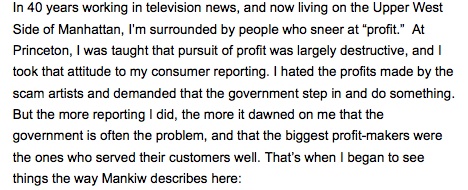
I grew up in the allegedly benevolent shadow of FDR, believing that business was greed and government was public spirit. My attitude has changed drastically, mostly (the way my attitude usually changes) through broadening circles of friendship, which came to include small entrepreneurs, a couple of first-generation millionaires from working-class backgrounds whom I love and admire. Also typically, though, I haven’t gone all the way. I think of government and business as another of the vital checks and balances of American life.
An example I’ve been thinking a lot about lately is cars. We had a visit recently (which I noted on Twitter) from a deeply and deliberately Southern character, a 61-year-old who looks (to RT myself) as if “The Rime of the Ancient Mariner” had been written by John Crowe Ransom, but who is a stealth liberal and Obama voter in a conservative small Tennessee town. He said that after the election he had heard one of his neighbors raging, “They’re going to take our cars away!” Who knew that SUVs were in the Bill of Rights? Which amendment is that?
There’s a paradox about business: it is at once the most innovative force in the world and, at the same time, can be one of the most conservative and inert. Nothing illustrates its inertia more than the fossil fuel economy, with all that it entails of manifold environmental damage (not even counting disputed global warming, just the health effects of air pollution and the ravages of, for instance, mining the Alberta tar sands) and dangerous dependence on foreign countries. As long as there is oil and as long as its price can be kept within broad bounds, our energy habits are not going to change. There’s too much employment, too much existing infrastructure, too much power and profit and, yes, pleasure (I love the freedom of a fast car as much as anyone, and more than many) entrenched there. Market forces will keep on playing that hand until it is catastrophically played out, because the costs of changing are too high and the rewards too meager and speculative. In this case, there isn’t enough necessity to mother sufficient invention, and there won’t be until it’s too late.
The conservative solution is “Drill, baby, drill!” The way of life that cheap oil made possible is too often equated with the American way, a days-are-numbered luxury with an eternal right. I think this is a place where government can play a legitimate role in forcing innovation by manipulating the market — creating an anticipatory artificial scarcity (through taxation and regulation) on one end and incentives for new solutions on the other end. (Don’t tell me government should never manipulate the market until you’ve eliminated farm subsidies, please.) It’s a delicate business because the transition can only be gradual and the regulation can’t be too draconian without strangling the economy. But the decades of permissive mileage standards have been shameful, and have contributed to the American auto industry’s fatal complacency. Unnecessary waste — in a sort of potlatch*-like display of boastful affluence — has too often been the American way.
Here’s how I feel about cars: getting places fast on Ike’s highway system, with the top down and the radio blasting, has been wonderful — and quintessentially American for a particular time. But I sometimes think about the places I’m passing, the detail I’m missing at my usual 75 miles per hour. The convenience and pleasure the automobile has given us has exacted a high and mostly unnoticed price, from the annual fatalities (which usually equal the number of American deaths in the Vietnam war) to the creation of car-dependent bedroom communities. If we have to drive slower, drive less, or drive shorter distances in yet-to-be-invented plug-in electrics, I won’t feel that my God-given rights have been violated; I’ll feel that a wonderful era has passed and another, differently wonderful, is beginning. Besides, I have faith in American inventiveness. Given the chance and the necessity, I don’t doubt that the problem of the fast electric car, too, will be solved.
(I didn’t have time to write this, and I definitely don’t have time to put links in, but will do so later. Meanwhile, Google “Alberta tar sands.”)
UPDATE: At the link to “potlatch” I find that these traditional feasts were all about the redistribution and sometimes the destruction of wealth. Prestige was proportionate to how much you gave away. Here’s the ultimate irony:
Potlatching was made illegal in Canada in 1885 and the United States in the late nineteenth century, largely at the urging of missionaries and government agents who considered it “a worse than useless custom” that was seen as wasteful, unproductive which was not part of “civilized” values.
I guess it was thought subversive of the sacredness of private property?
Fort Myers Beach Hits the Big Time!
My parents’ little beach town in Florida — my own second hometown, really — just put itself on the garish map of tabloid America by firing its town manager for marrying a porn actress.

The punch line: he’s from Alaska.
Real Life Wisdom . . .
. . . the kind that’s born on the knife edge between love and fear, born of falling off that edge again and again, and struggling back up, has never been so beautifully expressed as in this post by Danny Miller, one of his most magnificent ever. It’s a real collaboration between him and life; look how gracefully he fields the long-ball cues life throws him! It’s only right at the heart of the matter that everything is charged with message and meaning like that. We’re there all the time, but only at the edges do we know it.
And look at his son Charlie!! Remember when he was small enough to fit in your hand and crawled all over by a parasitic kudzu of tubes, so fragile his intestine and his brain tore like water just at the touch of the air . . . look at him! Almost free of tubes, smiling, frowning, sucking his thumb, looking so much older and more aware than the newborn infant he would have been just about now . . .
“Similarly matched in strength, both straddling the same foundation of awestruck inquiry…”
That’s Anchoress’s beautiful description of the striving between science and religion. It’s all about wonder, as I also tried to say in my Hubble piece, currently hosted in a temporary safe place while Natural History changes servers (I know, most of you have read it, but I’m awfully fond of it, not least because I sweated blood for it in that way that only happens when a piece of writing matters to you, and then makes it matter more). Anchoress describes the long intimacy (and sometimes lovers’ quarrel) between science and religion in many of the greatest minds; in another NH blog post I described my realization that science actually started out as a branch of religion.
But I didn’t mean to make this a “me, me, me” — more of an excited “Me too, me too!” Please read and savor Anchoress’s post. What a marvelous, generous writer!
Walter Cronkite, Up Close and Personal
My friend Dalma Heyn interviewed Walter Cronkite in 1985, and has now posted the interview on her Love Goddess blog in two parts: Part I, Part II. Besides an unusual glimpse of his personal life, relationship with his wife, and sense of humor (the last two very much intertwined), the interview showcases Cronkite’s old-fashioned beliefs on the ethics and standards of television journalism, already being gnawed away by entertainment value and the scramble for ratings by the time they spoke. Lament it, snort with laughter at it, or both, it really is a glimpse of another eon.
DH: Why do you think you’re so trusted by Americans?
WC: I think because, in doing my job in the news business, I really have held just as firmly as I could to what I believe to be the ethics and prinkcples of good journalism. I have tried desperately, particularly in television, to hew to the middle of the road in the presentation of any given story—the pros and cons, allegations and denials—and to see that facts are well pinned down and secure. That is integrity in news presentation, and I guess that through the years that showed through. I was always annoyed when the presentation got in the way of the facts—and show business aspects. Whe graphics and pictures got in the way of telling the story, it was always a source of annoyance for me.
* * *
DH: What annoys you about television news today?
WC: I do not think they make the best use of the limited amount of time that’s available to them. I think there is too much editorialization; too much “featurizing.” There is so much of importance to communicate to a population that’s getting most of its news from television that we shouldn’t spend the time doing anything except cramming news down their throats.
Hey Walt, the customer is always right. You can’t cram anything down his or her throat. Isn’t that the liberal elitist attitude — we’ll give you what’s good for you whether you want it or not? People are maddeningly resistant to that approach. The trick is to entice them to want what’s good for them. How do you get large numbers of people to want honest, thoughtful, exhaustive reporting — and not just to think it would be nice, but to demand it and consume it?
. . . That’s what I thought.
Reading the Honduran Constitution . . .
. . . rather than reading our Constitution into the Honduran situation, reveals that it is actually that country’s Constitution that removed President Zelaya from office. The Honduran Supreme Court and Army were not merely reacting to a violation of Article 239, which imposes a one-term limit on all presidents; they were carrying out the provisions of that Article.
My friend Casselman wrote an op-ed, “Brave Little Honduras,” that ran in the Washington Examiner. When he posted it on his own website, a commenter challenged him with the common argument that while Zelaya had acted unconstitutionally by attempting to hold a plebiscite on his reelection, the Supreme Court and Army had also acted unconstitutionally by ousting him rather than impeaching him. Not true, Casselman posted today in an update [scroll to the end of the piece]. An excerpt:
This argument has been also used by Sres. Castro, Chavez, Morales AND our own President Obama to justify Zelaya to return and finish out his term, I have now read the Honduran constitution, andalthough it does have an impeachment process, its Article 239 states that no one may serve more than one term as president, and that anyone who tries to do so, OR TRIES TO CHANGE ARTICLE 239, automatically defaults his official position. Thus, Zelaya was actually removed from office by the Honduras constitution. The supreme court was only doing its job in formally declaring the obvious. . . .
Sr. Zelaya, who has been trying to bully his way back into Honduras, has now called for a revolution. Make no mistake, he means a Marxist revolution. President Obama is backing the wrong horse for the wrong reasons.



My Brother on Marriage
From his anniversary post — good description of the thing, I think!
Right now is a challenging and transitional time. . . .
But that’s life, right? It’s all challenging, it’s all transitional. All relationships are confrontations, collaborations against solipsism, alliances in combat, diplomatic relations between different planets. Marriages are the closest and most mystifying of all partnerships: the twinning of strangers, the merging of galaxies. The alchemical conversion of an emotional attachment into a business arrangement, or vice versa.
His stepdad post is good too:
Middle Daughter turns 20 today.She is one of those rare individuals whose child-self shines through her adult self. As a child, she was dreamy, distracted, funny, very loving, resolutely happy. As an adult, she is still all those things. To have known her for 17 years is to have watched her grow lovely translucent layers — a sweet onion of a human being.
Keep going and you’ll come to his dad posts. At almost 50, he’s in academic (not pastoral) divinity school (always sounds to me like something divine to eat — do they learn to make angelic pastel fudge and taffy?), but given that the most sacred things in Judaism are Book and Family, in either order, I wonder which is his real religious education.
It’s nice to hear my brother being emotionally eloquent, especially when I’m feeling, in that respect, inexplicably mute. Most of my five siblings are having these empty-nest reunions with their spouses. (I say “most” only because one of my sisters is fairly newly married, for the third and best time.) The next generation is pretty well launched, and the generation after that has begun arriving, with the generation before us still here to welcome them. I feel at once very much a part of it all and like a bit of an outlier — like a comet: of the solar system but not in it, with a life cycle stretched to extremes, an eccentric elongated orbit that has taken me far out but not away.
 Ambiance