“Love is Interchangeable With Time.”
Said Moshé Feldenkrais. (I think I have his words right.) What you love, you find time for. As our friend Chris told me this morning. And then proceeded to demonstrate.
She came over late this morning, kindly bringing coffee, coffee filters, and milk, which, when she asked, was what I’d said I most urgently needed. (Animals and addictions must be fed first.) She offered to stay with J while I went shopping for necessities that couldn’t wait another day. But then we wound up talking for a while, and then it was too late for me to go shopping because she had a chance to meet her favorite person in the world to go to the state fair. She said she’d keep in touch and would come back this evening to sit with J while I went to an internet café to finish my work, because I haven’t so far been able to pirate or borrow a connection. She, also kindly, took some laundry to do for us, because the landlord here has been so frantic moving fire refugees into not-quite-ready apartments that they haven’t put a washer and dryer in here yet.
Never heard from Chris again.
I’m not complaining. She was wonderful to do as much as she did. I’m observing that it is best to be thankful for what people do give you (above all, of their time) and not to expect more, even when more is promised. In fact, it is best to be aware that people’s “eyes are bigger than their stomach” when it comes to offering help — help that costs time — and that they may offer more than they can actually give without resentment if they then keep their word and guilt (with its attendant resentment) if they break it. (I imagine that Chris never called to tell me she wasn’t coming because she felt bad about not coming.)
In my experience, especially my recent experience (and it’s a signal experience of older people), you can’t expect or ask very much of people unless a) they’re in love with you, or b) they need something from you. Which are somewhat the same thing, except that in the latter case they’re in love with something else that they think you can serve. (Editors get a lot of this kind of bank-shot love.)
I was originally going to say “unless they’re your parent, your child, or are in love with you, or need something from you,” but I had to reconsider even the former as simply a subset of the latter. How many parents wait in vain for their grown children to throw them a scrap of time — until the children need some money or a place to crash rent-free for a while? Generally speaking, parents are in love with their children but children are in need of their parents, not in love with them, except very early and too late. Now that’s a nice epigram, but it’s too neat to be true. “Parents are in love with their children but children aren’t in love with their parents” holds true in much of modern American culture, where children and young people have the power. In traditional European culture, adults, even old adults, had the power, and children were much more likely to be in lifelong love with their parents. But there are also plenty of cases anywhere in the world where the expected “natural” love fails completely on one side or the other of that bond. So much for generalizations.
In case it wasn’t obvious, all of the above is IRL. It’s different OL. Isn’t it? Or is it?
I’ve received, and also organized and transmitted, incredible help from people online. I’m not sure how much time it costs us to do this. Some, for sure. But physical time still is — is more than ever — one of the scarcest and costliest goods we possess, and therefore we reserve it for a very few. It has to do with the fact that a body can’t be in more than one place at a time. But a mind can. The time we spend online actually costs us far more than we know (LOL), but it doesn’t feel like it. It feels light, like flying around in dreams, without a body. (Is cyberspace all we can know of heaven? or a preview?) Clearly, we love this feeling and devote a lot of time to it. It gives us an intoxicating sense of power. It multiplies our knowing and our loving beyond what is physically possible, the way money multiplies our doing beyond what we can do with two arms and one shovel. It’s not surprising that these two forms of broadband shorthand go together, and that (even though still discriminatingly and sparingly) we can more easily help online friends with money than real-life friends with time.
It’s particularly ironic to be mulling over this just as several of my online friends have literally given me gifts of time — cellphone minutes — in the form of money! They say time is money. But old Feldenkrais said time is love. I think he was much more on the money.
If short, catchy communications in advertising and the media are called “sound bites” (who remembers that that was the original term, not “sound bytes”?), maybe what we give each other online are “love bites”?
The only trouble with this online community is that if the plug is pulled, it disappears like a dream.
J’s Star Turn . . . UPDATED
As “elderly man in wheelchair rescued from apartment blaze.” Even in this brief clip he looks too robust for the role. But he is definitely upstaged by the blaze. (Very sorry to upstage Whitey, a much happier sight. And sorry for the clunky, patience-trying video. That’s “NO sprinkler system” at the bottom.)
Vodpod videos no longer available.
UPDATE: This newspaper photo explains a lot. It explains why the news video confusingly showed you a building swathed in flames, and then a relatively intact façade with a ruined roof: these were back and front views, of course. It explains why, after we were awakened by the pounding and yelling, I looked out our bedroom window and saw the trees and grass bathed in a horrific Halloween-orange light. It explains why I looked over our back porch railing and saw a dark window directly to the left of us and then a burning railing beyond that. And it explains why we had time to get out. The white arrow points to our bedroom window.
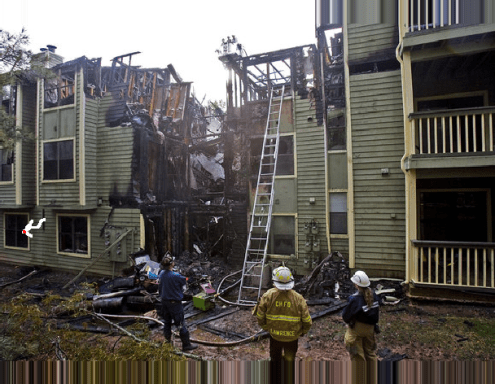
The intact window between ours and the devastation is that of our neighbors directly across the entryway, whose apartment, probably the mirror image of ours, was almost gutted — except for the bedroom. Our back porch, leading off our living room, was to the left of our bedroom from this perspective and is out of the frame of this picture; theirs — the one I saw burning — would have been to the right of their bedroom, and is gone. The indentation between the two upper stories above our respective bedrooms corresponds to the entryway and stairwell in front, which acted as a firebreak. The fire had leapt it and was going to work on the top floor directly above us when it was put out.
Thoughts on Fire
(To be added to as time and sanity permit)
Fire is the ultimate home invader.
If you ever hear the intent, grinding crackle of fire coming for you, you’ll never forget it. It sounds like a giant, unstoppable rotary saw or wood chipper chewing through matter and shelter. Pure appetite, stupid as a shark.
The reeling, glass-shattering barroom brawl between the bad guys and the good guys — fire and water — does almost as much damage as fire, unchecked. There’s something left, but there might as well not be. Collateral damage.
Fire is like a skunk: its musk clings to everything long after your encounter with it.
When your house is on fire, is one of the first things you think of your cellphone charger? Me neither. Yet it is one of the first things you’re going to need.
The only thing that seems like even more of an unnatural affront than the shortness of human (canine, feline) life is the shortness of battery life. Whoever lets lets the human race off that short leash is going to be a culture hero in the league of Prometheus.
A writer will write about anything, like fire will eat anything.
YAY.
If you’ve been worrying about us, you can stop. The hospice doctor came this morning (the only nonpsychotic person I’ve ever met besides us, once upon a time, who has 14, count ’em, 14 indoor cats!!) and she feels fine about recommending that J continue to be on hospice. She sees that we need the help, but more importantly from a bureaucratic, cost-saving standpoint, based mostly on her questions to me and my uncontrived answers, I think he met the central criterion, which is (sadly) decline over time — almost a “goes without saying” with his illness.
It’s an enormous relief. I really feared the re-isolation most. And being love-bombed with free Depends ain’t bad, either.
Creative Destruction
It’s all very well to approve of it, to cheer it on in principle, but the thing is, you can’t pick and choose what it’s going to destroy.
There’s a fairy-tale quality to it — turning loose the baby dragon, then having to live with the unintended consequences.
Print media, for instance (one of which I work for, a lot like being a deckhand on the Titanic). Natural History is a good thing. A physically beautiful little magazine that keeps science mindful of its roots, that maintains a bridge across time, with constant traffic back and forth, between the 18th-century cabinet of curiosities and the postmodern particle accelerator and PCR machine, and between science and the arts. It has a venerable tradition: counting its first 18 years as The American Museum Journal, it’s been publishing since 1900. And it has one of the most fiercely loyal subscriber bases I’ve ever heard of: even now, when everyone’s online, the renewal rate is around 85 percent. You get the feeling that a lot of its subscribers have been reading it since childhood.
But it’s a print medium — an endangered species. (You knew Gourmet is folding, right?) Like the newspaper, that’s one of the things creative destruction is destroying. Never mind your childhood, your history, your tradition, your comfortable habit of anticipating some beautifully wrapped mind candy in the mail every month. That’s all dispensable. It’s all paper in fire.
Conservatism is a curious and contradictory thing. To love tradition and also celebrate unfettered capitalism seems like a recipe for heartbreak. You can try to let God rule your moral life and Darwin rule your economic life, but really, how can you separate them? How can you tout values when creative destruction is value-free? Creative destruction has a mind of its own. It’s driven by appetite and effectiveness, not by sentiment or principle. It’s sort of like a hurricane of Buddhism. Attach at your own grief. Evolve beyond natural affections. Become as ruthless as that which created you and will destroy you. Learn to love nothing but the twisting dragon of change. Or be destroyed on the lathe of heaven.
Sure Enough . . .
. . . I got the distant early warning from the nurse today that they may not be able to keep us on hospice.
J just isn’t sick enough. He communicates. He has a good appetite. He still gets out of the house (albeit not under his own power). He doesn’t have pain.
(And I’m not broken down enough. Not all used up yet, not by a long shot. I could take care of him alone again if I had to. After all, I was doing it just a month ago.)
They want to keep us. They’re going to try. They think we need and deserve the help. But they have legal guidelines they have to follow, and we’re in a gray area at best. Or should I say, at worst.
This is one of those silly situations where good news is bad news and bad news is good news.
Of course, the irony is that the hospice people usually see him at his best — because he’s so happy to see someone other than me. He comes to life. He puts on his “company face.” He flirts, he kisses hands (I swear to God), he makes ’em laugh. He loves the sociality and attention. He comes from a village where there are people, neighbors and family members, around all the time. This is a tiny step closer to that.
I’ve been prepared for this possibility; I was the one who never thought he’d qualify for hospice in the first place (especially since starting Namenda, the drug that has made him more present and calm if no less confused). I swore that I would make the most of it while it lasted, and store some reserves. It hasn’t been a huge change, anyway. I’m still taking care of him alone most of the time. There are just three things I will miss if we get kicked out:
- Having someone else do some of the heavy lifting just three times a week. It has reduced the repetitive stress to my shoulders, in particular, and I’ve felt the difference.
- Free incontinence supplies. This I will mourn.
- Hardest of all will be returning to isolation.
Of course, we may see a bit more of our busy friends again, whom we’re now seeing somewhat less of because they assume we’re all right, they don’t have to worry about us, we’re being taken care of! And maybe we’ll make more of an effort to get out and see them if the alternative is hours and hours of four walls and each other. Plus, the nurse said she’ll come visit us as a friend. The volunteer might, too.
But I’m getting ahead of myself; it ain’t over till it’s over.
“I look at the world through my ears.”
See, Theobald Boehm is here even when he isn’t here:
When there’s some high drama, political or otherwise, I think of it in terms of opera. When some public figure is speaking, I’m thinking what musical instrument he or she reminds me of. When there is news of something involving a group of people, from Congress to the Tour de France, I’m always thinking of what kind of orchestra or other musical group they would be.
Weird.
Read on, and you’ll see — I should say, hear — Theo illustrate his statement that “the overtone series is music’s rainbow.” You’ll also meet Hot Lips, a sexy jazz alphornist (“Riiiiiicolaaa!!”) whose lung power is far more impressive than the purported talent of the protagonist of Deep Throat. (I know: sad story, not funny. Turns out alphorns, too, are less of a joke than you thought.)
Theo’s blog A Quiet Evening is an oasis in an alkali desert of political and religious recrimination. And he’s vowed to keep it that way.
The Holy and the Empirical
Nassim Nicholas Taleb, best known for his searing critiques of the great minds of Wall Street:
I make a divide between the holy, the sacred, the mysterious, the unexplainable, the implicit, the aesthetic, the moral, and the ethical on one hand, and the empirical, the functional, the explainable, the logical, the true, and the proven on the other. In short, the Holy and the Empirical. Literature belongs to the holy. You can do fiction, nonfiction, a mixture, who cares. Literature is above the distinction. It is sacred.
Clearly, there’s a lot more to the man than high finance. A fascinating thrilling mind. More links here.
Getting Out and Getting Down!
We were invited to an outdoor bluegrass concert on a school playground this beautiful afternoon. The musicians were the Stillhouse Bottom Band. (A statistical analysis was once done of this kind of old music, the fiddler said, and they found that the largest number of songs were not about love, loss, or heartbreak. They were about chickens.) I could not sit or stand still while listening to them, and understood the stories of people being driven to dance to exhaustion by a fiddling Devil. This is wild music, that made me feel planted in the soil of North Carolina in a new way. You can hear its Scotch-Irish roots; I thought of it as “Celtic Klezmer.” J called it “rockin’ mountain music.” It’s the kind of music that, when people had nothing else for entertainment, was enough.
I missed the person I would have wanted to tell “Celtic Klezmer” to. Laurence Halsey Reeve. He and his girlfriend Bonnie used to go to bluegrass festivals and clog dancing. Maybe the last time I saw him, over a cat — he was, besides our longtime friend, our vet — I joked with him about it being “WASP Soul.” He loved that. I discovered I’m still very angry at him. Angry for the casual machismo of not fastening his seatbelt that icy New Year’s Eve eve in the early ’90s when he went out to run an errand and ended up killing himself instead of a deer.


Tough Love for America from a Fan and Critic
It isn’t likely that a lot of red-blooded Americans will graciously accept criticism from someone named Kishore Mahbubani. And you can accuse him here and there of succumbing to a “groupthink” of his own — on the Palestinians, for instance, or on climate change. These points of valid disagreement will cause some minds to close and throw out his entire argument. But that would be a pity, because there’s a baby in that there bathwater. Just a taste:
When Americans are asked to identify what makes them proudest of their society, they inevitably point to its democratic character. And there can be no doubt that America has the most successful democracy in the world. Yet it may also have some of the most corrupt governance in the world. The reason more Americans are not aware of this is that most of the corruption is legal. [Quoting Obama, ironically:] ““These days, almost every congressional district is drawn by the ruling party with computer-driven precision to ensure that a clear majority of Democrats or Republicans reside within its borders. Indeed, it’s not a stretch to say that most voters no longer choose their representatives; instead, representatives choose their voters.”
The net effect of this corruption is that American governmental institutions and processes are now designed to protect special interests rather than public interests. As the financial crisis has revealed with startling clarity, regulatory agencies such as the Securities and Exchange Commission and the Commodity Futures Trading Commission have been captured by the industries they are supposed to regulate.
* * *
Americans believe [that on 9/11] they were innocent victims of an evil attack by Osama bin Laden and Al Qaeda. And there can be no doubt that the victims of 9/11 were innocent. Yet Americans tend to forget the fact that Osama bin Laden and Al Qaeda were essentially created by U.S. policies. In short, a force launched by the United States came back to bite it.During the Cold War, the United States was looking for a powerful weapon to destabilize the Soviet Union. It found it when it created a pan-Islamic force of mujahideen fighters, drawn from countries as diverse as Algeria and Indonesia, to roll back the Soviet invasion of Afghanistan after 1979. For a time, American interests and the interests of the Islamic world converged, and the fighters drove the Soviets out and contributed to the collapse of the Soviet Union. At the same time, however, America also awakened the sleeping dragon of Islamic solidarity.
Yet when the Cold War ended, America thoughtlessly disengaged from Afghanistan and the powerful Islamic forces it had supported there.
* * *
Looking back at the origins of the current financial crisis, it is amazing that American society accepted the incredible assumptions of economic gurus such as Alan Greenspan and Robert Rubin that unregulated financial markets would naturally deliver economic growth and serve the public good [and that] the financial players would regulate themselves.This is manifest nonsense. The goal of these financial professionals was always to enhance their personal wealth, not to serve the public interest. So why was Greenspan’s nonsense accepted by American society? The simple and amazing answer is that most Americans assumed that their country has a rich and vibrant “marketplace of ideas” in which all ideas are challenged. [… T]he belief that American society allows every idea to be challenged has led Americans to assume that every idea is challenged. They have failed to notice when their minds have been enveloped in groupthink.
* * *
[M]any of those who have grown wealthy in the past few decades have added little of real economic value to society. Instead, they have created “financial weapons of mass destruction,” and now they continue to expect rich bonuses even after they delivered staggering losses. Their behavior demonstrates a remarkable decline of American values and, more important, the deterioration of the implicit social contract between the wealthy and the rest of society.
* * *
At the moment of their country’s greatest economic vulnerability in many decades, few Americans dare to speak the truth and say that the United States cannot retreat from globalization. Both the American people and the world would be worse off. However, as globalization and global capitalism create new forces of “creative destruction,” America will have to restructure its economy and society in order to compete. It will need to confront its enormously wasteful and inefficient health care policies and the deteriorating standards of its public education system. It must finally confront its economic failures as well, and stop rewarding them. If General Motors, Chrysler, and Ford cannot compete, it will be futile to protect them. They, too, have failed because they could not conceive of failure.
Finally, that is the whole point of Mahbubani’s article in the Wilson Quarterly: “failure occurs when you do not conceive of failure.” And:
America, I wrote in 2005 in Beyond the Age of Innocence: Rebuilding Trust Between America and the World, “has done more good for the rest of the world than any other society.” If the United States fails, the world will suffer too.
ADDENDUM: Another blog commenter on this article highlights a part of it that I didn’t: our broad tendency to “demonize taxes” yet continue to expect entitlements, which forces us into deficit and debt. This commentator, Fr. Ted, notes acerbically that “Entitlement thinking is found not just in those favoring a welfare state” — something I have oft thought but ne’er so concisely expressed.

