Urban Barbarian’s Pandumbic Prepper Advice
In The Graduate, a movie you may know of even if you’re too young to know it—for its portrayal of Mrs. Robinson, a 40-something cougar preying on a fresh college grad, and its Simon & Garfunkel soundtrack featuring the song of the same name—Dustin Hoffman’s character is taken aside by a friend of his father’s and given this portentous career advice:
Mr. McGuire: I want to say one word to you. Just one word.
Benjamin: Yes, sir. . . .
Mr. McGuire: Plastics.
As the tsunami of COVID-19 bears down on us, I have just two words for you:
PAPER TOWELS.
If you didn’t drive to Costco for a flat of toilet paper and now you can’t find any, I’m guessing you can still get a whole bunch of paper towels. Any brand, any size
You may not know this, but paper towels are the original substance, the Prima Materia, the stuff the world was created from.
I know this because I have not lived a normal American life. I’ve never owned a house, I never bought a new car (I’ve owned a new car just once—I won it on Wheel of Fortune, as I can prove if you have a dusty old VCR in your basement; I’ve never had a basement). I had a dishwasher and a washer-dryer only for the four last years of my husband’s life when we were renting a normal American apartment in Chapel Hill, NC. This is not because I was a back-to-the-lander or heard the words “carbon footprint” in a prophetic dream in 1971. It’s because I was an early adopter of the gig economy and I live in New York City, specifically in Greenwich Village, in a tiny old building that is just barely wired even for A/C. New York City houses millions of normal and supernormal American lives, but it is also a reversion to a Stone Age jungle. We walk everywhere. We have a hunter-gatherer’s alertness to our surroundings.
So I have never understood why there has to be a different paper good for every purpose. For instance, I’ve never gotten why, in America, strong emotion is associated with Kleenex. (Somebody finally clued me in. I was bragging about how when I cry, I like to feel the tears running down my face. There was a pause, and then they said, “. . . And your nose doesn’t run?”) Instead of holding and comforting someone (I get that your therapist shouldn’t do that), when they start to cry we hand them a Kleenex. What a triumph of Puritanism and brand placement! But seriously, why do we need toilet paper AND paper towels AND napkins AND Kleenex? In our skylight walk-up we did have toilet paper, usually the plainest 1000-sheet, 1-ply kind, but for everything else? Paper towels. Setting the table? Tear off a few sheets of paper towel, fold ’em—voilà! napkins! Nose running? Grab a paper towel!
Well, I’m here to tell you that in a pinch, paper towels can be toilet paper, too. (You’d have figured this out, if you haven’t already—the last time you ran out of toilet paper.)
Paper towels are thick, and there is a real danger of clogging your plumbing—not a mess you want to get into when you and the plumber are both quarantined. So here’s what you do. Virtually all brands of paper towel are 2-ply. So while you’re sitting there, you find or finagle a little separation along the edge and then you gently pull the two layers apart. You have two sheets of about the thickness of 1-ply toilet paper, ready to fold or wad. And: It lasts twice as long!
When this is over, returning to our ordinary lives, we may find them very strange, overstuffed with cumbersome unnecessaries. Maybe, in that new world, some entrepreneur of minimalism will even invent and market the one paper good that does it all.
UPDATE
Here’s a clever variation on this very theme. It isn’t necessary, but it is comforting because it looks more like the real thing. I’ve clued him in about the 2-ply deal.


What to Do while “Waiting for Coro”
COMPREHENSIVE pandemic preparation advice, from the practical and medical (precautions, immune support) to the communal/political to the emotional, spiritual, and evolutionary—how can we come out of this with not just grief and wreckage but transformation?
Stephen Dinan’s hard information is very sound (I know, because I’ve been boning up myself), and very thorough, and very urgent.
These are not overreactions but necessary given the risks of delay. Every day will see more.
Expect all the social distancing practices to come to every town fast, from quarantines to bans on public meetings, all virtual work for companies, cancellation of schools, universities and more. Basically, we’re going to have to grind much of our social interaction to a halt almost immediately in order to slow the spread enough to prevent catastrophic overwhelm of the medical system in particular. That will also help us to catch up with the urgent needs for testing.
To be part of the solution, the time for you to do this is NOW.
Without massive, rapid intervention, we will escalate to a very high pandemic peak that might be 5–10x or more of medical patients our system can handle leading a much higher percentage to die. Globally, that could mean 50M additional deaths if we peak fast vs. peak slower.
But when all that is said and, hopefully, done, there is more:
- A list of instructions for “social distancing”
- A list of logistical steps to take (such as what to stock up on)
- Steps to “prepare your emotional and community support network” to take care of yourself and each other, especially the most vulnerable
- Basic recommendations for self-care: how to “optimize your own psychological and physical health to boost your immunity and your resilience. You want to enter this window as strong as possible.” This step includes “Double down on your spiritual practices” and “Work with fears as they arise but don’t let them overwhelm you.”
- A list of ways to use the time cooped up at home creatively. As the thousand distractions we’re hooked on fall away, his can be an opportunity to focus and contemplate.
- A list of desperately needed ways this crisis can change our everyday way of living for the better even after it is over, including more virtual work, more-local food and other production, creation and strengthening of local networks, “shift from over-consumption to a more experiential and relational life,” and “focus on what unites us rather than what divides us,” including “cross-generational collaboration.” Irrepressible entrepreneurs and inventors will come up with new organizations and new tools.
So, yes, it’s long (long reads are about to become a Thing!), and yes, if you are so minded, I do recommend you read it.
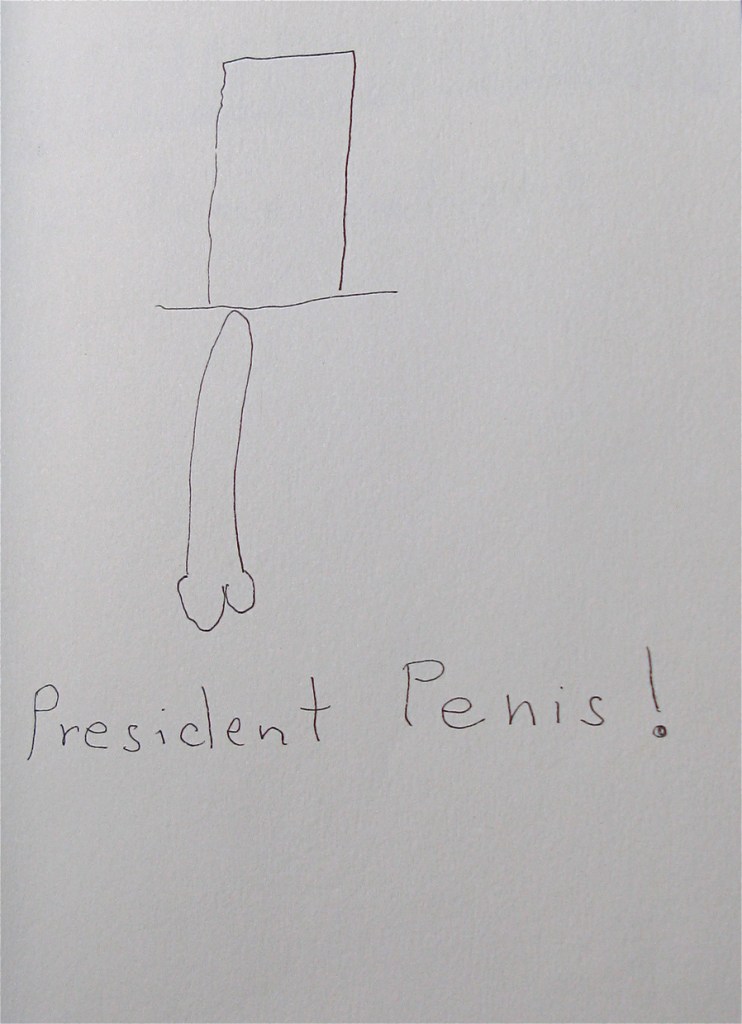
President P*nis
In the wake of Warren’s and Klobuchar’s withdrawal from the presidential primary, leaving two old white men playing geriatric High Noon in the arena, son’t miss my new post on Cloven Not Crested, really a guest post by Boston-based artist Jo Ann Rothschild, skewering the patriarchy. Ouch.
A young relative’s take post-Super Tuesday
This just all feels so pointless. Why have we had a primary at this point. The DNC wanted Biden, they got Biden. Politics is a rigged game and nothing the common people want or need or care about matters at all. How much time and money was wasted in what feels like a preordained coronation of a senile and deeply flawed bowl of oatmeal. It’s like they just let us all play a game like we are children for a year and now The Party has spoken and we can go back to being irrelevant serfs who provide background noise to their real lives in Washington
“The virus can be deadly, but so far, it most often isn’t.”
I’m reproducing this bit from The New York Times, unauthorized, because it puts the threat of the coronavirus in perspective. Granted that its effect on any individual is unpredictable (in Iran, an 81-year-old mullah and a 22-year-old woman soccer star have died), what you can probably expect if (or when) you get it is . . . not a whole lot.
The new coronavirus has sown fear and anxiety, with more than 81,000 cases and nearly 3,000 deaths.
But so far, it appears that the vast majority of those infected have only mild symptoms and make full recoveries. And those who get the virus develop powerful antibodies that should protect them from reinfection.
In China, people who have been infected are being asked to donate blood plasma, in the hope that their antibodies can be used to treat sick patients.
The largest study of the virus to date, published by China’s Center for Disease Control and Prevention, concluded that 81 percent of the 44,000 cases confirmed in China by mid-February were mild — defined by the study’s author’s as involving little or no pneumonia.
Just under 14 percent were deemed severe, involving shortness of breath, low blood oxygen saturation or other lung problems. Just under 5 percent were critical, involving respiratory failure, septic shock or multiple organ dysfunction.
By Thursday, of the 78,487 confirmed cases in China, 32,495, or 41 percent, had been discharged from the hospital, according to China’s National Health Commission. About 8,300 patients were in serious condition. More than 2,700 people had died, giving an overall mortality rate of 2.3 percent, far higher than the seasonal flu’s rate of about 0.1 percent.
The number of mild cases creates its own complications.
Those with few or no symptoms may not know they have contracted the virus, or may misidentify it as a cold. They may then continue their daily lives, coming into close contact with others and spreading the virus without anyone knowing.
The Majesty of Collapse
You’d think this was a contemporary poem. Wait for it.
Rearmament
These grand and fatal movements toward death: the grandeur of the mass
Makes pity a fool, the tearing pity
For the atoms of the mass, the persons, the victims, makes it seem monstrous
To admire the tragic beauty they build.
It is beautiful as a river flowing or a slowly gathering
Glacier on a high mountain rock-face,
Bound to plow down a forest, or as frost in November,
The gold and flaming death-dance for leaves,
Or a girl in the night of her spent maidenhood, bleeding and kissing.
I would burn my right hand in a slow fire
To change the future … I should do foolishly. The beauty of modern
Man is not in the persons but in the
Disastrous rhythm, the heavy and mobile masses, the dance of the
Dream-led masses down the dark mountain.
~ Robinson Jeffers, 1935
The last line gave the name to the Dark Mountain Manifesto. From the beginning:
‘Few men realise,’ wrote Joseph Conrad in 1896, ‘that their life, the very essence of their character, their capabilities and their audacities, are only the expression of their belief in the safety of their surroundings.’ Conrad’s writings exposed the civilisation exported by European imperialists to be little more than a comforting illusion, not only in the dark, unconquerable heart of Africa, but in the whited sepulchres of their capital cities. The inhabitants of that civilisation believed ‘blindly in the irresistible force of its institutions and its morals, in the power of its police and of its opinion,’ but their confidence could be maintained only by the seeming solidity of the crowd of like-minded believers surrounding them. Outside the walls, the wild remained as close to the surface as blood under skin, though the city-dweller was no longer equipped to face it directly. . . .
That civilisations fall, sooner or later, is as much a law of history as gravity is a law of physics. What remains after the fall is a wild mixture of cultural debris, confused and angry people whose certainties have betrayed them, and those forces which were always there, deeper than the foundations of the city walls: the desire to survive and the desire for meaning.
*
It is, it seems, our civilisation’s turn to experience the inrush of the savage and the unseen; our turn to be brought up short by contact with untamed reality. There is a fall coming. We live in an age in which familiar restraints are being kicked away, and foundations snatched from under us. After a quarter century of complacency, in which we were invited to believe in bubbles that would never burst, prices that would never fall, the end of history, the crude repackaging of the triumphalism of Conrad’s Victorian twilight – Hubris has been introduced to Nemesis. Now a familiar human story is being played out. It is the story of an empire corroding from within. It is the story of a people who believed, for a long time, that their actions did not have consequences. It is the story of how that people will cope with the crumbling of their own myth. It is our story.
Political Dreams
When the public sphere floods your night head you know you are “living in interesting times” and there is no escape.
The New Yorker recently ran an article whose SEO (search engine optimization) title is “How Dreams Change under Authoritarianism.” (I can’t find its print title, so I’ll resist a digression on how the internet sucks all the art and wit out of writing titles and turns them into dull labels.) The article is about an out-of-print book, published in English translation in 1968, called The Third Reich of Dreams: The Nightmares of a Nation, 1933-1939. The author, Charlotte Beradt, was not a psychoanalyst, simply a writer who collected 300+ dreams of apprehension and dread from friends and acquaintances before she made it to New York in 1939.
A small shopkeeper in Vienna dreamt that the lamp in the corner of his room suddenly began to talk, repeating to the police every sentence that he had ever uttered against the Government, every political joke he had told.
(To think that we complacently invite just such “talking lamps” into our homes—Alexa!! It’s not even a stretch to imagine them put to work as household spies surveilling and betraying us. They already keep dossiers of our consumer choices and personal vulnerabilities. Only that last hook-up between the tech corp and the government is unfinished . . . and Zuck is working on it.)
Learning more about this book led to the discovery that there is a Museum of Dreams in London, Ontario, “a hub for exploring the social and political significance of dream-life.” Its founder, Sharon Sliwinski, published her own book in 2018 called Dreaming in Dark Times. Her conviction is that dreams can (again, as they did for our tribal ancestors) reveal truth in times of confusion and denial, and provide insight and guidance not only to individual dreamers but to the community:
[T]he disclosure of dream-life represents a form of unconscious thinking that can serve as a potent brand of political intervention and a means for resisting sovereign power.
How about that! Show me yours and I’ll show you mine and we can call it Resistance!
Reading the dreams of people under the rising Nazis makes you realize that comparisons of our situation to theirs are still hyperbolic. But does anyone really doubt anymore that “it could happen here” (and has, if you’re not white), that we are on a road that leads there for many more of us if we don’t get off it ASAP, and that we’ve trusted in institutions to protect us that are far weaker than we thought they were?
I’ll show you mine, and maybe you’ll show me some of yours in the comments. Maybe we can get a read on the truth of our predicament.
√
This dream of a grove of tree trunks with their branches and leaves (and the sky) sealed off by a crude concrete ceiling, cemented out of sight—trees painfully choked off from their own upper reaches—seemed to me a political dream though there is nothing overtly political in it. I still don’t know how to “read” it. Any thoughts?
√
Yesterday Twitter was flooded with posts on the hashtag #PresidentWarren, a vigorous pushback against the media’s “erasure” of candidate Warren. Like most such tweetstorms, it was clearly orchestrated and coordinated, yet some unknown proportion of the participants also seemed sincere. It’s hard to tell the operatives from those who are there in all innocence. Anyway it was effective in blasting Warren back onto the radar and creating the perception that she still has lots of ardent, enthusiastic support. (This morning there’s no sign that the mainstream media noticed.) (UPDATE: One day later, they noticed.)
So I dreamt of a cityscape that looked like a Maurice Sendak children’s-book illustration—something like the city skyline of baking soda boxes in In the Night Kitchen, in cozy brownstone colors. In this cityscape, Elizabeth Warren’s already largish figure was to be cut out, made larger still, and reinserted into the scene so that she would stand out more—if not quite bestride the city like a colossus, a political Godzilla. I was somehow to be one of the participants in this effort, or at least an implicated bystander, and I was very confused about whether it was a good thing or not. Clearly you could do that, you’d better do it if you wanted to be visible at all . . . but should you, really?
√
My best political dream to date, in terms of giving me heart, was more than a year ago, maybe even two. I thought I wrote about it, but that was probably on Facebook.
I was out shopping, carrying some bundles and a paper cone of flowers, and I had to pee. I stopped in a deserted corner of some mall or train station or bus terminal or Starbucks and went into one of those big one-person, all-gender, family-and-wheelchair bathrooms. Sitting on the john and reading a magazine, I fell asleep in the dream.
I woke up and Donald Trump was looming over me.
He had on a cheap-looking royal-blue suit—it could have been an expensive suit but it still looked cheap—and a red tie. His face was flushed (or blushed), his eyes were a hot blue and his expression was challenging and overbearing. There was no iota of a #MeToo situation. His intent was simply to intimidate.
I was not intimidated. He was ridiculous. I would have burst out laughing if I weren’t so annoyed at the intrusion and incredulous at his rude bloody nerve. I rolled up the magazine and started whacking him with it, shouting with every blow, “GET – OUT – OF – HERE! . . . GET – OUT!!”
I kept on whacking him until he slunk out the door.
I woke up lighthearted, freed from the burden of fearing or even hating Trump. He is a joke. I remain very afraid, but not of him—of the forces that are filling him like a poisoned Macy’s Thanksgiving Day Parade balloon and using him (as long as he’s useful) as the front and figurehead for their takeover.
(Credit where credit is due: this dream may have been enabled by Nancy Pelosi, at one of their early meetings, shaking her finger in his face.)
Ha-HaRari
This subtle skewering of Yuval Harari, by Ian Parker in The New Yorker, is making me laugh out loud and congratulate myself on my instincts in avoiding reading Sapiens, which had felt guiltily like shirking a cultural duty.
“Sapiens” feels like a study-guide summary of an immense, unwritten text—or, less congenially, like a ride on a tour bus that never stops for a poke around the ruins. (“As in Rome, so also in ancient China: most generals and philosophers did not think it their duty to develop new weapons.”) Harari did not invent Big History, but he updated it with hints of self-help and futurology, as well as a high-altitude, almost nihilistic composure about human suffering. He attached the time frame of aeons to the time frame of punditry—of now, and soon. . . .
He spends part of almost every appearance denying that he is a guru. But, when speaking at conferences where C.E.O.s meet public intellectuals, or visiting Mark Zuckerberg’s Palo Alto house, or the Élysée Palace, in Paris, he’ll put a long finger to his chin and quietly answer questions about Neanderthals, self-driving cars, and the series finale of “Game of Thrones.”
Is it possible that I’ll never ever have to choke down this book-length TED-talk smoothie? Ahhhhhh.
UPDATE: I have to hand it to him, though: Harari is a tireless advocate for animal welfare, and he considers industrial agriculture possibly “the greatest crime in history.” That’s the book of his (not yet written) I’ll read.
Concrete R vs composite D
Reading this article this morning, after watching that lamentable debate, I got the sinking feeling that Michael Bloomberg is going to be foisted on us. He and his backers banked on (pun intended) the emergence of that void we saw last night. While the Republicans are a phalanx (of white men in suits), Democrats are a gaggle. Their diversity is their disunity. So by default they are going to hire a proxy, their own white man in a suit with a fortune, who represents none of them. It’s a weak position.
For some reason I started thinking of it in terms of construction materials.
Republicans are the “rump” of the old, white, Christian America that had three TV networks and 16 baseball teams and the AFL-CIO and a Fourth of July picnic cuisine, garnished with a Norman Rockwell Thanksgiving banquet. Note that I’m nostalgically exaggerating the unity of that lost America, just as its embattled fetishizers do. In reality that America was always riven by “the narcissism of small differences” between Christian denominations and European immigrant groups contending for assimilation, and patrolled by vigilant contrast with those it would never take in because they would freckle its complexion and relativize its religion. Still, it had a unity, a mass, an aspirational uniformity. It was an identifiable substance, Americanness, homogeneous as Wonder Bread and solid as concrete. Its remnant is like an old pillbox bunker on a sea bluff. Weatherbeaten, shrinking and eroding on the outside as it loses chips and chunks to the elements, at its core it is still uniform and, if nothing else, it still coheres.
Democrats are everyone else. They are—someone in construction please help me out with the terminology here—like an amalgam or composite with insufficient binder. It hasn’t yet fused into a substance with enough consistency and alignment to hold a shape and have tensile strength. It keeps crumbling back into its components. When you look at the Democratic field of candidates, they embody this. Each is a different piece. None is the binder that can hold it all together.
The Democrats and the coming-to-be America they attempt to represent have never recovered from the assassinations of April and June, 1968.
 Ambiance