Can Computers Play Chess?
A guest post by Icepick
[Ed. note: Icepick agreed to my request to promote this to a post in J’s honor. As I told him, J was riveted by chess and was quite a strong player, although — as with writing and jazz — his true genius was as a generous and penetrating appreciator of other people’s brilliance. He could watch high-level chess play for hours. He didn’t play more because he feared falling into chess and never coming out. In the words of an old Russian proverb in a book of chess quotations he treasured: “Chess is a sea in which a gnat may drink and an elephant may bathe.”]
I have seen computers play pretty mean games of chess. Wait, let me check….
I have to date played 7605 games against the BulletB program on the Internet Chess Club. I’m currently +950. Disappointing, but those are 1 1 games, and I’m just not that good with a mouse, so my current ratio is probably about as good as I can hope for long term.
Based on my experience of playing a few thousands of games against people live, and another several thousand against people over the internet (still looking for a day where I can play against people on all seven continents in one day – personal best is five continents in one day) I think I can be a reasonable judge of whether or not a computer can or has played chess.
And the judge SEZ – Computers can and do play chess.
As for the Turing Test – too few human beings can pass it.
* * *
A further elaboration:
Machines have been built that do most PHYSICAL feets better than humans. (I believe John Henry got his ass whupped long ago.) Autonomous machines (robots) started getting used in manufacturing decades ago. And adding machines have been faster than (most) humans for a long time now.
But what happened over the last few decades with chess playing computers was a different matter altogether. Chess was chosen for a reason – namely that it was a very difficult game that didn’t come down to a simple formula. (Unlike, say, tic tac toe.) The variety of different pieces also separated the game in complexity from checkers. (Checkers HAS been largely beaten by the computers. Only Marion Tinsley could match them.) Chess requires memory (a specialty of computers), calculation (another specialty of the silicon monsters), pattern recognition (not a strength – or at least it wasn’t a few decades ago), and positional judgement.
That last was somewhat mysterious – the good chess players knew better than the poor ones when a position had something in it. The very good players had a better sense than the good ones. The very best were better still, and the true greats leave everyone baffled. But it’s hard to define what the “it” is. It was more than just pattern recognition, although that was part of it.
I remember an anecdote about Bobby Fischer. He was playing in some open tournament somewhere in his youth. He walked by the board of an acquaintance, looked at the position for maybe five seconds, and wandered off. Years latter he ran into the man again and asked him, “Did you win that game against so-and-so?” The man replied that he hadn’t won, so Fischer quickly explained to the man what he should have done to win the game. A mere glance at a complex position was enough for Fischer to judge the position accurately and formulate the winning plan. FIVE SECONDS. Such powers mystify us regular players.
Then there was the story of Capablanca explaining an endgame to some other masters. He stopped by an analysis session and started explaining the position to them, one they had been working on for some time at that point. He said something along the lines of “this piece should be here, and that one there, and then White wins easily.” They asked for variations and he replied that he didn’t need them – once he knew where everything went the rest was elementary. I’ve heard similar stories about (amongst others) Bisguier (an under-rated American GM), Kasparov, Tal, and especially Karpov. Even Kasparov (the greatest chess player ever – human player anyway) seems in awe of Karpov’s ability to just know where the pieces belong.
So this positional judgement thing was a great challenge. It was a perfect problem for the programmers.
In the early years they hoped to mimic a human approach to the game. That was the great hope of early pioneers, including Mikhail Botvinnik, the greatest of the Soviet players (and their longest tenured world champion). Botvinnik also happened to be an engineering whiz, and he hoped to construct a machine to mimic the human mind’s functions. He failed miserably.
Early on the programmers realized that the strongest element of a computer’s ability was the calculation aspect. So they put more and more effort into algorithms to evaluate positions along strictly mechanistic means, and to calculate as many positions as possible. No gestalt in this approach, nothing “holistic”. This approach bore fruit.
And it was ultimately this approach that led to the creation of programs that could best all but the strongest humans. And as it stands today, the humans really can’t hope to win a match save by glitch in the machine. They might tie (the match, not any individual game, which they still win on occasion) with best play, but that’s all they can really hope for. In about five years I doubt they will have any hope at all of even winning a single game off the best programs. It’s changed that much.
In addition, these programs have shown people new ways to play the game. Their calculating abilities have revealed any number of flaws in old approaches to specific positions. About ten years back they even started occasionally started showing new strategies and positional motifs in certain positions. (I remember a game with a Re3 lift that kind of blew everyone’s mind – computer programs weren’t supposed to DO that.) But it wasn’t understanding, it was more and more calculations.
These days the best of the younger grandmasters show unmistakable computer influence on their style of play – not just in the opening preparation but throughout the game. (I thinking most notably of Magnus Carlsen’s relentlessness and Hikaru Nakamura’s tactical wizardry.) The computer programs have changed the game. (The old-timers generally don’t seem to like it – they believe it has removed much artistry. I don’t entirely agree, as their is much beauty in the new stuff as well. Times change.)
But the sad upshot of all of this has been that computers don’t think like people when playing chess. The more … call it … holistic approach never worked. Botvinnik would have been disappointed, as is his latter successor Kasparov. The big loss isn’t for chess, it’s for understanding how human thought works, and determining if it can be duplicated. Chess just didn’t hold the answer.
OTOH, we have observed two things in the meantime. First, that computers CAN solve extremely complex problems through systematic refining of brute force algorithms. Second, that humans can learn to mimic that approach, within limitations. So some things have been learned.
But there is still hope that the computer guys can do something different. The hope now rests on coming up with good Go programs, as that game turns out to be much more difficult for programmers to figure out. I’ve heard they hope to have some success with poker playing programs, but I expect that to be a bit less worthwhile. Poker can be reduced to mathematics fairly easily (for a computer at least), and some clever application of game theory ought to insure enough variability that I expect such a program to be better than pretty much all humans in the not distant future. (Assuming it hasn’t happened yet. I only follow that peripherally.)
But the upshot has been this – the brute force “materialist” approach works. And I mean that both from a chess esthetics viewpoint (computers, like Victor Korchnoi, are suckers for grabbing all the material they can get) and as a programming solution to complex problems.
* * *
(The BulletB program I mentioned is one that has been “lobotomized” to play at around a certain strength at certain time limits. The Crafty program upon which it is based is a pretty solid free-ware program developed primarily by Dr. Robert Hyatt. Interestingly for me, the program’s origins date back to 1968, the same year as my birth. I’ve been lucky enough to play a few games (fewer than five, I think) where I have managed to draw a non-lobotomized version of Crafty. )
* But the humans are catching up. There’s a reason that we have so many people who’ve become grandmasters at 13 these days. Playing programs and especially databases have drastically altered the learning curve. The kids are getting programmed too these days.
* * *
H. G. Wells’ description in this piece is wonderful. Here’s the best extract:
The passion for playing chess is one of the most unaccountable in the world. It slaps the theory of natural selection in the face. It is the most absorbing of occupations, the least satisfying of desires, an aimless excrescence upon life. It annihilates a man. You have, let us say, a promising politician, a rising artist, that you wish to destroy. Dagger or bomb are archaic, clumsy, and unreliable–but teach him, inoculate him with chess!
I must say, however, that the game does have some charms. The Dutch GM Hans Ree once said, “Chess is beautiful enough to waste your life for.” If you don’t understand that statement, if you don’t feel it in your soul, you aren’t really a chess player.
About three years ago I started entering all my existing live game scores into a database. I forget what the total is, but it’s around 300 games, if memory serves. Those are just the live tournament games, plus some games from high school matches, and together they span 27 years now. Not a great big number, not by any stretch. I’d play every weekend, given the opportunity, but they haven’t always presented themselves. But I played regularly with a couple of diehards back in my Maryland days. One of them has played in over 655 EVENTS since late 1991, and the other has played in over 1273 EVENTS in the same period of time. They’re both lifetime Class B players at best. But they’re out playing every chance they can get. And that’s just the rated events they PAY to play in. I can find one of them online just about every day, looking for more action. I just checked a recent tournament they both played in, and I recognized every player in the tournament. Dedication, baby!
So the short bit is that yes, it can dominate/ruin one’s life!
* * *
Another proverb from J’s book of chess quotations, this one German:
No fool can play chess, and only fools do.
Christchurch Quake
Administrator’s note: I’m front-paging this post for the time being, because its comments section has unexpectedly become such an extraordinary source of direct reporting from Christchurch.
It appears that most of those killed by the devastating earthquake that hit Christchurch, New Zealand, were inside modern structures built to strict standards. The latest reports are that none of the 100 people believed to be inside the CTV building when it collapsed during the quake survived.
The CTV building pre-quake:

The remains of the CTV building after the quake:

J Pays a Birthday Visit!
. . . albeit not to me.
A friend of ours, Nick, who is now close to 60, and has known and loved and been influenced by Jacques since he was 8, called me today to report an unusual dream he had last night.
Jacques dropped by to see him with Frank, J’s old Yorkville-born, German-Ukrainian-American, Greenwich Village running buddy, who died of lung cancer in about 1985, and whom J had often vocally missed. Nick’s first reaction was, but you’re dead! You’re both dead! and yet there they were, having a vivid, ordinary visit. Nick was sitting with his knee touching J’s and J seemed perfectly alive to him. He was like, wait a minute, you’re not dead after all — Annie didn’t tell me about this! No, no, Jacques gave him to understand; he was indeed dead; but he was going to come and visit every now and then, nonetheless.
Nick said this was very different from the dreams he occasionally has featuring his mother (who died twenty years ago) or his father (who died a couple of years ago) or other friends who are gone. We all draw a distinction between dreams that seem to be conjured up by our own fading memories or helpless longings, and dreams so vivid, autonomous, and realistic that they seem to be . . . well, visits.
The temptation is to go one way or the other — to say “It was just a vivid dream” or “That was J!” Who really knows? Whatever such dreams are, they come from a depth of the psyche that is not bounded by skin or by time. You could say they are “just” exceptionally effective creations of your own unconscious; but at the level where it’s that effective, the unconscious is no longer “your own.” There is something more than a self-comforting illusion going on there, some confirmation of the real contact souls make in — no, through — life. Exactly what it is, we might best leave undefined. But it’s a living bond across the threshold of death.
Nick’s dream has made me really happy (and only a little jealous). For one thing, it seems to indicate that J has gotten beyond that awkward transitional period. For another, my first reaction to hearing he was with Frank was, “Oh, they found each other!” The two of them and Mas Oyama used to get in trouble together, and they were all highly nostalgic for those days. Who knows, maybe that’s their idea of heaven.
— Oh, the punch line: Nick had no idea (consciously, at least) that it was J’s birthday.
I’m a Generic.
I’ve led a sheltered (work) life. Most of my jobs have come through personal connections. Now that I’m looking for work every which way, I’ve been warned that my resume is lame and drab and poorly represents me as a copy editor. I’m sure this is true. I know how to edit an article, but I haven’t got a clue how to write a resume, or where to look for proper examples. (There are a lot of trashy ones on the web.)
I thought I’d post without further comment a resume assessment that I received from one of the job-hunting websites. The fact that the writer has an ulterior motive, to sell me an expensive resume-writing service, doesn’t invalidate his critique. I don’t doubt it. What fascinates me, though, is how all-important the resume has become. It says something about the ascendancy of marketing and advertising that the assessment of our skills is now supposedly based on the gloss and graphics of our personal billboard, more than the strength of our references or work samples. (Red highlighting added by me.)
Dear Annie,
I’m the Jobfox resume expert who was assigned to evaluate your resume. I reviewed your resume with the goal of giving you an honest, straightforward assessment of your current resume, and not a judgment of your skills and qualifications. I should warn you about my style: I’m direct and to the point, so I hope you won’t be offended by my comments. My goal is to help you present yourself to potential employers in the best possible light, increasing your odds of landing a job you want.
So, let’s get started on reviewing your resume:
Here’s the good news: My first impression of you is that you have an impressive array of skills and experiences. You’re a qualified Senior Copy Editor with a lot to offer an employer. Now, here’s the bad news: Your resume does not pass the 30-second test, and the content is not up to the standards one would expect from a candidate like you. Countless studies have proven that resume quality is the key determinant as to whether a candidate is selected to be interviewed. Your resume needs a boost from a visual, content, and overall writing standpoint to engage the reader. It needs to make them want to learn more about you. I didn’t find it to be exciting, and it didn’t make me want to run to the phone to call you. In short, your resume is effectively sabotaging your job search.
Annie, your resume is missing key elements that we see on the best resumes at your level of experience. Here are the major issues I see on your resume:
Your resume’s visual presentation
We’ve all been told that looks don’t matter as much as substance, but in the case of your resume this just isn’t true. I found your design to be visually uneven and simplistic. The appearance is not polished, and it doesn’t say “high potential Senior Copy Editor.” Remember that your resume is your marketing tool. It’s the first impression a potential employer has of you. Now – think about how generic brands are marketed versus the name brand. The packaging, advertising and branding are all carefully selected to attract attention and convince you to buy. Your resume should do the same thing- you want to be the brand name product. I’m concerned that your resume is selling you like a generic, and that it’s not likely to get picked among those of other candidates. The ideal resume design is airy, clean, and uncluttered, with the effective and strategic use of white space.
The content of your resume
As I was reading your resume, I was trying to imagine myself as a hiring executive, looking for that ideal Senior Copy Editor. When I reviewed your resume, I asked myself if I could easily pick out your key attributes, experience, skills and accomplishments. A recruiter will do this to quickly decide if you’ll be successful in the job they have open. When I read your resume, the answer to that question was “no.” Here is one of the reasons why:
Your resume has an objective statement instead of a career summary. An objective is more for a new college grad or someone very early in their career. A career summary is a critical element of your resume and it should be designed to compel the hiring manager to keep reading. The purpose of this section is to define you as a professional and cover those areas most relevant to your career level and job target. By not having this you are making it easier for the reviewer to say “pass” when your resume is given the customary cursory glance.
From the way the resume is worded, you come across as a “doer,” not an “achiever.” Too many of your job descriptions are task-based and not results-based. This means that they tell what you did, instead of what you achieved. This is a common mistake for non-professional resume writers. To be effective and create excitement, a great resume helps the hiring executive “envision” or “picture” you delivering similar achievements at his or her company. Here are some examples of task-based sentences in your resume:
- Copyedit and fact check monthly articles addressed to a professional audience of scientists
- Edit and vet all articles for clean copy, lucid style, and factual accuracy on a monthly deadline
Employers want to know about your previous contributions and specifically how you’ve made a difference. More importantly, they want to know how you are going to make a significant difference at their company.
When I read your resume, I didn’t find compelling language that brings your work to life. I saw many passive words and non-action verbs. Phrases like “evaluated” and “copyedited” add no value to your resume. Strong action verbs, used with compelling language to outline exemplary achievements, are essential parts of a well-constructed resume.
Now, let’s put it all together. Here’s a real life example taken from a former client’s resume. By changing the language, we helped improve the perception of the candidate.
- Passive language/ Doing: Duties include dealing with difficult customer service issues
- Action language/ Achieving: Entrusted with the most complex customer service issues as a result of exceptional ability to promptly resolve concerns and satisfy customers.
A change like this makes a dramatic improvement. [In this specific case I disagree. I think it sounds like puffery and hype from a professional resume writer. Employers aren’t stupid. Are they?] I hope you can see the difference when we implement action verbs, achievements, and results.
The writing on your resume
It’s easy to overlook errors in your resume. They could be typographical errors, inconsistent verb tenses, grammatical errors, punctuation problems, or misspelled words. You’ve rewritten the resume and proofed it multiple times so you may not notice the issue. But errors can be the kiss of death for your resume. Recruiters are reading your resume with fresh eyes, and they’re experts at finding errors. A misspelled word or punctuation error may not seem like a big deal, but to an employer these errors demonstrate unprofessionalism and a lack of attention to detail. That’s not the impression you want to leave. I spotted at least one of the above-mentioned errors on your resume.
Additional Issues
• I liked your use of bullets to emphasize, but you probably want to consider limiting them in some areas to increase the impact to the employer. If they see too many bullets, they might find it difficult to zero in on the most important information. Size and type of bullets are also a consideration. Although seemingly minor, visual impact of a resume is the key to ensuring that an employer reads it thoroughly.
• When reading through your resume, I noticed that it contained several pages. And, this doesn’t even include your cover letter. Employers have a limited amount of time to scan resumes in their initial search, so you want your resume to be as concise as possible.
• Make sure that the additional pages of your resume have contact information on them. If a hiring manager prints your resume, but for some reason, the pages are accidentally separated, the manager is still able to identify the additional pages. They will not spend time trying to place a page that has been separated and will move on to the next resume.
My recommendation
Your resume is selling you short, and I recommend that you make the investment in having it professionally rewritten. Professional resume writers are skilled at writing a resume for the job you aspire to have. They are trained to help move you up the ladder in your field. They are also skilled at taking what you have done in the past and translating it to show how it is relevant to other industries or professions.
Many people ask a friend or colleague to help them write a resume. Sadly, unless they are an experienced, certified resume writer this is usually a big mistake. Companies now use electronic tools to capture, evaluate, and screen incoming resumes, so your resume must be organized with the right structure, keywords, and format to be “processed” by a resume tracking system properly. It must be designed to identify select, and track you as a qualified candidate. This is known as keyword optimization and most non-professionals are not well-versed in this technique.
Putting your best resume forward now is critical. The sooner you invest in having your resume professionally written, the faster you increase your odds of landing a job you want. Once your old resume goes into a company’s database, it stays there permanently and could affect your candidacy for other jobs at that company as well. You will be amazed when you see the difference a professionally-written resume can make in presenting your credentials.
As I’m sure you know, be certain to send a cover letter when you forward your resume directly to a recruiter or hiring executive for a specific job. A well-written cover letter can give you a valuable edge over other candidates with similar skills. It’s the best way to make a memorable appeal that grabs attention and personally links you to the job. Use it to explain why you are uniquely qualified for the specific role. Jobfox can craft a custom cover letter that distinguishes you from the crowd (and it’s free when you purchase a professionally-written and formatted resume.)
Why Have Your Resume Rewritten by Jobfox?
To encourage you to make the investment now, we are offering our best price on our resume writing services in the first 7 days after you view your resume evaluation. Save $75 off our standard price of $399. In addition, we are the only resume service that offers the option to pay for your resume in installments. We spread the cost over six months to make our service affordable for everyone.
If you purchase in the next 7 days, you have the option to make a one-time payment of $324 (a $75 savings), or six monthly payments of $59.00. Either way, you will still have your new documents back in 4-6 business days so you can improve your chances of getting hired quickly.
What’s included in the Jobfox Resume writing Service?
- Professionally written resume in Microsoft Word format
- Electronic version of your resume (e-resume)
- Resume Keyword optimization
- Professionally written reusable cover letter (if you order in the next 7 days)
His First Birthday . . .
. . . dead.
One year ago:
 I’ve been encouraged to celebrate his life today and I’m all with that in principle, but right now he just seems long gone and me in the middle of nowhere. I don’t even feel sad: just adrift.
It’s the jet lag, stupid. (Coming back from Japan it can last more than a week.) And the confrontation with financial reality, which mercifully held off somehow as long as J was ill, but now it’s time to deal. I took the bus to the accountant’s, walking through Target’s vast empty mall again and through that landscape designed only for cars, walking along road shoulders littered with fast-food trash and along sidewalks like afterthoughts that peter out in the middle of nowhere. How different everything looks when you’re on foot and moving slowly! I’ve swooped obliviously along this very stretch of highway that I’m now crossing like an ant on an overpass. I feel cast out of power in multiple ways. For no good reason I take a pratfall on the cement and spill the rest of my McDonald’s latte, which was probably why I tripped, tossing my head back to eke out the foam.
I fall asleep in the accountant’s waiting room.
On the way back to the bus, I pass the tower after which Tower Boulevard is named, a truncated glass “skyscraper” that looks absurd to a New Yorker, as if someone jammed an imitation of the Empire State Building halfway into the earth so that only the top fifteen stories stick up. In fact, whenever we passed it I’d point it out to J as “the funny building.” This memory comes to me from faraway, with a muffled pang. It strikes me that losing someone you’ve taken care of for a long time is more like losing a child than an adult companion. You miss the routines of your own tenderness.
On the bus I fall asleep again and sleep way past my stop, waking up in “downtown” Chapel Hill. I had been craving a deli sandwich, and the bus deposits me right in front of a deli, which seems fortuitous. Except it isn’t a real deli. The “rye bread” is some kind of fluff, they have no coleslaw, they have to put the thing in a nasty styrofoam container, and they insist on giving you a choice of sides; I choose applesauce which I guess correctly will be sweetened, in fact with high fructose corn syrup. I leave the applesauce on top of a trash container for one of the surprisingly many homeless men sitting on the street in front of the terminally cute stores and restaurants among the red-eyed, self-indulgent-looking students, the young joggers who keep bouncing in place during the long push-button lights, and the older people who come in three flavors—drug-dissolute, counterculture-complacent, and Christian-prim. I realize that I hate Chapel Hill.
There is another reason why sleeping through my bus stop was a lucky break: I needed to come downtown to the place Chris took me for my new glasses, and get them adjusted, because in another bout of jet lag a few days ago, I woke up to find the glasses under me. They’ve been slightly askew ever since.
Glasses on straight again, I climb on a bus going back the other way, and what does the driver say to me but, “Didn’t you just get off the bus?”
When I tell him I slept through my stop, wishing I could explain that I’m not just your garden-variety befuddled old lady — I’m Kung Fu Granny, befuddled by jet lag from training in Japan! — he tells me I should have asked for a transfer, and says that if someone gives him $2 in cash he’ll refund my fare. That doesn’t happen, but it does remind me, in the midst of stropping my contempt for Chapel Hill, that there are some sweet things about living in a small town.
And that’s why they call it Greenwich Village.
(And with that, Jacques smiles.)
UPDATE: “Don’t Cry Because It’s Over, Smile Because It Happened.”
Commenter Mockturtle sent these words in a different context, but they’ve put a smile on my face. If something was good enough to make you sad when it’s gone, it’s worth being grateful that you had it! Mockturtle wrote:
This is a sign a woman in Seattle posted on a wine keg as her wine-making business was folding due to the economy. Her husband died of Alzheimer’s a couple of years ago. She created a special wine in his name, put his face on the label, and will give all proceeds from the sales, estimated at $100,000, to Alzheimer’s research.
Since there were no buyers for her business, she put that sign up for her customers who were disappointed she was closing. I have been pondering those words since I read them.
Yikes Wow!!
Note: I drafted this post while fact checking several articles on epigenetics, and then thought I had lost the post when my computer crashed. Now that I discover a draft of the post was saved, I can’t retrace my steps to the links that gave me such an electrifying view of the subject.
So you probably bought the notion that we are organisms physically crafted by DNA’s direction of protein assembly, whose memories, habits, and character are encoded in the electrical “wiring” of our brains.
It goes even deeper.
Turns out that the expression of our genes is almost certainly shaped and reshaped throughout our lives by our own experiences and choices. It’s beyond neuroplasticity. The very stuff of ourselves in in play.
Two paradoxically related and stunningly powerful insights spring from this. One is how profoundly life experience shapes us, and not only us: many “epigenetic” changes, as these modifications of DNA expression are called, are (are you ready?) heritable. Lamarck is smiling in his grave, and the Biblical patriarchs who noted “The father has eaten sour grapes, and the children’s teeth are set on edge” are looking smarter than we thought.
The companion astounding fact, however, is that many of these epigenetic changes are reversible, or further modifiable. That means that by changing our behavior (not that this is easy, but it is possible) we can not only change the wiring of our brains, as my friend Jeffrey Schwartz has long asserted; we can change our very substance. As profoundly as experience shapes us, that deeply can our own choices reach into ourselves and change what we’re made of.
I Am Not a Gadget. [UPDATED]
Jet lag proves it.
Awake against my will at 5:30 a.m., I didn’t plunge into the search for tax documents that is my most pressing obligation, because this wasn’t real time, this was jet-lag time — time out from sleep but also, given the wooziness, from productivity. So I started reading Jaron Lanier’s You Are Not a Gadget. Tim, formerly “Theo Boehm,” read this book if you haven’t yet — you will find yourself consoled and vindicated. If you don’t want to buy it, I’ll send you mine when I’m through.
I was intrigued from the get-go, but Lanier really had me on page 27, when he nailed the most annoying characteristic of Microsoft Word, a program with a stupid, wayward arrogance that I always attribute to and blame on the personality of its creator:
If you believe the distinction between the roles of people and computers is starting to dissolve, you might express that — as some friends of mine at Microsoft once did — by designing features for a word processor that are supposed to know what you want, such as when you want to start an outline within your document. You might have had the experience of having Microsoft Word suddenly determine, at the wrong moment, that you are creating an indented outline. [Yes, yes, oh yes! This is when I yell, “I HATE BILL GATES!”] While I am all for the automation of petty tasks, this is different.
From my point of view, this type of design feature is nonsense, since you end up having to work more than you would otherwise in order to manipulate the software’s expectations of you. The real function of the feature isn’t to make life easier for people. Instead, it promotes a new philosophy: that the computer is evolving into a life-form that can understand people better than people can understand themselves.
Exactly. One of Lanier’s many insights is that this information-worship is for all practical purposes a religion, offering its own hope of immortality (the “Singularity,” when human consciousnesses will be uploaded into a machine). His response to the “digital Maoist” slogan “Information wants to be free” (even at the price of enslaving people) is, “Information doesn’t deserve to be free . . . Information is alienated experience. . . . Experience is the only process that can de-alienate information. Information of the kind that purportedly wants to be free is nothing but a shadow of our own minds, and wants nothing on its own. It will not suffer if it doesn’t get what it wants.”
On pages 29–31, Lanier has a little elegy to on Alan Turing that is breathtaking and heartbreaking, “The Apple Falls Again.”
And here’s a bit of provocation for you: “Wikipedia . . . works on what I call the Oracle illusion, in which knowledge of the human authorship of a text is suppressed in order to give the text superhuman validity. Traditional holy books work in precisely the same way and present many of the same problems.”
Read this book, so we can talk about it!
UPDATE: I’m in the middle of the book now and finding some things to criticize about it. For one thing, though Lanier has some libertarian leanings, he is basically a liberal who puts the lion’s share of the blame on the Bush years for America’s current troubles. For another, he is (like most prophets) a better diagnostician than prescriber; some of his ideas for how to fix the free-content problem (which is pauperizing journalists, musicians and the like) are pretty lame. Can you imagine paying, even pennies, every time you read your favorite blogs? How would you find new ones? Would your intellectual curiosity be constrained by budgetary considerations?
Granted, no one has come up with good solutions to these problems.
Ne’er So Well Expressed.
I’ve heard this good writing advice before (I don’t always follow it, to my detriment), in words like “Your prose should be as invisible as a pane of clear glass.” But I’ve never heard it put quite like this.
Having beautiful imagery, vibrant vocabulary, and full sensory-immersion is a good exercise for authors, but four or five hundred pages of it is too much. It’s tiring for the reader to process. Ideally, for most authors, your words should become invisible, and the story should take center stage. If the reader is continually awed by your linguistic gymnastics, your prose is competing with the story for the reader’s attention.
Bingo!
(Driven to desperation by the mismatch between the 13-hour plane flight and my 5-hour laptop battery, I read a dragon fantasy book by Patricia Briggs. I enjoyed it more than I like to admit.)
Like a Good Neighbor?
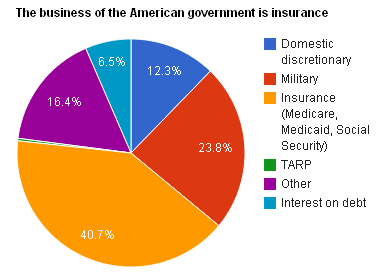
As anyone who has read my comments over the years surely knows by now, I generally view Ezra Klein as over-rated and unimaginative. As the saying goes, “Even a broken clock is right twice a day,” and Klein provided a genuine public service this week when he noted:
If you look at how the federal government spends our money, it’s an insurance conglomerate protected by a large, standing army.
Renovation Time

As currently seen at the official website of the Egyptian government
(Via Outside the Beltway)
 Ambiance