Dialing for Dollars
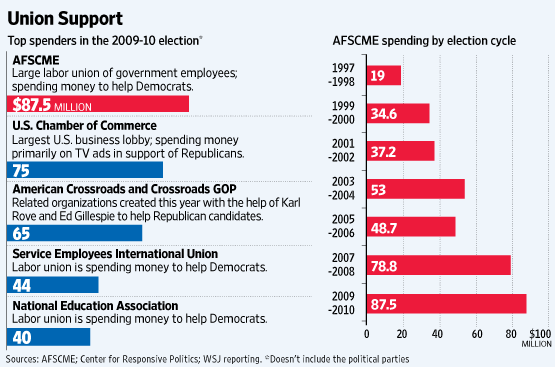
So far, the latest figures show that the Democratic Party machinery has outraised its Republican counterpart in this campaign cycle by almost $270 million.
And even when outside spending on television advertising and direct mail is added to the mix, Republicans still haven’t closed the gap.
The money race totals come to $856 million for the Democratic committees and their aligned outside groups, compared to $677 for their Republican adversaries, based on figures compiled by the Center for Responsive Politics.
Ballot Measure
Shall the voters for the City and County of Denver adopt an Initiated Ordinance to require the creation of an extraterrestrial affairs commission to help ensure the health, safety, and cultural awareness of Denver residents and visitors in relation to potential encounters or interactions with extraterrestrial intelligent beings or their vehicles, and fund such commission from grants, gifts and donations?
(Via Jonah Goldberg at NRO)
Losing the Narrative
A president cannot control the economy. But he can control the story he tells.
Call Me Senator (Retrieved)
Original comment appears below the fold:
Radical Shriek
“I wonder if we’re likely to see a Timothy McVeigh situation,” says Nicholas Robert, an attendee originally from Australia, who basically wonders if any Tea Partiers can be arrested. “It seems to be that we’re being very polite. I wonder if there are any legal mechanisms—one that comes to mind are the provisions used to crush the Wobblies.”
He gets no sympathy from the academics. “I think that’s a dangerous road to go down,” says Berlet.
Abramowitz finds me and whispers into my ear. “In Berkeley,” he says, “you’re seeing the other side of polarization.”
“Now they work for us” (Retrieved)
Reposting with apologies to Icepick. Original comments appear below the fold.
Progress
I used to believe we were evolving in a positive direction. I was a liberal and a progressive because I grew up in that context, and it was reinforced in college. But my progressive beliefs gradually fell away until now hardly any are left. I have questioned all of it and found it to be a big pile of myths, without a connection to reality.
Human societies all have myths, so of course ours does also. Myths are the things that go without saying and are too obvious to mention.
But because our society is so enormous and diverse and complex, we have multiple, contradictory, mythologies.
The progressive myth is widely believed, by political conservatives as well as by the political left. It says we are becoming smarter, nicer, safer, healthier, all thanks to western science and technology.
Then you have the people who cling to guns and religion — they don’t entirely buy the progressive myth. And I am, more or less, on their side now. Think I might get a gun, and maybe join a church.
The Glory of Western Civilization
The core discovery upon which western civilization rests, and what makes the western mind fundamentally different, is the individual, and, since the establishment of the individual as the center of meaning, the astonishingly productive journey into the inner life of man that has been taken over the past three centuries by both the arts and science. […]
This was a revolution of incalculable importance. It is the central revolution of the human experience, the most important thing that has ever happened, and it is also the foundation of western culture, and the thing we need to protect and foster and increase.
~ Whitley Strieber
The Filibuster Must Die(t)
Writing of the sharp budget cuts now being implemented by the British Tories, Matthew Yglesias makes a good point:
But I do hope that American conservatives will look at the UK and recognize that even though they may have enjoyed the filibuster in 2009-2010, the extremely cumbersome nature of the American political process will make it forever impossible to enact these kind of sweeping cuts in the United States.
From where I sit, the system they have in the UK where you can simply sweep opposition objections aside is actually the right way to do bipartisanship. Call it bipartisanship by alternation. When Labour wins the election, Labour has the chance to implement a bold agenda creating and expanding programs in a way that they think will make Britain a better place to live. Then when the Tories come in, they’re able to be brutal in their efforts to pare back or eliminate things that they think aren’t working. Over the long term, you get a trajectory where programs survive if and only if they’re so widely regarded as successful that no mainstream party would dare abolish them.
The Tea Party may be clamoring for “less,” but without structural changes to the way government works it is pretty much impossible to imagine a scenario in which spending is so significantly pared back in this country. The filibuster is good for one thing: preserving the status quo. But what good is that if the status quo is unsustainable?
 Ambiance